2,281 posters, 63 videos, 56 audios, 43 topics, 18 sessions, 6,174 authors, 2,323 institutions
ePostersLive by SciGen Technologies S.A. All rights reserved.
RCOG World Congress 2025
June 23 - 25, 2025 | ExCeL London, UK
EP.1194
Prophylactic Internal Iliac Artery Occlusion Balloons in Placenta Accreta Spectrum Management
Poster Presenter
Part of Topic
Hot topics (emerging research/issues) in obstetrics
Introduction:
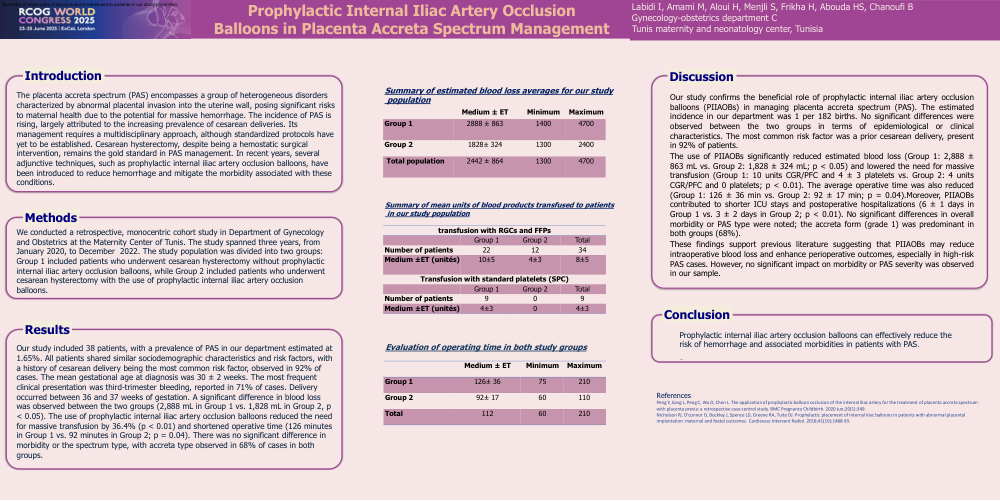
The placenta accreta spectrum (PAS) encompasses a group of heterogeneous disorders characterized by abnormal placental invasion into the uterine wall, posing significant risks to maternal health due to the potential for massive hemorrhage. The incidence of PAS is rising, largely attributed to the increasing prevalence of cesarean deliveries. Its management requires a multidisciplinary approach, although standardized protocols have yet to be established. Cesarean hysterectomy, despite being a hemostatic surgical intervention, remains the gold standard in PAS management. In recent years, several adjunctive techniques, such as prophylactic internal iliac artery occlusion balloons, have been introduced to reduce hemorrhage and mitigate the morbidity associated with these conditions.
Methods:
We conducted a retrospective, monocentric cohort study in Department of Gynecology and Obstetrics at the Maternity Center of Tunis. The study spanned three years, from January 2020, to December 2022. The study population was divided into two groups: Group 1 included patients who underwent cesarean hysterectomy without prophylactic internal iliac artery occlusion balloons, while Group 2 included patients who underwent cesarean hysterectomy with the use of prophylactic internal iliac artery occlusion balloons.
Results:
Our study included 38 patients, with a prevalence of PAS in our department estimated at 1.65%. All patients shared similar sociodemographic characteristics and risk factors, with a history of cesarean delivery being the most common risk factor, observed in 92% of cases. The mean gestational age at diagnosis was 30 ±2 weeks. The most frequent clinical presentation was third-trimester bleeding, reported in 71% of cases. Delivery occurred between 36 and 37 weeks of gestation. A significant difference in blood loss was observed between the two groups (2,888 mL in Group 1 vs. 1,828 mL in Group 2, p < 0.05). The use of prophylactic internal iliac artery occlusion balloons reduced the need for massive transfusion by 36.4% (p < 0.01) and shortened operative time (126 minutes in Group 1 vs. 92 minutes in Group 2; p = 0.04). There was no significant difference in morbidity or the spectrum type, with accreta type observed in 68% of cases in both groups.
Discussion :
Our study confirms the beneficial role of prophylactic internal iliac artery occlusion balloons (PIIAOBs) in managing placenta accreta spectrum(PAS). The estimated incidence in our department was 1 per 182 births.No significant differences were observed between the two groups in terms of epidemiological or clinical characteristics.The most common risk factor was a prior cesarean delivery,present in 92% of patients. The use of PIIAOBs significantly reduce destimated blood loss (Group1: 2,888± 863mLvs.Group2:1,828±324mL;p<0.05)andloweredtheneedformassive transfusion (Group1: 10unitsCGR/PFCand4±3platelets vs.Group2: 4units CGR/PFCand0platelets;p<0.01).Theaverageoperativetimewasalsoreduced (Group1:126±36minvs.Group2:92±17min;p=0.04).Moreover, PIIAOBs contributed toshorter ICUstaysandpostoperativehospitalizations (6±1days in Group1vs.3±2days inGroup2;p<0.01).Nosignificantdifferences inoverall morbidityorPAStypewerenoted; theaccreta form(grade1)waspredominant in bothgroups(68%). These findings support previous literature suggesting that PIIAOBsmay reduce intraoperativebloodlossandenhanceperioperativeoutcomes,especiallyinhigh-risk PAScases.However,nosignificant impactonmorbidityorPASseveritywasobserved inoursample.
Conclusion:
Prophylactic internal iliac artery occlusion balloons can effectively reduce the risk of hemorrhage and associated morbidities in patients with PAS