2,281 posters, 63 videos, 56 audios, 43 topics, 18 sessions, 6,174 authors, 2,323 institutions
ePostersLive by SciGen Technologies S.A. All rights reserved.
RCOG World Congress 2025
June 23 - 25, 2025 | ExCeL London, UK
EP.1189
Stillbirth audit in a district general hospital in 2023
Poster Presenter
Authors
Affiliations
Part of Topic
Hot topics (emerging research/issues) in obstetrics
Stillbirth audit in a district general hospital in 2023
Authors: Ms Sangeeta Agnihotri, Dr Yee Neng Adaylia Faith Loo, Dr Maliha Banu
Background:
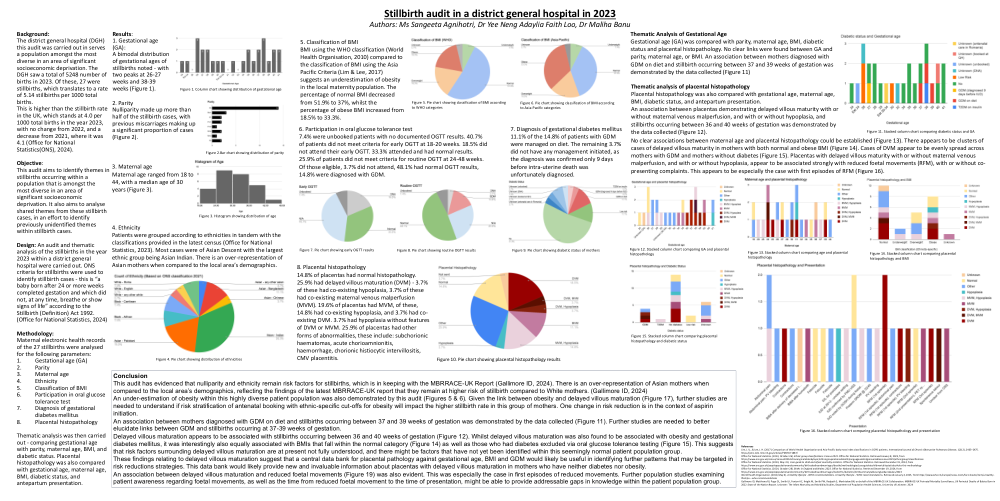
The district general hospital (DGH) this audit was carried out in serves a population amongst the most diverse in an area of significant socioeconomic deprivation. The DGH saw a total of 5248 number of births in 2023. Of these, 27 were stillbirths, which translates to a rate of 5.14 stillbirths per 1000 total births.
This is higher than the stillbirth rate in the UK, which stands at 4.0 per 1000 total births in the year 2023, with no change from 2022, and a decrease from 2021, where it was 4.1 (Office for National Statistics(ONS), 2024).
Objective:
This audit aims to identify themes in stillbirths occurring within a population that is amongst the most diverse in an area of significant socioeconomic deprivation. It also aims to analyse shared themes from these stillbirth cases, in an effort to identify previously unidentified themes within stillbirth cases.
Design: An audit and thematic analysis of the stillbirths in the year 2023 within a district general hospital were carried out. ONS criteria for stillbirths were used to identify stillbirth cases - this is “a baby born after 24 or more weeks completed gestation and which did not, at any time, breathe or show signs of life” according to the Stillbirth (Definition) Act 1992. (Office for National Statistics, 2024)
Methodology:
Maternal electronic health records of the 27 stillbirths were analysed for the following parameters:
1. Gestational age (GA):
A bimodal distribution of gestational ages of stillbirths noted - with two peaks at 26-27 weeks and 38-39 weeks (Figure 1).
2. Parity
Nulliparity made up more than half of the stillbirth cases, with previous miscarriages making up a significant proportion of cases (Figure 2).
3. Maternal age
Maternal age ranged from 18 to 44, with a median age of 30 years (Figure 3).
4. Ethnicity
Patients were grouped according to ethnicities in tandem with the classifications provided in the latest census (Office for National Statistics, 2023). Most cases were of Asian Descent with the largest ethnic group being Asian Indian. There is an over-representation of Asian mothers when compared to the local area’s demographics.
Thematic analysis was then carried out - comparing gestational age with parity, maternal age, BMI, and diabetic status. Placental histopathology was also compared with gestational age, maternal age, BMI, diabetic status, and antepartum presentation.
5. Classification of BMI
BMI using the WHO classification (World Health Organisation, 2010) compared to the classification of BMI using the Asia Pacific Criteria (Lim & Lee, 2017) suggests an underestimation of obesity in the local maternity population. The percentage of normal BMI decreased from 51.9% to 37%, whilst the percentage of obese BMI increased from 18.5% to 33.3%.
6. Participation in oral glucose tolerance test
7.4% were unbooked patients with no documented OGTT results. 40.7% of patients did not meet criteria for early OGTT at 18-20 weeks. 18.5% did not attend their early OGTT. 33.3% attended and had normal results. 25.9% of patients did not meet criteria for routine OGTT at 24-48 weeks. Of those eligible, 3.7% did not attend, 48.1% had normal OGTT results, 14.8% were diagnosed with GDM.
7. Diagnosis of gestational diabetes mellitus
11.1% of the 14.8% of patients with GDM were managed on diet. The remaining 3.7% did not have any management initiated, as the diagnosis was confirmed only 9 days before intra-uterine death was unfortunately diagnosed.
8. Placental histopathology
14.8% of placentas had normal histopathology. 25.9% had delayed villous maturation (DVM) - 3.7% of these had co-existing hypoplasia, 3.7% of these had co-existing maternal venous malperfusion (MVM). 19.6% of placentas had MVM, of these, 14.8% had co-existing hypoplasia, and 3.7% had co-existing DVM. 3.7% had hypoplasia without features of DVM or MVM. 25.9% of placentas had other forms of abnormalities, these include: subchorionic haematomas, acute chorioamnionitis, haemorrhage, chorionic histiocytic intervillositis, CMV placentitis.
Thematic Analysis of Gestational Age
Gestational age (GA) was compared with parity, maternal age, BMI, diabetic status and placental histopathology. No clear links were found between GA and parity, maternal age, or BMI. An association between mothers diagnosed with GDM on diet and stillbirth occurring between 37 and 39 weeks of gestation was demonstrated by the data collected (Figure 11)
Thematic analysis of placental histopathology
Placental histopathology was also compared with gestational age, maternal age, BMI, diabetic status, and antepartum presentation.
An association between placentas demonstrating delayed villous maturity with or without maternal venous malperfusion, and with or without hypoplasia, and stillbirths occurring between 36 and 40 weeks of gestation was demonstrated by the data collected (Figure 12).
No clear associations between maternal age and placental histopathology could be established (Figure 13). There appears to be clusters of cases of delayed villous maturity in mothers with both normal and obese BMI (Figure 14). Cases of DVM appear to be evenly spread across mothers with GDM and mothers without diabetes (Figure 15). Placentas with delayed villous maturity with or without maternal venous malperfusion, and with or without hypoplasia, appear to be associated strongly with reduced foetal movements (RFM), with or without co-presenting complaints. This appears to be especially the case with first episodes of RFM (Figure 16).
Conclusion
This audit has evidenced that nulliparity and ethnicity remain risk factors for stillbirths, which is in keeping with the MBRRACE-UK Report (Gallimore ID, 2024). There is an over-representation of Asian mothers when compared to the local area’s demographics, reflecting the findings of the latest MBRRACE-UK report that they remain at higher risk of stillbirth compared to White mothers. (Gallimore ID, 2024)
An under-estimation of obesity within this highly diverse patient population was also demonstrated by this audit (Figures 5 & 6). Given the link between obesity and delayed villous maturation (Figure 17), further studies are needed to understand if risk stratification of antenatal booking with ethnic-specific cut-offs for obesity will impact the higher stillbirth rate in this group of mothers. One change in risk reduction is in the context of aspirin initiation.
An association between mothers diagnosed with GDM on diet and stillbirths occurring between 37 and 39 weeks of gestation was demonstrated by the data collected (Figure 11). Further studies are needed to better elucidate links between GDM and stillbirths occurring at 37-39 weeks of gestation.
Delayed villous maturation appears to be associated with stillbirths occurring between 36 and 40 weeks of gestation (Figure 12). Whilst delayed villous maturation was also found to be associated with obesity and gestational diabetes mellitus, it was interestingly also equally associated with BMIs that fall within the normal category (Figure 14) as well as those who had diabetes excluded via oral glucose tolerance testing (Figure 15). This suggests that risk factors surrounding delayed villous maturation are at present not fully understood, and there might be factors that have not yet been identified within this seemingly normal patient population group.
These findings relating to delayed villous maturation suggest that a central data bank for placental pathology against gestational age, BMI and GDM would likely be useful in identifying further patterns that may be targeted in risk reductions strategies. This data bank would likely provide new and invaluable information about placentas with delayed villous maturation in mothers who have neither diabetes nor obesity.
An association between delayed villous maturation and reduced foetal movements (Figure 19) was also evident. This was especially the case in first episodes of reduced movements. Further population studies examining patient awareness regarding foetal movements, as well as the time from reduced foetal movement to the time of presentation, might be able to provide addressable gaps in knowledge within the patient population group.