2,281 posters, 63 videos, 56 audios, 43 topics, 18 sessions, 6,174 authors, 2,323 institutions
ePostersLive by SciGen Technologies S.A. All rights reserved.
RCOG World Congress 2025
June 23 - 25, 2025 | ExCeL London, UK
EP.1188
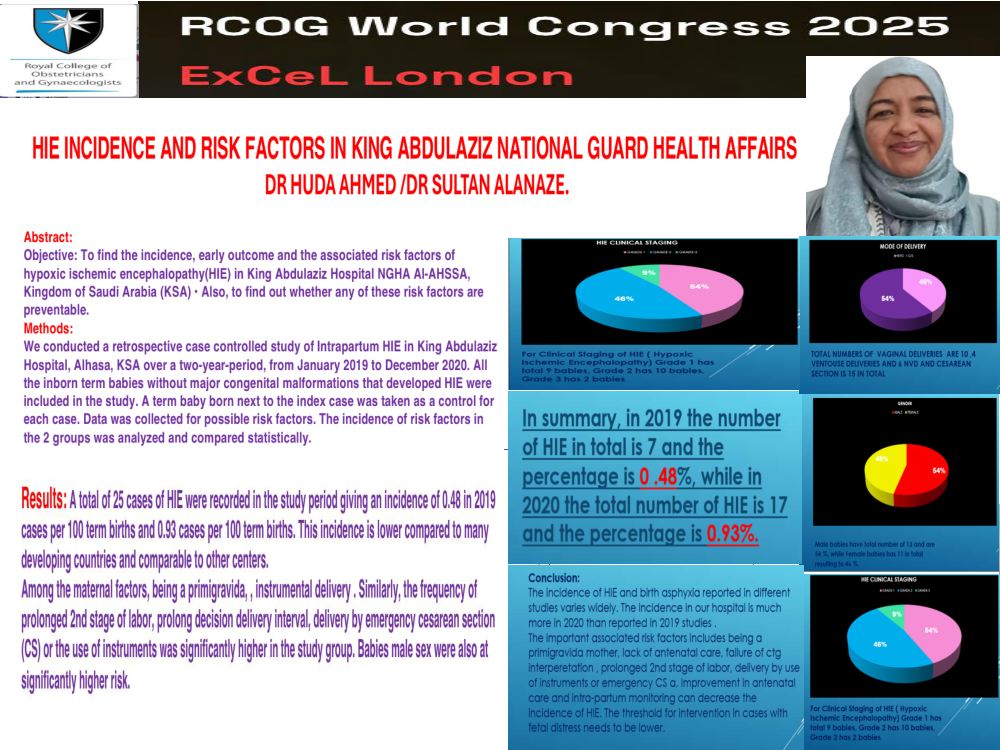
INTRAPARTUM HYPOXIC ISCHEMIC ENCEPHALOPATHY INCIDENCE AND RISK FACTORS IN KING ABDULAZIZ NGHA
Poster Presenter
Authors
Affiliations
Part of Topic
Hot topics (emerging research/issues) in obstetrics
Abstract
Objective: To find the incidence, early outcome and the associated risk factors of hypoxic ischemic encephalopathy(HIE) in King Abdulaziz Hospital NGHA Al-AHSSA , Kingdom of Saudi Arabia (KSA) . Also, to find out whether any of these risk factors are preventable.
Methods:
We conducted a retrospective case controlled study of Intrapartum HIE in King Abdulaziz Hospital, Alhasa , KSA over a two-year-period, from January 2019 to December 2020. All the inborn term babies without major congenital malformations that developed HIE were included in the study. A term baby born next to the index case was taken as a control for each case. Data was collected for possible risk factors. The incidence of risk factors in the 2 groups was analyzed and compared statistically
Results: A total of 25 cases of HIE were recorded in the study period giving an incidence of 0.48 in 2019 cases per 100 term births and 0.93 cases per 100 term births . This incidence is lower compared to many developing countries and comparable to other centers. Among the maternal factors, being a primigravida, , instrumental delivery . Similarly, the frequency of prolonged 2nd stage of labor, prolong decision delivery interval , delivery by emergency cesarean section (CS) or the use of instruments was significantly higher in the study group. Babies male sex were also at significantly higher risk.
Conclusion:
The incidence of HIE and birth asphyxia reported in different studies varies widely. The incidence in our hospital is much more in 2020 than reported in 2019 studies .
The important associated risk factors includes being a primigravida mother, lack of antenatal care, failure of ctg interperetation , prolonged 2nd stage of labor, delivery by use of instruments or emergency CS a. Improvement in antenatal care and intra-partum monitoring can decrease the incidence of HIE. The threshold for intervention in cases with fetaldistress needs to be lower.