2,281 posters, 63 videos, 56 audios, 43 topics, 18 sessions, 6,174 authors, 2,323 institutions
ePostersLive by SciGen Technologies S.A. All rights reserved.
RCOG World Congress 2025
June 23 - 25, 2025 | ExCeL London, UK
PP.0066
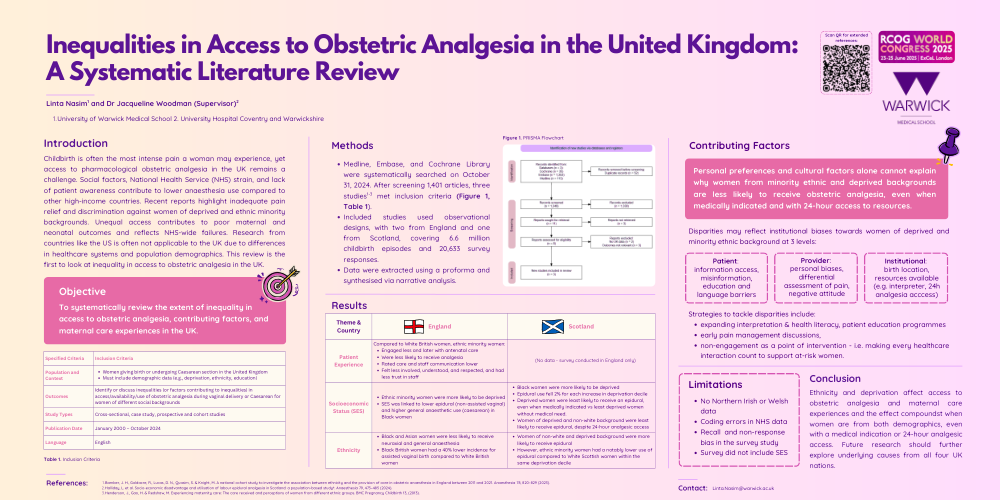
Inequalities in Access to Obstetric Analgesia in the UK: A Systematic Review
Poster Presenter
Authors
Affiliations
Part of Topic
Hot topics (emerging research/issues) in obstetrics
Inequalities in Access to Obstetric Analgesia in the United Kingdom: A Systematic Literature Review
Linta Nasim1 and Dr Jacqueline Woodman (Supervisor)2
University of Warwick Medical School 2. University Hospital Coventry and Warwickshire
Introduction
Childbirth is often the most intense pain a woman may experience, yet access to pharmacological obstetric analgesia in the UK remains a challenge. Social factors, National Health Service (NHS) strain, and lack of patient awareness contribute to lower anaesthesia use compared to other high-income countries. Recent reports highlight inadequate pain relief and discrimination against women of deprived and ethnic minority backgrounds. Unequal access contributes to poor maternal and neonatal outcomes and reflects NHS-wide failures. Research from countries like the US is often not applicable to the UK due to differences in healthcare systems and population demographics. This review is the first to look at inequality in access to obstetric analgesia in the UK.
Objective
To systematically review the extent of inequality in access to obstetric analgesia, contributing factors, and maternal care experiences in the UK.
Methods
- Medline, Embase, and Cochrane Library were systematically searched on October 31, 2024. After screening 1,401 articles, three studies1-3 met inclusion criteria (Figure 1, Table 1).
- Included studies used observational designs, with two from England and one from Scotland, covering 6.6 million childbirth episodes and 20,633 survey responses.
- Data were extracted using a proforma and synthesised via narrative analysis.
Disparities may reflect institutional biases towards women of deprived and minority ethnic background at 3 levels:
- Patient: information access, misinformation, education and language barriers
- Provider: personal biases, differential assessment of pain, negative attitude
- Institutional: birth location, resources available (e.g. interpreter, 24h analgesia acccess)
Strategies to tackle disparities include:
- expanding interpretation & health literacy, patient education programmes
- early pain management discussions,
- non-engagement as a point of intervention - i.e. making every healthcare interaction count to support at-risk women.
- No Northern Irish or Welsh data
- Coding errors in NHS data
- Recalland non-response bias in the survey study
- Survey did not include SES