2,281 posters, 63 videos, 56 audios, 43 topics, 18 sessions, 6,174 authors, 2,323 institutions
ePostersLive by SciGen Technologies S.A. All rights reserved.
RCOG World Congress 2025
June 23 - 25, 2025 | ExCeL London, UK
EP.1184
SAFETY & EFFICACY OF VACCUM DELIVERY OF HIGH FLOATING HEAD DURING CAESAREAN SECTION
Poster Presenter
Part of Topic
Hot topics (emerging research/issues) in obstetrics
EFFICACY AND SAFETY OF VACCUM DELIVERY OF HIGH FLOATING HEAD COMPARED TO MANUAL EXTRACTION DURING CAESAREAN SECTION - A COMPARATIVE STUDY
Radhika Bharadwaj, Gautam Mukhopadhyay, Sandip Sengupta
Difficult extraction of foetal head occurs in 1-2% of caesarean deliveries especially in cases with floating head. It is associated with maternal complications like extensions in uterine incisions , prolonged uterine incision to delivery times leading to depressed neonatal APGAR scores.
OBJECTIVES
Primary outcome: Uterine incision to delivery interval in manual and vaccum extraction were compared
Secondary outcome: Maternal outcomes in terms of amount of blood loss, extension of uterine incision and post partum haemmorhage were compared
Neonatal outcomes in terms of APGAR scores, neonatal hyperbilirubinemia, trauma, need for neonatal resuscitation were compared
STUDY DESIGN
Prospective observational comparative study
100 pregnant women presenting with high floating head at term were selected in which 50 were delivered with vaccum and 50 by manual extraction. Ultrasound was done to assess the estimated period of gestation, foetal weight, placental site and ruling out foetal anomalies. Crichton’s trans-abdominal method was used to assess engagement of foetal head. Uterine incision to delivery time was estimated by using stopwatch and estimated blood loss measured by suctioning.
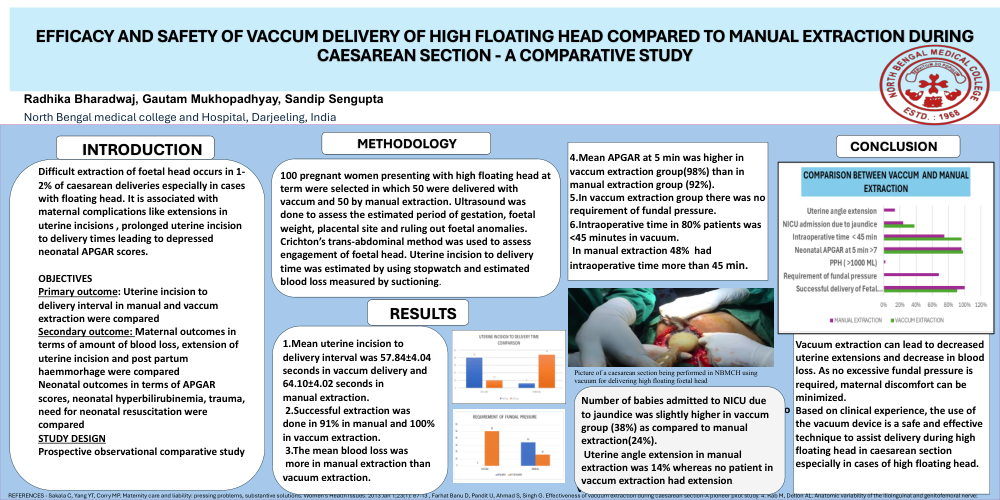
1.Mean uterine incision to delivery interval was 57.84±4.04 seconds in vaccum delivery and 64.10±4.02 seconds in
manual extraction.
2.Successful extraction was
done in 91% in manual and 100% in vaccum extraction.
3.The mean blood loss was
more in manual extraction than vacuum extraction.
4.Mean APGAR at 5 min was higher in vaccum extraction group(98%) than in manual extraction group (92%).
5.In vaccum extraction group there was no requirement of fundal pressure.
6.Intraoperative time in 80% patients was <45 minutes in vacuum.
In manual extraction 48% had intraoperative time more than 45 min
Number of babies admitted to NICU due to jaundice was slightly higher in vaccum group (38%) as compared to manual extraction(24%).
Uterine angle extension in manual extraction was 14% whereas no patient in vaccum extraction had extension.
Vacuum extraction can lead to decreased uterine extensions and decrease in blood loss. As no excessive fundal pressure is required, maternal discomfort can be minimized.
Based on clinical experience, the use of the vacuum device is a safe and effective technique to assist delivery during high floating head in caesarean section especially in cases of high floating head.