2,281 posters, 63 videos, 56 audios, 43 topics, 18 sessions, 6,174 authors, 2,323 institutions
ePostersLive by SciGen Technologies S.A. All rights reserved.
RCOG World Congress 2025
June 23 - 25, 2025 | ExCeL London, UK
EP.1182
Beyond the Incision: Optimizing Pain Management in Post-Cesarean Mothers
Part of Topic
Hot topics (emerging research/issues) in obstetrics
Beyond the Incision: Optimizing Pain Management in Post-Cesarean Mothers
Authors:
Ms. Tesia Khawaja1,2
Mr. Nick Dukaj1,2
Ms. Janean Peterson1,2
Ms. Abeir Suliman1,3
Miss Radhika Viswanatha1
Affiliations:
Epsom & St. Helier’s NHS Hospital Trust1
American University of the Caribbean School of Medicine2
St. George’s University of London3
Introduction:
Pain management is an integral part of the role of a healthcare practitioner. Cesarean sections rank amongst the most frequently performed surgeries globally, yet were identified as the ninth most painful surgery in a 2013 cohort study. Postoperative pain impacts patients in various ways and poor management can be a precursor to further complications including deep venous thromboembolism, delayed recovery, clinical depression, and chronic pain syndrome which in turn decreases patient satisfaction. Effective pain management must consider multiple factors including individualized treatment plans based on patient history, minimizing side effects, and ensuring adequate pain control to allow for minimal interference with daily activities especially in the setting of a newborn.
Objective:
The objective is to evaluate the management of postoperative cesarean section pain in a large teaching hospital in Surrey and use the data to identify potential areas for improvement to enhance pain management practices and patient satisfaction within the department.
Methodology:
Study design: Cross-sectional, observational study conducted in the postnatal ward using a modified version of Pain-Out questionnaire
Participants: 71 patients, at least 24 hours post-cesarean
Primary Goal: Assess pain intensity, frequency of severe pain, patient satisfaction, and side effects of pain treatment
Data Collection
- Pain intensity (least/worst pain): rated on a 0-10 scale
- Pain interference: impact on activities such as sleeping, breathing, and moving
- Emotional impact: anxiety and helplessness
- Side effects: nausea, drowsiness, itching, dizziness
- Patient satisfaction: pain relief and involvement in treatment decisions
- Non-pharmacological methods: non-medicinal options used (e.g., deep breathing, walking, talking to staff, cold pack, etc.)
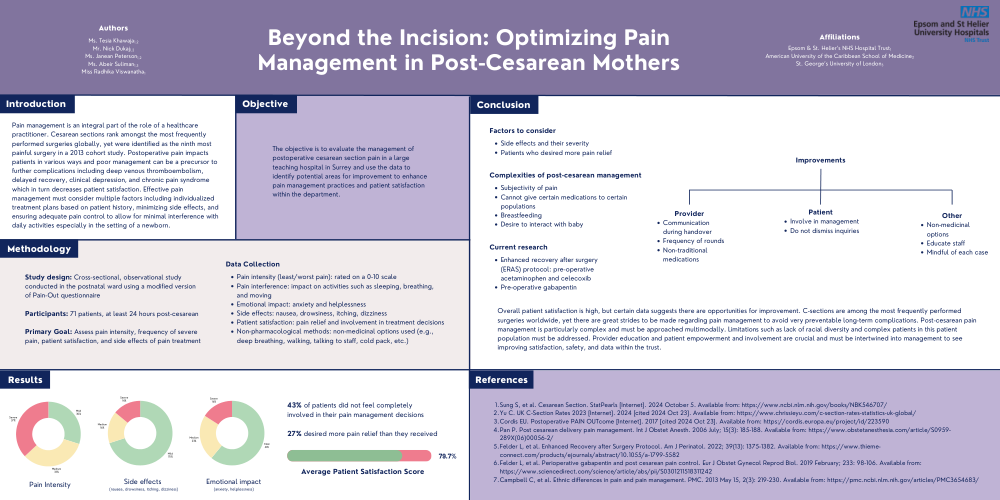
43% of patients did not feel completely involved in their pain management decisions
27% desired more pain relief than they received
Conclusion:
Factors to consider
- Side effects and their severity
- Patients who desired more pain relief
Complexities of post-cesarean management
- Subjectivity of pain
- Cannot give certain medications to certain populations
- Breastfeeding
- Desire to interact with baby
Current research
- Enhanced recovery after surgery (ERAS) protocol: pre-operative acetaminophen and celecoxib
- Pre-operative gabapentin
Overall patient satisfaction is high, but certain data suggests there are opportunities for improvement. C-sections are among the most frequently performed surgeries worldwide, yet there are great strides to be made regarding pain management to avoid very preventable long-term complications. Post-cesarean pain management is particularly complex and must be approached multimodally. Limitations such as lack of racial diversity and complex patients in this patient population must be addressed. Provider education and patient empowerment and involvement are crucial and must be intertwined into management to see improving satisfaction, safety, and data within the trust.
References:
- Sung S, et al. Cesarean Section. StatPearls [Internet]. 2024 October 5. Available from: https://www.ncbi.nlm.nih.gov/books/NBK546707/
- Yu C. UK C-Section Rates 2023 [Internet]. 2024 [cited 2024 Oct 23]. Available from: https://www.chrissieyu.com/c-section-rates-statistics-uk-global/
- Cordis EU. Postoperative PAIN OUTcome [Internet]. 2017 [cited 2024 Oct 23]. Available from: https://cordis.europa.eu/project/id/223590
- Pan P. Post cesarean delivery pain management. Int J Obstet Anesth. 2006 July; 15(3): 185-188. Available from: https://www.obstetanesthesia.com/article/S0959-289X(06)00056-2/
- Felder L, et al. Enhanced Recovery after Surgery Protocol. Am J Perinatol. 2022; 39(13): 1375-1382. Available from: https://www.thieme-connect.com/products/ejournals/abstract/10.1055/a-1799-5582
- Felder L, et al. Perioperative gabapentin and post cesarean pain control. Eur J Obstet Gynecol Reprod Biol. 2019 February; 233: 98-106. Available from: https://www.sciencedirect.com/science/article/abs/pii/S0301211518311242
- Campbell C, et al. Ethnic differences in pain and pain management. PMC. 2013 May 15, 2(3): 219-230. Available from: https://pmc.ncbi.nlm.nih.gov/articles/PMC3654683/