2,281 posters, 63 videos, 56 audios, 43 topics, 18 sessions, 6,174 authors, 2,323 institutions
ePostersLive by SciGen Technologies S.A. All rights reserved.
RCOG World Congress 2025
June 23 - 25, 2025 | ExCeL London, UK
EP.1151
Urosepsis in Pregnancy with CP-CRE Bacteriuria and Autosomal Dominant Polycystic Kidney Disease
Poster Presenter
Authors
Affiliations
Part of Topic
High risk pregnancy
|
UROSEPSIS IN PREGNANCY WITH CP-CRE BACTERIURIA AND AUTOSOMAL DOMINANT POLYCYSTIC KIDNEY DISEASE NABILAH ABD RAHIM, NURUL KHAUSAR KAMARUZAMAN |
||
|
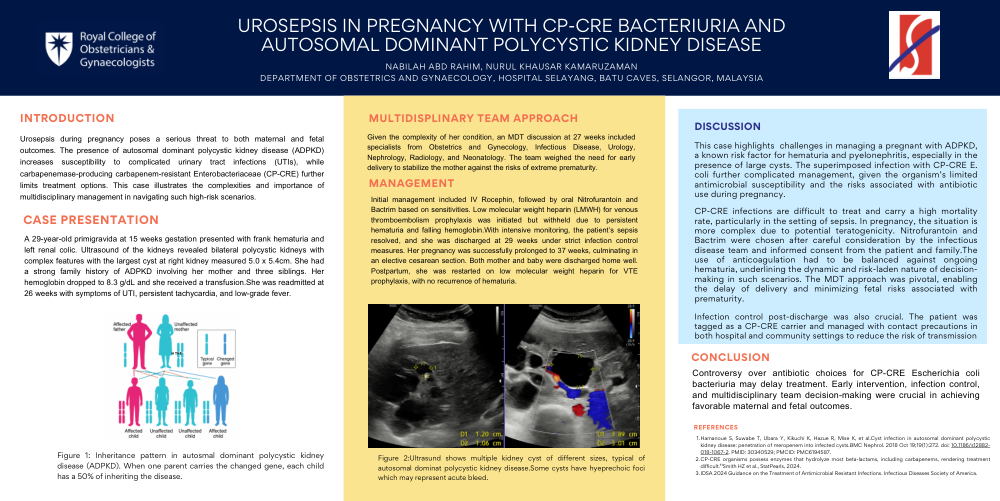
INTRODUCTION Urosepsis during pregnancy poses a serious threat to both maternal and fetal outcomes. The presence of autosomal dominant polycystic kidney disease (ADPKD) increases susceptibility to complicated urinary tract infections (UTIs), while carbapenemase-producing carbapenem-resistant Enterobacteriaceae (CP-CRE) further limits treatment options. This case illustrates the complexities and importance of multidisciplinary management in navigating such high-risk scenarios. CASE PRESENTATION A 29-year-old primigravida at 15 weeks gestation presented with frank hematuria and left renal colic. Ultrasound of the kidneys revealed bilateral polycystic kidneys with complex features with the largest cyst at right kidney measured 5.0 x 5.4cm. She had a strong family history of ADPKD involving her mother and three siblings. Her hemoglobin dropped to 8.3 g/dL and she received a transfusion.She was readmitted at 26 weeks with symptoms of UTI, persistent tachycardia, and low-grade fever. H THE Figure 1: Inheritance pattern in autosmal dominant polycystic kidney disease (ADPKD). When one parent carries the changed gene, each child has a 50% of inheriting the disease. |
MULTIDISPLINARY TEAM APPROACH Given the complexity of her condition, an MDT discussion at 27 weeks included specialists from Obstetrics and Gynecology, Infectious Disease, Urology, Nephrology, Radiology, and Neonatology. The team weighed the need for early delivery to stabilize the mother against the risks of extreme prematurity. MANAGEMENT Initial management included IV Rocephin, followed by oral Nitrofurantoin and Bactrim based on sensitivities. Low molecular weight heparin (LMWH) for venous thromboembolism prophylaxis was initiated but withheld due to persistent hematuria and falling hemoglobin.With intensive monitoring, the patient’s sepsis resolved, and she was discharged at 29 weeks under strict infection control measures. Her pregnancy was successfully prolonged to 37 weeks, culminating in an elective cesarean section. Both mother and baby were discharged home well. Postpartum, she was restarted on low molecular weight heparin for VTE prophylaxis, with no recurrence of hematuria. Figure 2:Ultrasund shows multiple kidney cyst of different sizes, typical of autosomal dominat polycystic kidney disease.Some cysts have hyeprechoic foci which may represent acute bleed. |
DISCUSSION This case highlights challenges in managing a pregnant with ADPKD, a known risk factor for hematuria and pyelonephritis, especially in the presence of large cysts. The superimposed infection with CP-CRE E. coli further complicated management, given the organism’s limited antimicrobial susceptibility and the risks associated with antibiotic use during pregnancy. CP-CRE infections are difficult to treat and carry a high mortality rate, particularly in the setting of sepsis. In pregnancy, the situation is more complex due to potential teratogenicity. Nitrofurantoin and Bactrim were chosen after careful consideration by the infectious disease team and informed consent from the patient and family.The use of anticoagulation had to be balanced against ongoing hematuria, underlining the dynamic and risk-laden nature of decision- making in such scenarios. The MDT approach was pivotal, enabling the delay of delivery and minimizing fetal risks associated with prematurity. Infection control post-discharge was also crucial. The patient was tagged as a CP-CRE carrier and managed with contact precautions in both hospital and community settings to reduce the risk of transmission CONCLUSION Controversy over antibiotic choices for CP-CRE Escherichia coli bacteriuria may delay treatment. Early intervention, infection control, and multidisciplinary team decision-making were crucial in achieving favorable maternal and fetal outcomes. REFERENCES 1.Hamanoue S, Suwabe T, Ubara Y, Kikuchi K, Hazue R, Mise K, et al.Cyst infection in autosomal dominant polycystic kidney disease: penetration of meropenem into infected cysts.BMC Nephrol. 2018 Oct 19;19(1):272. doi: 10.1186/s12882- 018-1067-2. PMID: 30340529; PMCID: PMC6194587. 2.CP-CRE organisms possess enzymes that hydrolyze most beta-lactams, including carbapenems, rendering treatment difficult.11Smith HZ et al., StatPearls, 2024. 3.IDSA 2024 Guidance on the Treatment of Antimicrobial Resistant Infections. Infectious Diseases Society of America. |