2,281 posters, 63 videos, 56 audios, 43 topics, 18 sessions, 6,174 authors, 2,323 institutions
ePostersLive by SciGen Technologies S.A. All rights reserved.
RCOG World Congress 2025
June 23 - 25, 2025 | ExCeL London, UK
EP.1150
"A Silent Threat: Toxic Megacolon Masquerading as Constipation in the Postpartum Period"
Poster Presenter
Authors
Damayantha Watthuhewa, Suad Hirsi-Farah, Singarathnam Kandasamy
Affiliations
Part of Topic
High risk pregnancy
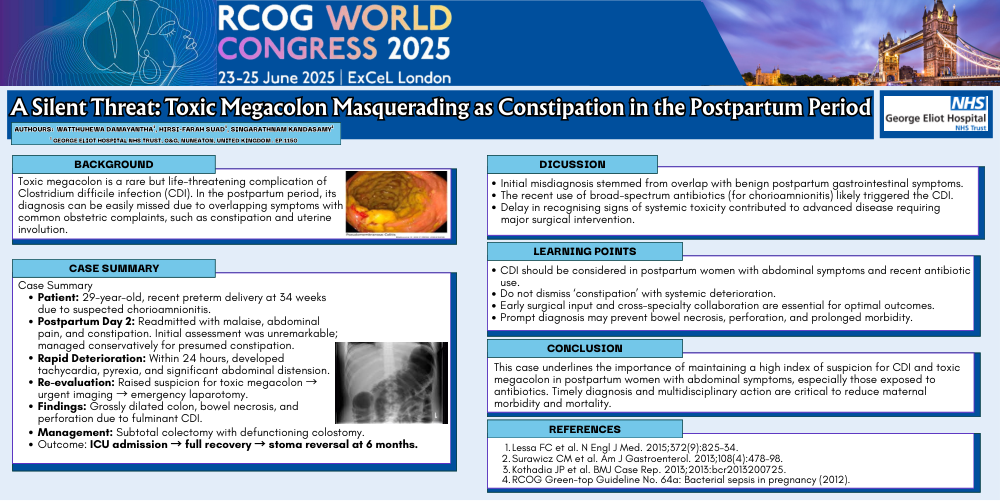
A Silent Threat: Toxic Megacolon Masquerading as Constipation in the Postpartum Period
AUTHOURS: WATTHUHEWA DAMAYANTHA , HIRSI-FARAH SUAD , SINGARATHNAM KANDASAMY
GEORGE ELIOT HOSPITAL NHS TRUST , O&G, NUNEATON, UNITED KINGDOM . EP.1150
BACKGROUND
Toxic megacolon is a rare but life-threatening complication of
Clostridium difficile infection (CDI). In the postpartum period, its
diagnosis can be easily missed due to overlapping symptoms with
common obstetric complaints, such as constipation and uterine
involution.
CASE SUMMARY
Case Summary
Patient: 29-year-old, recent preterm delivery at 34 weeks
due to suspected chorioamnionitis.
Postpartum Day 2: Readmitted with malaise, abdominal
pain, and constipation. Initial assessment was unremarkable;
managed conservatively for presumed constipation.
Rapid Deterioration: Within 24 hours, developed
tachycardia, pyrexia, and significant abdominal distension.
Re-evaluation: Raised suspicion for toxic megacolon →
urgent imaging → emergency laparotomy.
Findings: Grossly dilated colon, bowel necrosis, and
perforation due to fulminant CDI.
Management: Subtotal colectomy with defunctioning colostomy.
Outcome: ICU admission → full recovery → stoma reversal at 6 months.
DICUSSION
Initial misdiagnosis stemmed from overlap with benign postpartum gastrointestinal symptoms.
The recent use of broad-spectrum antibiotics (for chorioamnionitis) likely triggered the CDI.
Delay in recognising signs of systemic toxicity contributed to advanced disease requiring
major surgical intervention.
LEARNING POINTS
CDI should be considered in postpartum women with abdominal symptoms and recent antibiotic
use.
Do not dismiss
‘
’
constipation
with systemic deterioration.
Early surgical input and cross-specialty collaboration are essential for optimal outcomes.
Prompt diagnosis may prevent bowel necrosis, perforation, and prolonged morbidity.
CONCLUSION
This case underlines the importance of maintaining a high index of suspicion for CDI and toxic
megacolon in postpartum women with abdominal symptoms, especially those exposed to
antibiotics. Timely diagnosis and multidisciplinary action are critical to reduce maternal
morbidity and mortality.
REFERENCES
1.Lessa FC et al. N Engl J Med. 2015;372(9):825–34.
2.Surawicz CM et al. Am J Gastroenterol. 2013;108(4):478–98.
3.Kothadia JP et al. BMJ Case Rep. 2013;2013:bcr2013200725.
4.RCOG Green-top Guideline No. 64a: Bacterial sepsis in pregnancy (2012).