2,281 posters, 63 videos, 56 audios, 43 topics, 18 sessions, 6,174 authors, 2,323 institutions
ePostersLive by SciGen Technologies S.A. All rights reserved.
RCOG World Congress 2025
June 23 - 25, 2025 | ExCeL London, UK
EP.1149
Alagille syndrome in pregnancy complicated by intrahepatic cholestasis and pre-eclampsia
Poster Presenter
Authors
Affiliations
Part of Topic
High risk pregnancy
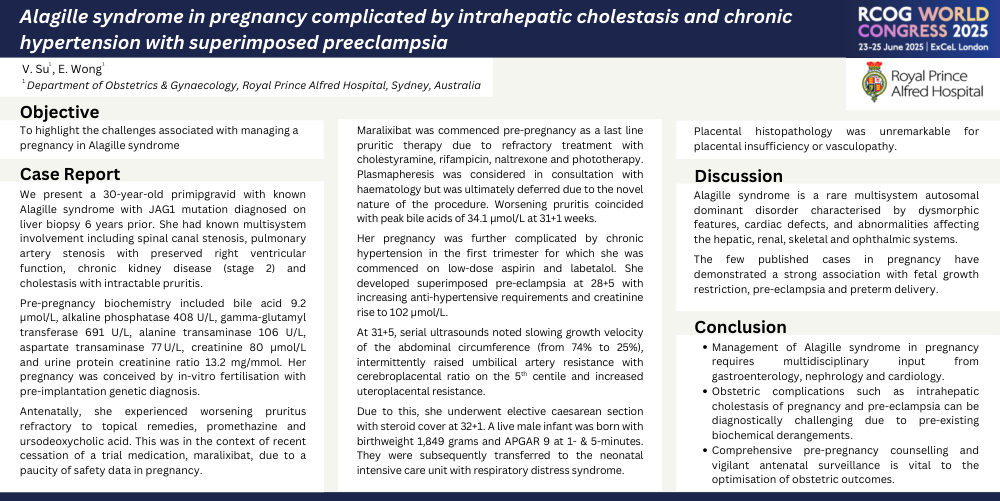
Alagille syndrome in pregnancy complicated by intrahepatic cholestasis and pre-eclampsia
V Su1, E Wong1
1 Department of Obstetrics and Gynaecology, Royal Prince Alfred Hospital, Sydney, Australia
Objective:
To highlight the challenges associated with managing a pregnancy in Alagille syndrome
Case report:
We present a 30-year-old primipgravid with known Alagille syndrome with JAG1 mutation diagnosed on liver biopsy 6 years prior. She had known multisystem involvement including spinal canal stenosis, pulmonary artery stenosis with preserved right ventricular function, chronic kidney disease (stage 2) and cholestasis with intractable pruritis. Pre-pregnancy biochemistry included bile acid 9.2 µmol/L, alkaline phosphatase 408 U/L, gamma-glutamyl transferase 691 U/L, alanine transaminase 106 U/L, aspartate transaminase 77 U/L, creatinine 80 µmol/L and urine protein creatinine ratio 13.2 mg/mmol. Her pregnancy was conceived by in-vitro fertilisation with pre-implantation genetic diagnosis. Antenatally, she experienced worsening pruritus refractory to topical remedies, promethazine and ursodeoxycholic acid. This was in the context of recent cessation of a trial medication, maralixibat, due to a paucity of safety data in pregnancy. Maralixibat was commenced pre-pregnancy as a last line pruritic therapy due to refractory treatment with cholestyramine, rifampicin, naltrexone and phototherapy. Plasmapheresis was considered in consultation with haematology but was ultimately deferred due to the novel nature of the procedure. Worsening pruritis coincided with peak bile acids of 34.1 µmol/L at 31+1 weeks. Her pregnancy was further complicated by chronic hypertension in the first trimester for which she was commenced on low-dose aspirin and labetalol. She developed superimposed pre-eclampsia at 28+5 with increasing anti-hypertensive requirements and creatinine rise to 102 µmol/L. At 31+5, serial ultrasounds noted slowing growth velocity of the abdominal circumference (from 74% to 25%), intermittently raised umbilical artery resistance with cerebroplacental ratio on the 5th centile and increased uteroplacental resistance. Due to this, she underwent elective caesarean section with steroid cover at 32+1. A live male infant was born with birthweight 1,849 grams and APGAR 9 at 1- & 5-minutes. They were subsequently transferred to the neonatal intensive care unit with respiratory distress syndrome. Placental histopathology was unremarkable for placental insufficiency or vasculopathy.
Discussion:
Alagille syndrome is a rare multisystem autosomal dominant disorder characterised by dysmorphic features, cardiac defects, and abnormalities affecting the hepatic, renal, skeletal and ophthalmic systems. The few published cases in pregnancy have demonstrated a strong association with fetal growth restriction, pre-eclampsia and preterm delivery.
Conclusions:
Management of Alagille syndrome in pregnancy requires multidisciplinary input from gastroenterology, nephrology and cardiology. Obstetric complications such as intrahepatic cholestasis of pregnancy and pre-eclampsia can be diagnostically challenging due to pre-existing biochemical derangements. Comprehensive pre-pregnancy counselling and vigilant antenatal surveillance is vital to the optimisation of obstetric outcomes.