2,281 posters, 63 videos, 56 audios, 43 topics, 18 sessions, 6,174 authors, 2,323 institutions
ePostersLive by SciGen Technologies S.A. All rights reserved.
RCOG World Congress 2025
June 23 - 25, 2025 | ExCeL London, UK
EP.1144
Severe Plasmodium Falciparum Malaria Induced Haemolytic Anaemia in Pregnancy: A Case Report
Poster Presenter
Authors
Affiliations
Part of Topic
High risk pregnancy
Background
Malaria is the second most common cause of infectious disease related death globally, with malaria in pregnancy contributing to more than 10,000 maternal and 200,000 neonatal deaths per year.
This report aims to highlight the importance of considering this diagnosis early in non-endemic areas secondary to globalisation of disease, with early identification allowing for appropriate management of maternal sequelae and risks of intrauterine demise, premature delivery, foetal growth restriction, congenital infection and maternal/neonatal mortality.
Case Study
A 36-year-old multipara female, presented to a tertiary Hospital in Melbourne, Australia at 31 weeks gestation with limited antenatal care after having arrived from Uganda one month prior. She presented with generalised myalgias, headache and on physical examination was found to have a maternal pyrexia of 38.8°C and tachycardia up to 139bpm. She was immediately commenced on triple broad-spectrum antibiotics to treat for presumed maternal sepsis.
Continuous electronic fetal monitoring remained stable throughout with ongoing fluid resuscitation.
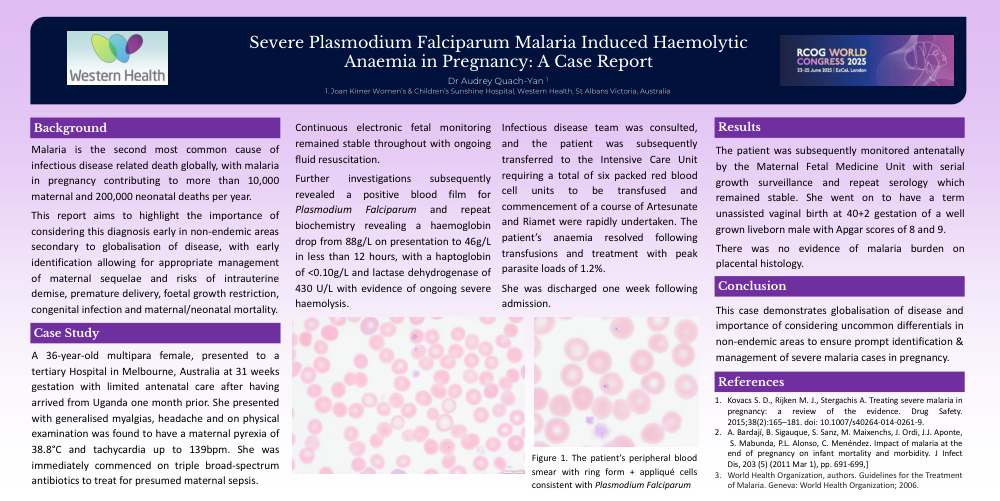
Further investigations subsequently revealed a positive blood film for Plasmodium Falciparum and repeat biochemistry revealing a haemoglobin drop from 88g/L on presentation to 46g/L in less than 12 hours, with a haptoglobin of <0.10g/L and lactase dehydrogenase of 430 U/L with evidence of ongoing severe haemolysis.
Infectious disease team was consulted, and the patient was subsequently transferred to the Intensive Care Unit requiring a total of six packed red blood cell units to be transfused and commencement of a course of Artesunate and Riamet were rapidly undertaken. The patient ’s anaemia resolved following transfusions and treatment with peak parasite loads of 1.2%.
She was discharged one week following admission.
Results
The patient was subsequently monitored antenatally by the Maternal Fetal Medicine Unit with serial growth surveillance and repeat serology which remained stable. She went on to have a term unassisted vaginal birth at 40+2 gestation of a well grown liveborn male with Apgar scores of 8 and 9.
There was no evidence of malaria burden on placental histology.
Conclusion
This case demonstrates globalisation of disease and importance of considering uncommon differentials in non-endemic areas to ensure prompt identification & management of severe malaria cases in pregnancy.