2,281 posters, 63 videos, 56 audios, 43 topics, 18 sessions, 6,174 authors, 2,323 institutions
ePostersLive by SciGen Technologies S.A. All rights reserved.
RCOG World Congress 2025
June 23 - 25, 2025 | ExCeL London, UK
EP.1142
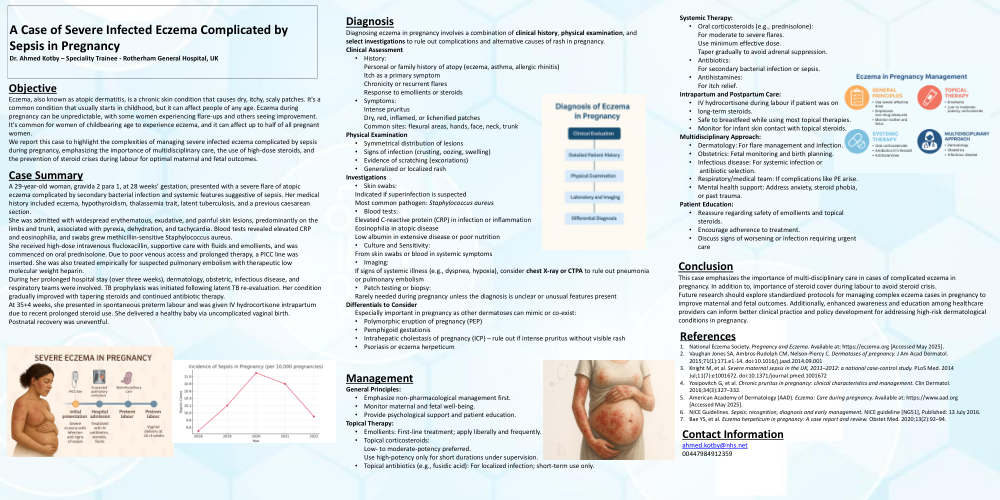
A case of severe infected Eczema complicated by sepsis in pregnancy
Poster Presenter
Authors
Affiliations
Part of Topic
High risk pregnancy
Objective
Eczema, also known as atopic dermatitis, is a chronic skin condition that causes dry, itchy, scaly patches. It's a common condition that usually starts in childhood, but it can affect people of any age. Eczema during pregnancy can be unpredictable, with some women experiencing flare-ups and others seeing improvement. It's common for women of childbearing age to experience eczema, and it can affect up to half of all pregnant women.
We report this case to highlight the complexities of managing severe infected eczema complicated by sepsis during pregnancy, emphasizing the importance of multidisciplinary care, the use of high-dose steroids, and the prevention of steroid crises during labour for optimal maternal and fetal outcomes.
Case Summary
A 29-year-old woman, gravida 2 para 1, at 28 weeks’ gestation, presented with a severe flare of atopic eczema complicated by secondary bacterial infection and systemic features suggestive of sepsis. Her medical history included eczema, hypothyroidism, thalassemia trait, latent tuberculosis, and a previous caesarean section.
She was admitted with widespread erythematous, exudative, and painful skin lesions, predominantly on the limbs and trunk, associated with pyrexia, dehydration, and tachycardia. Blood tests revealed elevated CRP and eosinophilia, and swabs grew methicillin-sensitive Staphylococcus aureus.
She received high-dose intravenous flucloxacillin, supportive care with fluids and emollients, and was commenced on oral prednisolone. Due to poor venous access and prolonged therapy, a PICC line was inserted. She was also treated empirically for suspected pulmonary embolism with therapeutic low molecular weight heparin.
During her prolonged hospital stay (over three weeks), dermatology, obstetric, infectious disease, and respiratory teams were involved. TB prophylaxis was initiated following latent TB re-evaluation. Her condition gradually improved with tapering steroids and continued antibiotic therapy.
At 35+4 weeks, she presented in spontaneous preterm labour and was given IV hydrocortisone intrapartum due to recent prolonged steroid use. She delivered a healthy baby via uncomplicated vaginal birth.
Postnatal recovery was uneventful.
Diagnosis
Diagnosing eczema in pregnancy involves a combination of clinical history, physical examination, and select investigations to rule out complications and alternative causes of rash in pregnancy.
Clinical Assessment
Personal or family history of atopy (eczema, asthma, allergic rhinitis)
Itch as a primary symptom
Chronicity or recurrent flares
Response to emollients or steroids
Intense pruritus
Dry, red, inflamed, or lichenified patches
Common sites: flexural areas, hands, face, neck, trunk
Physical Examination
Investigations
Indicated if superinfection is suspected
Most common pathogen: Staphylococcus aureus
Elevated C-reactive protein (CRP) in infection or inflammation
Eosinophilia in atopic disease
Low albumin in extensive disease or poor nutrition
From skin swabs or blood in systemic symptoms
If signs of systemic illness (e.g., dyspnea, hypoxia), consider chest X-ray or CTPA to rule out pneumonia or pulmonary embolism
Rarely needed during pregnancy unless the diagnosis is unclear or unusual features present
Differentials to Consider
Especially important in pregnancy as other dermatoses can mimic or co-exist:
Management
General Principles:
Topical Therapy:
Low- to moderate-potency preferred.
Use high-potency only for short durations under supervision.
Systemic Therapy:
For moderate to severe flares.
Use minimum effective dose.
Taper gradually to avoid adrenal suppression.
For secondary bacterial infection or sepsis.
For itch relief.
Intrapartum and Postpartum Care:
Multidisciplinary Approach:
antibiotic selection.
Patient Education:
Conclusion
This case emphasizes the importance of multi-disciplinary care in cases of complicated eczema in pregnancy. In addition to, importance of steroid cover during labour to avoid steroid crisis.
Future research should explore standardized protocols for managing complex eczema cases in pregnancy to improve maternal and fetal outcomes. Additionally, enhanced awareness and education among healthcare providers can inform better clinical practice and policy development for addressing high-risk dermatological conditions in pregnancy.
References