2,281 posters, 63 videos, 56 audios, 43 topics, 18 sessions, 6,174 authors, 2,323 institutions
ePostersLive by SciGen Technologies S.A. All rights reserved.
RCOG World Congress 2025
June 23 - 25, 2025 | ExCeL London, UK
EP.1141
Acute Fatty Liver in Pregnancy: A case presentation
Poster Presenter
Authors
Affiliations
Part of Topic
High risk pregnancy
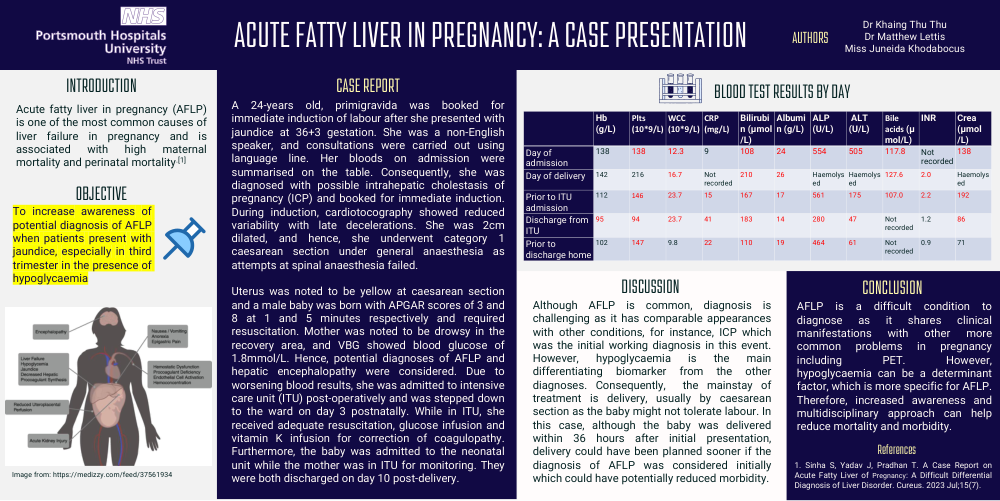
Objective: To increase awareness of potential diagnosis of acute fatty liver in pregnancy (AFLP) when patients present with jaundice, especially in third trimester.
Case Report: A 24-years old, primigravida was booked for immediate induction of labour after she presented with jaundice at 36+3 gestation. She was of ethnic minority background, and she did not speak English. Therefore, consultations were carried out using language line. Her bloods on admission showed bilirubin of 105, ALT of 505 and bile acid levels of 117.8. She was diagnosed with possible intrahepatic cholestasis of pregnancy (ICP) and was induced using cook cervical ripening balloon. The balloon was removed 12 hours later and cardiotocography showed reduced variability with late decelerations. A vaginal examination showed 2cm cervical dilation and therefore, a decision was made for category 1 caesarean section under general anaesthesia as attempts at spinal anaesthesia failed.
Uterus was noted to be yellow at caesarean section and a male baby was born with APGAR scores of 3 and 8 at 1 and 5 minutes respectively and required resuscitation at birth. Mother was noted to be drowsy in the recovery area after the operation and at this point, potential diagnoses of AFLP and hepatic encephalopathy was considered. Due to worsening blood results, she was admitted to intensive care unit (ITU) post-operatively and was stepped down to the ward on day 3 postnatally. While in ITU, she received adequate resuscitation, glucose infusion and vitamin K infusion for correction of coagulopathy. Furthermore, the baby was admitted to the neonatal unit while the mother was in ITU for monitoring. They were both discharged on day 10 post-delivery.
Discussion: AFLP is one of the most common causes of liver failure in pregnancy and is associated with high maternal morbidity and perinatal mortality. However, diagnosis is challenging as it has comparable appearances with other conditions, for instance, ICP which was the initial working diagnosis in this event. The mainstay of treatment is delivery, usually by caesarean section as the baby might not tolerate labour. In this case, although the baby was delivered within 36 hours after initial presentation, delivery could have been planned sooner if the diagnosis of AFLP was considered initially which could have potentially reduced morbidity.
Conclusion: AFLP is a difficult condition to diagnose as it shares clinical manifestations with other more common problems in pregnancy, including pre-eclampsia. Therefore, increased awareness and multidisciplinary approach can help reduce mortality and morbidity.