2,281 posters, 63 videos, 56 audios, 43 topics, 18 sessions, 6,174 authors, 2,323 institutions
ePostersLive by SciGen Technologies S.A. All rights reserved.
RCOG World Congress 2025
June 23 - 25, 2025 | ExCeL London, UK
EP.1134
Caesarean Myomectomy – A Role for Vasopressin?
Poster Presenter
Authors
Affiliations
Part of Topic
High risk pregnancy
Caesarean Myomectomy – A Role for Vasopressin?
Objective
Uterine leiomyomas are common in women of childbearing age, and have the potential to complicate pregnancies antenatally and intraoperatively. Myomectomies are generally avoided at caesarean section (CS) to avoid post-partum haemorrhage (PPH), but the potent vasoconstrictor vasopressin is often used in gynaecological surgeries, particularly myomectomies and hysterectomies to reduced blood loss.
Case
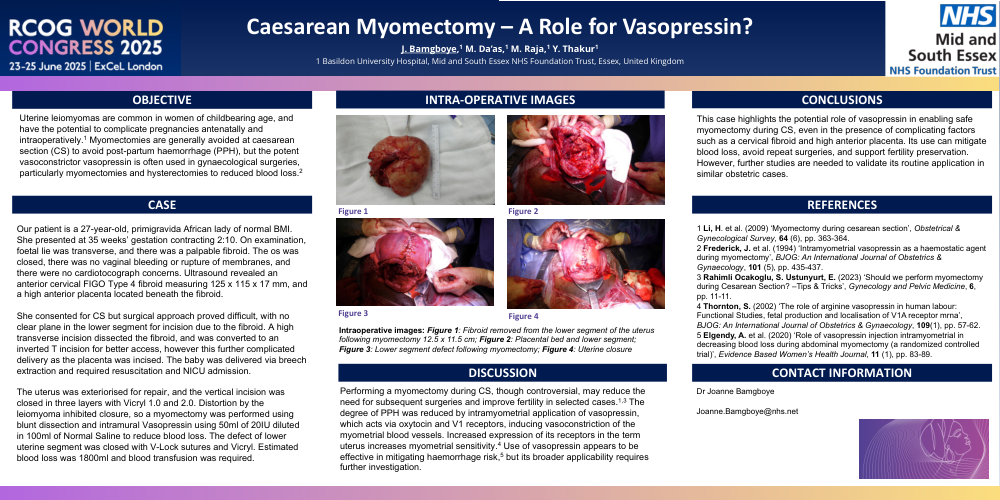
Our patient is a 27-year-old, primigravida African lady of normal BMI. She presented at 35 weeks’ gestation contracting 2:10. On examination, foetal lie was transverse, and there was a palpable fibroid. The os was closed, there was no vaginal bleeding or rupture of membranes, and there were no cardiotocograph concerns. Ultrasound revealed an anterior cervical FIGO Type 4 fibroid measuring 125 x 115 x 17 mm, and a high anterior placenta located beneath the fibroid.
She consented for CS but surgical approach proved difficult, with no clear plane in the lower segment for incision due to the fibroid. A high transverse incision dissected the fibroid, and was converted to an inverted T incision for better access, however this further complicated delivery as the placenta was incised. The baby was delivered via breech extraction and required resuscitation and NICU admission.
The uterus was exteriorised for repair, and the vertical incision was closed in three layers with Vicryl 1.0 and 2.0. Distortion by the leiomyoma inhibited closure, so a myomectomy was performed using blunt dissection and intramural Vasopressin using 50ml of 20IU diluted in 100ml of Normal Saline to reduce blood loss. The defect of lower uterine segment was closed with V-Lock sutures and Vicryl. Estimated blood loss was 1800ml and blood transfusion was required.
Discussion
Performing a myomectomy during CS, though controversial, may reduce the need for subsequent surgeries and improve fertility in selected cases. The degree of PPH was reduced by intramyometrial application of vasopressin, which acts via oxytocin and V1 receptors, inducing vasoconstriction of the myometrial blood vessels. Increased expression of its receptors in the term uterus increases myometrial sensitivity. Use of vasopressin appears to be effective in mitigating haemorrhage risk, but its broader applicability requires further investigation.
Conclusion
This case highlights the potential role of vasopressin in enabling safe myomectomy during CS, even in the presence of complicating factors such as a cervical fibroid and high anterior placenta. Its use can mitigate blood loss, avoid repeat surgeries, and support fertility preservation. However, further studies are needed to validate its routine application in similar obstetric cases.