2,281 posters, 63 videos, 56 audios, 43 topics, 18 sessions, 6,174 authors, 2,323 institutions
ePostersLive by SciGen Technologies S.A. All rights reserved.
RCOG World Congress 2025
June 23 - 25, 2025 | ExCeL London, UK
EP.1132
Caesarean Scar Niche: A High Risk Pregnancy
Poster Presenter
Authors
Joanne Bamgboye, Thekla Charitou, Ifeoluwa Ajayi, Mustafa Guma
Affiliations
Part of Topic
High risk pregnancy
Caesarean Scar Niche: A High Risk Pregnancy
Objective
The rise in Caesarean Section (CS) rate has led to increased incidence in complications, including caesarean scar niche (CSN), an indentation of the scar due to tethering of the endometrium. CSN is detected on ultrasound and increases the risk of uterine rupture and abnormal placentation.
Case Report
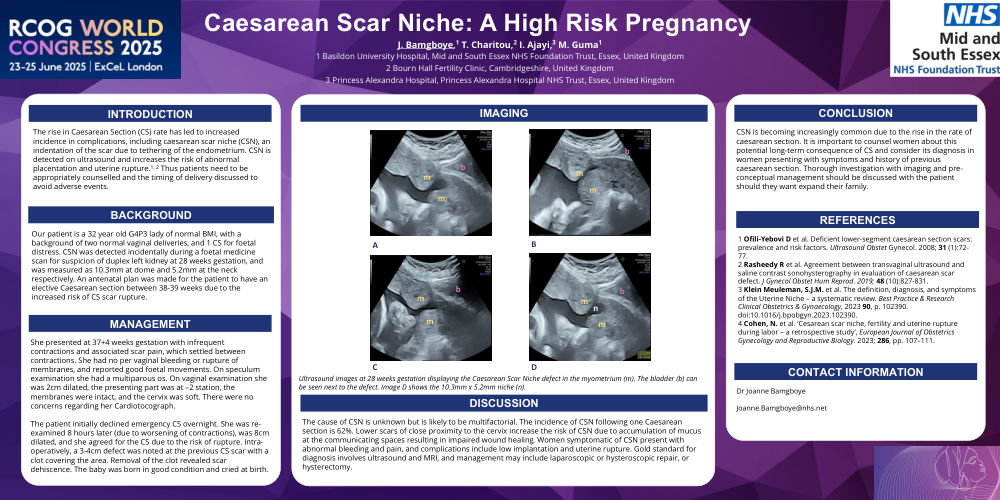
Our patient is a 32 year old G4P3 lady of normal BMI and background of two normal vaginal deliveries and 1 CS for foetal distress. CSN was detected during a foetal medicine scan for suspicion of duplex left kidney at 28 weeks and, was measured as 10.3mm at dome and 5.6mm at the neck. An antenatal plan was made for the patient to have an elective Caesarean section between 38-39 weeks due to the increased risk of CS scar rupture.
She presented at 37+4 weeks gestation with infrequent contraction and associated scar pain, which settled between contractions. She had no per vaginal bleeding or rupture of membranes and reported good foetal movements. On speculum examination she had a multips os. On vaginal examination she was 2cm dilated, the presenting part was at –2 station, the membranes were intact, and the cervix was soft. There were no concerns regarding her Cardiotocograph. The patient initially declined EmCS overnight. She was re-examined 8 hours later (due to worsening of contractions), she was 8cm dilated and she agreed for the CS due to the risk of rupture. Intra-operatively, a 3-4cm defect was noted at the previous CS scar with a clot covering the area. Removal of the clot revealed scar dehiscence. The baby born in good condition and cried at birth.
Discussion
The cause of CSN is unknown but is likely to be multifactorial. The incidence of CSN following one Caesarean section is 62%. Lower scars of close proximity to the cervix increase the risk of CSN due to accumulation of mucus at the communicating spaces resulting in impaired wound healing. Women symptomatic of CSN present with abnormal bleeding and pain, and complications include low implantation and uterine rupture. Gold standard for diagnosis involves ultrasound and MRI, and management may include laparoscopic or hysteroscopic repair, or hysterectomy.
Conclusion
CSN is becoming increasingly common due to the rise in the rate of caesarean section. It is important to counsel women about this potential long-term consequence of CS and consider its diagnosis in women presenting with symptoms and history of previous caesarean section.