2,281 posters, 63 videos, 56 audios, 43 topics, 18 sessions, 6,174 authors, 2,323 institutions
ePostersLive by SciGen Technologies S.A. All rights reserved.
RCOG World Congress 2025
June 23 - 25, 2025 | ExCeL London, UK
EP.1130
Challenges in Diagnosing and Managing Lateral Placenta Accreta: A Case Perspective
Poster Presenter
Authors
Affiliations
Part of Topic
High risk pregnancy
Title
Challenges in Diagnosing and Managing Lateral Placenta Accreta: A Case Perspective
Objective
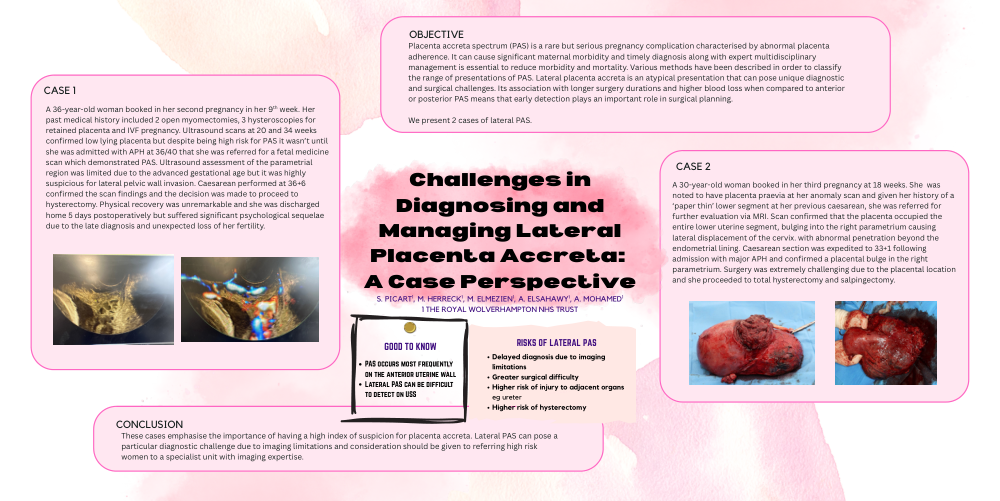
Placenta accreta spectrum (PAS) is a rare but serious pregnancy complication characterised by abnormal placenta adherence. It can cause significant maternal morbidity and timely diagnosis along with expert multidisciplinary management is essential to reduce morbidity and mortality. Various methods have been described in order to classify the range of presentations of PAS. Lateral placenta accreta is an atypical presentation that can pose unique diagnostic and surgical challenges. Its association with longer surgery durations and higher blood loss when compared to anterior or posterior PAS means that early detection plays an important role in surgical planning.
We present 2 cases of lateral PAS.
Case 1
A 36-year-old woman booked in her second pregnancy in her 9th week. Her past medical history included 2 open myomectomies, 3 hysteroscopies for retained placenta and IVF pregnancy. Ultrasound scans at 20 and 34 weeks confirmed low lying placenta but despite being high risk for PAS it wasn’t until she was admitted with APH at 36/40 that she was referred for a fetal medicine scan which demonstrated PAS. Ultrasound assessment of the parametrial region was limited due to the advanced gestational age but it was highly suspicious for lateral pelvic wall invasion. Caesarean performed at 36+6 confirmed the scan findings and the decision was made to proceed to hysterectomy. Physical recovery was unremarkable and she was discharged home 5 days postoperatively but suffered significant psychological sequelae due to the late diagnosis and unexpected loss of her fertility.
Case 2
A 30-year-old woman booked in her third pregnancy at 18 weeks. She was noted to have placenta praevia at her anomaly scan and given her history of a ‘paper thin’ lower segment at her previous caesarean, she was referred for further evaluation via MRI. Scan confirmed that the placenta occupied the entire lower uterine segment, bulging into the right parametrium causing lateral displacement of the cervix. with abnormal penetration beyond the endometrial lining. Caesarean section was expedited to 33+1 following admission with major APH and confirmed a placental bulge in the right parametrium. Surgery was extremely challenging due to the placental location and she proceeded to total hysterectomy and salpingectomy.
Conclusion
These cases emphasise the importance of having a high index of suspicion for placenta accreta. Lateral PAS can pose a particular diagnostic challenge due to imaging limitations and consideration should be given to referring high risk women to a specialist unit with imaging expertise.