2,281 posters, 63 videos, 56 audios, 43 topics, 18 sessions, 6,174 authors, 2,323 institutions
ePostersLive by SciGen Technologies S.A. All rights reserved.
RCOG World Congress 2025
June 23 - 25, 2025 | ExCeL London, UK
EP.1128
Redefining High-Risk Obstetric Care: Lessons from a Specialist Service Model
Poster Presenter
Authors
Affiliations
Part of Topic
High risk pregnancy
Video
Title
Redefining High-Risk Obstetric Care: Lessons from a Specialist Service Model
Objective
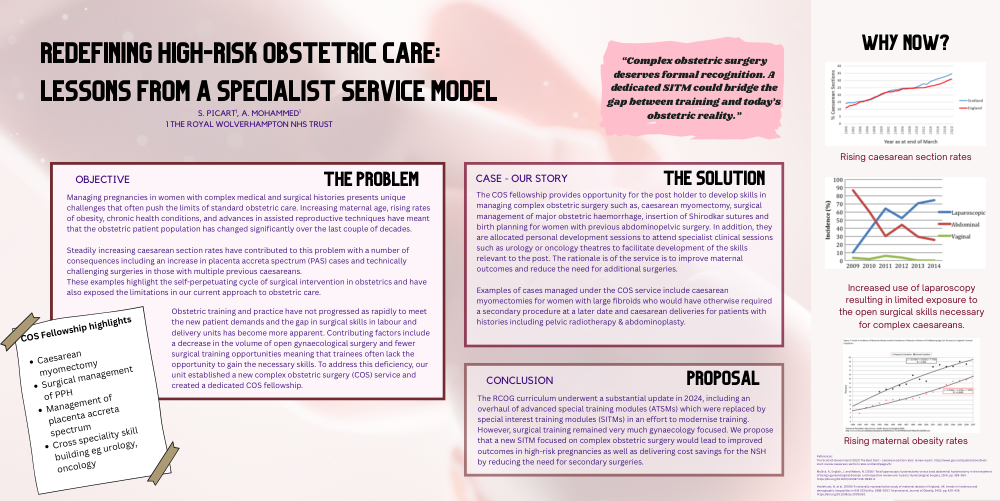
Managing pregnancies in women with complex medical and surgical histories presents unique challenges that often push the limits of standard obstetric care. Increasing maternal age, rising rates of obesity, chronic health conditions, and advances in assisted reproductive techniques have meant that the obstetric patient population has changed significantly over the last couple of decades.
Steadily increasing caesarean section rates have contributed to this problem with a number of consequences including an increase in placenta accreta spectrum (PAS) cases and technically challenging surgeries in those with multiple previous caesareans.
These examples highlight the self-perpetuating cycle of surgical intervention in obstetrics and have also exposed the limitations in our current approach to obstetric care.
Obstetric training and practice have not progressed as rapidly to meet the new patient demands and the gap in surgical skills in labour and delivery units has become more apparent. Contributing factors include a decrease in the volume of open gynaecological surgery and fewer surgical training opportunities meaning that trainees often lack the opportunity to gain the necessary skills. To address this deficiency, our unit established a new complex obstetric surgery (COS) service and created a dedicated COS fellowship.
Case
The COS fellowship provides opportunity for the post holder to develop skills in managing complex obstetric surgery such as, caesarean myomectomy, surgical management of major obstetric haemorrhage, insertion of Shirodkar sutures and birth planning for women with previous abdominopelvic surgery. In addition, they are allocated personal development sessions to attend specialist clinical sessions such as urology or oncology theatres to facilitate development of the skills relevant to the post. The rationale is of the service is to improve maternal outcomes and reduce the need for additional surgeries.
Examples of cases managed under the COS service include caesarean myomectomies for women with large fibroids who would have otherwise required a secondary procedure at a later date and caesarean deliveries for patients with histories including pelvic radiotherapy & abdominoplasty.
Conclusion
The RCOG curriculum underwent a substantial update in 2024, including an overhaul of advanced special training modules (ATSMs) which were replaced by special interest training modules (SITMs) in an effort to modernise training. However, surgical training remained very much gynaecology focused. We propose that a new SITM focused on complex obstetric surgery would lead to improved outcomes in high-risk pregnancies as well as delivering cost savings for the NSH by reducing the need for secondary surgeries.