2,281 posters, 63 videos, 56 audios, 43 topics, 18 sessions, 6,174 authors, 2,323 institutions
ePostersLive by SciGen Technologies S.A. All rights reserved.
RCOG World Congress 2025
June 23 - 25, 2025 | ExCeL London, UK
EP.1123
Ileal Gangrene Secondary to Closed Loop Obstruction in Pregnancy: A Case Report
Poster Presenter
Authors
Affiliations
Part of Topic
High risk pregnancy
Video
Ileal Gangrene Secondary to Closed Loop Obstruction in Pregnancy: A Case Report
Objective:
Around 2% of pregnant women undergo urgent surgical procedures each year for non-obstetric causes of abdominal pain. Ileal gangrene from adhesive closed loop obstruction in pregnancy is rare with unknown incidence. This case report highlights the significance of having a high index of suspicion for diagnosing and managing acute abdomen in pregnancy and the importance of performing urgent surgical intervention when necessary.
Case report:
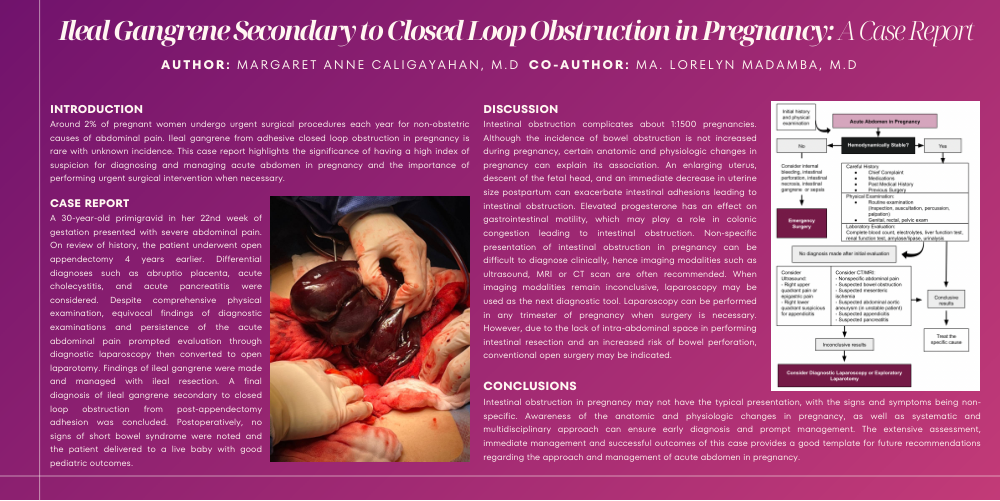
A 30-year-old primigravid in her 22nd week of gestation presented with severe abdominal pain. On review of history, this patient underwent open appendectomy 4 years earlier. Differential diagnoses such as abruptio placenta, acute cholecystitis, and acute pancreatitis were considered. Despite comprehensive physical examination, equivocal findings of diagnostic examinations and persistence of the acute abdominal pain prompted evaluation through diagnostic laparoscopy then converted to open laparotomy. Findings of ileal gangrene were made and managed with ileal resection. A final diagnosis of ileal gangrene secondary to closed loop obstruction from post-appendectomy adhesion was concluded. Postoperatively, no signs of short bowel syndrome were noted and the patient delivered to a live baby with good pediatric outcomes.
Discussion:
Intestinal obstruction complicates about 1:1500 pregnancies. Although the incidence of bowel obstruction is not increased during pregnancy, certain anatomic and physiologic changes in pregnancy can explain its association. An enlarging uterus, descent of the fetal head, and an immediate decrease in uterine size postpartum can exacerbate intestinal adhesions leading to intestinal obstruction. Elevated progesterone has an effect on gastrointestinal motility, which may play a role in colonic congestion leading to intestinal obstruction. Non-specific presentation of intestinal obstruction in pregnancy can be difficult to diagnose clinically, hence imaging modalities such as ultrasound, MRI or CT scan are often recommended. When imaging modalities remain inconclusive, laparoscopy may be used as the next diagnostic tool. Laparoscopy can be performed in any trimester of pregnancy when surgery is necessary. However, due to the lack of intra-abdominal space in performing intestinal resection and the increased risk of bowel perforation, conventional open surgery may be indicated.
Conclusions:
Intestinal obstruction in pregnancy may not have the typical presentation, with the signs and symptoms being non-specific. Awareness of the anatomic and physiologic changes in pregnancy, as well as systematic and multidisciplinary approach can ensure early diagnosis and prompt management. The extensive assessment, immediate management and successful outcomes of this case provides a good template for future recommendations regarding the approach and management of acute abdomen in pregnancy.