2,281 posters, 63 videos, 56 audios, 43 topics, 18 sessions, 6,174 authors, 2,323 institutions
ePostersLive by SciGen Technologies S.A. All rights reserved.
RCOG World Congress 2025
June 23 - 25, 2025 | ExCeL London, UK
EP.1114
Unmasking the Challenge: Managing White Coat Syndrome (WCS) in Obstetrics
Poster Presenter
Authors
Affiliations
Part of Topic
High risk pregnancy
Unmasking the Challenge: Managing White Coat Syndrome in Obstetrics
Laxmi Saha, Hirsi-Farah Suad
Department of Obstetrics and Gynaecology
Objective:
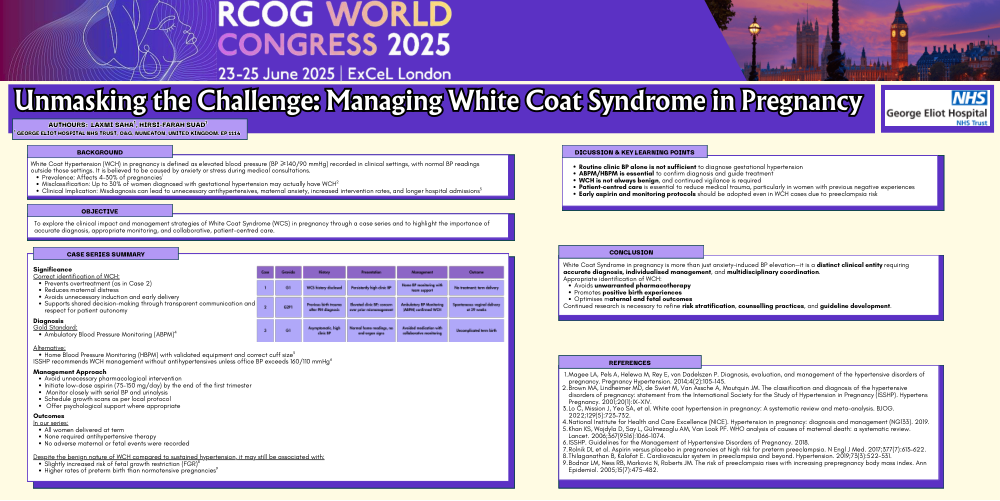
To explore the challenges of diagnosing and managing white coat syndrome (WCS) in pregnancy, emphasising its implications for monitoring, unnecessary interventions, and delivery outcomes.
Case Reports:
Three cases illustrate the impact of WCS on clinical decision-making and outcomes:
- Case 1: A primigravida presented with suspected essential hypertension at booking due to persistently elevated clinic blood pressure (BP). Despite labile readings, the patient disclosed a history of WCS and requested home BP monitoring. Over multiple weeks, all calibrated home BP readings were normal. Collaborative monitoring with the obstetric team avoided unnecessary treatment and interventions.
- Case 2: A multiparous woman (P1) with a prior history of fetal distress at 38 weeks following induction of labour (IOL) for pregnancy-induced hypertension (PIH) presented with borderline BP at booking. Despite using an appropriately sized cuff, clinic BP readings remained high. One week of home monitoring revealed normotensive readings. The patient, convinced her prior diagnosis had been influenced by WCS, proceeded with home monitoring and achieved a spontaneous vaginal delivery (SVD) at 39 weeks without requiring antihypertensive therapy or further intervention.
- Case 3: A primigravida presented with persistently elevated BP readings at antenatal visits. The patient was asymptomatic, and no end-organ damage was evident. Portable BP monitoring and home readings were normal. Close collaboration with the patient and ongoing home monitoring allowed safe avoidance of antihypertensives and intervention.
Discussion:
Definition
In pregnancy, hypertension is typically defined as a systolic blood pressure (SBP) of ≥140 mmHg and/or a diastolic blood pressure (DBP) of ≥90 mmHg, based on readings taken on at least two occasions that are at least 4 hours apart.
Classification of Hypertensive Disorders in Pregnancy.
- Preeclampsia: Hypertension (≥140/90 mmHg) with evidence of end-organ damage, such as proteinuria, liver dysfunction, thrombocytopenia, renal impairment, or neurological symptoms.
- Gestational Hypertension: New-onset hypertension after 20 weeks of gestation without signs of preeclampsia.
- Chronic Hypertension: Preexisting hypertension diagnosed before pregnancy or before 20 weeks of gestation.
- Superimposed Preeclampsia: Occurs in chronic hypertension patients who later develop additional features of preeclampsia.
- White Coat Hypertension: Elevated BP in clinical settings but normal reading at home or via ambulatory monitoring
- Masked Hypertension: Normal BP in clinical settings but elevated at home or through ambulatory monitoring.
Prevalence
White coat hypertension (WCH) affects around 1in 4 individuals in the general population, but its prevalence in pregnancy is highly variable, reported between 4 to 30 % in different studies.
Diagnosis:
The diagnosis of WCH is established through a structured assessment incorporating both office blood pressure measurements and ambulatory blood pressure monitoring(ABPM).
ABPM: It is a gold. standard for confirmation of WCH, providing BP recordings over 24 hours. Diagnostic criteria for WCH are normal BP values on ABPM despite previously recorde elevated clinic readings.
Home Blood Pressure Monitoring (HBPM): Serial BP measurements conducted outside clinicla settings aiding in diagnosis where ABPM is unavailable. Patient education on correct BP measurement technique and a reliable BP instrument is important.
Management Strategies: Once WCH is diagnosed, the management approach typically focuses on monitoring and preventive measures rather than immediate medication. The International Society for the Study of Hypertension in Pregnancy (ISSHP) recommends that pregnant women with confirmed WCH can often be managed without antihypertensive drugs unless office BP rises to ≥160/110 mmHg. In our case series, no women needed antihypertensives, consistent with a milder BP profile. However, preventive interventions are still important. Notably, women with WCH are often started on low-dose aspirin (e.g., 75–150 mg daily) by the end of the first trimester as prophylaxis against preeclampsia. This is the same recommendation as for chronic hypertension in pregnancy, reflecting that WCH confers an elevated preeclampsia risk and thus merits prophylactic therapy. Lifestyle advice, such as stress reduction, moderate exercise, and dietary improvements, may also be given, though specific research on lifestyle impact in WCH is limited.
Outcome
Women diagnosed with WCH during pregnancy exhibit a higher risk of developing preeclampsia (PET), delivering small for gestatinal age (SGA), and experiencing preterm birth, compared with normotensive pregnant individuals. These findings suggest that WCH, while transient, may signal an underlying susceptibility to hypertensive complications.
Conversely, when compared with individuals diagnosed with GH, women with WCH demonstrate a lower incidence of PET, SGA newborns, preterm delivery and admission to neonatal unit.
Conclusion: White coat hypertension in pregnancy is a real condition with measurable impacts on pregnancy. Pregnant women with WCH benefit from Aspirin, growth scans, and regular blood pressure and urine monitoring.
Recognizing WCH allows for optimized care, ensuring maternal-fetal safety through monitoring and timely interventions while avoiding unnecessary overtreatment. Continued research and improved guidelines will enhance WCH management, promoting the best outcomes for both mothers and babies.