2,281 posters, 63 videos, 56 audios, 43 topics, 18 sessions, 6,174 authors, 2,323 institutions
ePostersLive by SciGen Technologies S.A. All rights reserved.
RCOG World Congress 2025
June 23 - 25, 2025 | ExCeL London, UK
EP.1113
PERIRENAL ABSCESS IN PREGNANCY; A CASE REPORT
Poster Presenter
Authors
Affiliations
Part of Topic
High risk pregnancy
PERIRENAL ABSCESS IN PREGNANCY; A CASE REPORT
N. Ambreen, Z. Woodward, S. Bugren
Queen Elizabeth The Queen Mother Hospital, Margate, Kent, United Kingdom
•Objective:
Perirenal abscess is a rare condition. When it occurs, it is usually secondary to the complications of acute pyelonephritis and can lead to severe consequences including fetal or maternal complications. .
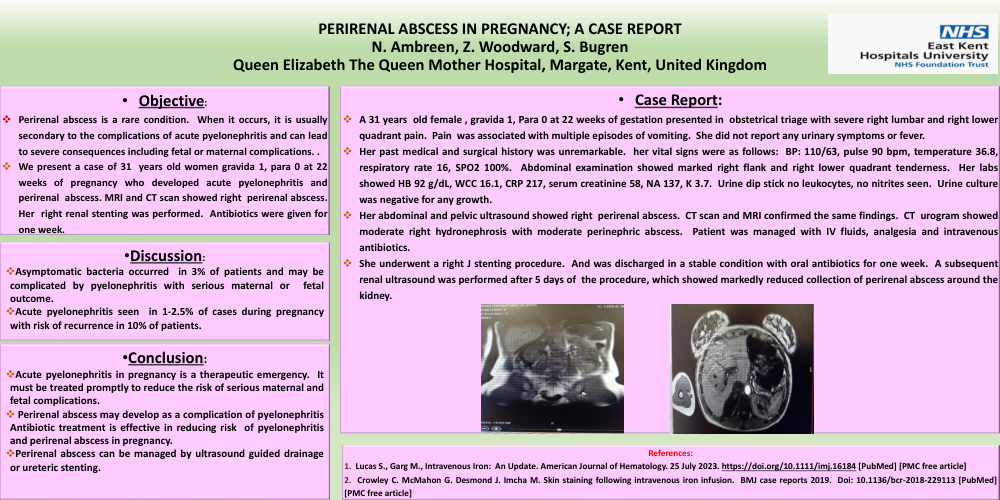
We present a case of 31 years old women gravida 1, para 0 at 22 weeks of pregnancy who developed acute pyelonephritis and perirenal abscess. MRI and CT scan showed right perirenal abscess. Her right renal stenting was performed. Antibiotics were given for one week.
Discussion:
Asymptomatic bacteria occurred in 3% of patients and may be complicated by pyelonephritis with serious maternal or fetal outcome.
Acute pyelonephritis seen in 1-2.5% of cases during pregnancy with risk of recurrence in 10% of patients.
•Case Report:
A 31 years old female , gravida 1, Para 0 at 22 weeks of gestation presented in obstetrical triage with severe right lumbar and right lower quadrant pain. Pain was associated with multiple episodes of vomiting. She did not report any urinary symptoms or fever.
Her past medical and surgical history was unremarkable. her vital signs were as follows: BP: 110/63, pulse 90 bpm, temperature 36.8, respiratory rate 16, SPO2 100%. Abdominal examination showed marked right flank and right lower quadrant tenderness. Her labs showed HB 92 g/dL, WCC 16.1, CRP 217, serum creatinine 58, NA 137, K 3.7. Urine dip stick no leukocytes, no nitrites seen. Urine culture was negative for any growth.
Her abdominal and pelvic ultrasound showed right perirenal abscess. CT scan and MRI confirmed the same findings. CT urogram showed moderate right hydronephrosis with moderate perinephric abscess. Patient was managed with IV fluids, analgesia and intravenous antibiotics.
She underwent a right J stenting procedure. And was discharged in a stable condition with oral antibiotics for one week. A subsequent renal ultrasound was performed after 5 days of the procedure, which showed markedly reduced collection of perirenal abscess around the kidney.
Conclusion:
Acute pyelonephritis in pregnancy is a therapeutic emergency. It must be treated promptly to reduce the risk of serious maternal and fetal complications.
Perirenal abscess may develop as a complication of pyelonephritis Antibiotic treatment is effective in reducing risk of pyelonephritis and perirenal abscess in pregnancy.
Perirenal abscess can be managed by ultrasound guided drainage or ureteric stenting.