2,281 posters, 63 videos, 56 audios, 43 topics, 18 sessions, 6,174 authors, 2,323 institutions
ePostersLive by SciGen Technologies S.A. All rights reserved.
RCOG World Congress 2025
June 23 - 25, 2025 | ExCeL London, UK
EP.1112
Pregnancy outcome with history of Mitrofanoff Repair – A rare case report
Poster Presenter
Authors
Affiliations
Part of Topic
High risk pregnancy
Pregnancy outcome with history of Mitrofanoff Repair – A rare case report
Objective:
Augmentation cystoplasty is a surgical procedure that uses segments of bowel or stomach to provide increased bladder capacity in persons who lack adequate bladder function or detrusor compliance.
To optimally manage such pregnancies one must have knowledge of pregnancy associated complications, such as recurrent urinary tract infection, the possibility of adhesions from previous surgery and damage to the augmented segment/channel in case of cesarean section
Case Report:
We present the case of a 27 year old who was first booked in our hospital as Primigravida at 13 weeks gestation. She had history of augmentation cystoplasty with Mitrofanoff channel due to neurogenic bladder at the age of 17 years and was performing clean intermittent self catheterization every 4 hours.
Patient had regular antenatal care which was significant for recurrent urinary tract infections, isolating E coli on the cultures and treated as per local hospital antibiotics protocol.
After multidisciplinary discussion involving senior obstetrician and urology, decision made that preferred mode of delivery would be a normal vaginal delivery unless there was an obstetric indication for cesarean section.
At 38 weeks gestation, she presented with premature rupture of membranes and symptoms of severe pre eclampsia. Induction of labour was started with prostaglandins; however she was taken for emergency cesarean section in view of failed induction of labour and severe pre eclampsia.
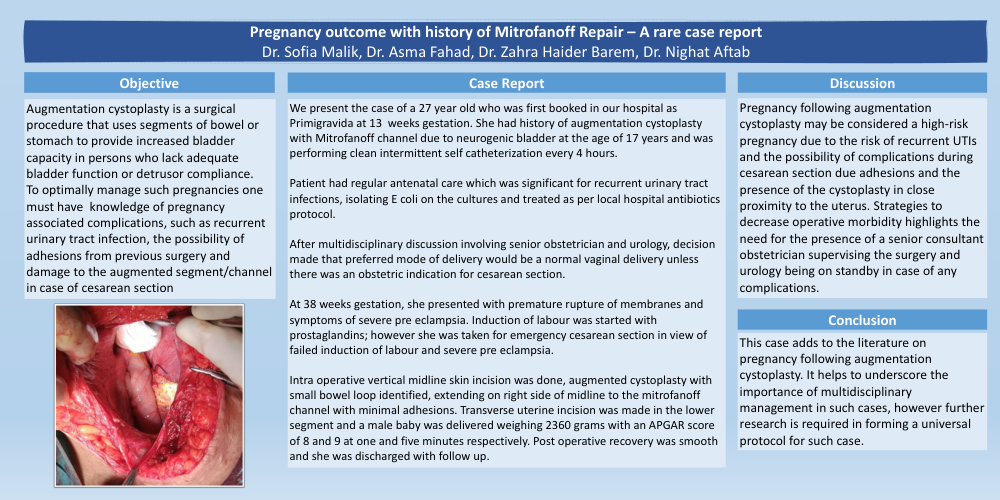
Intra operative vertical midline skin incision was done, augmented cystoplasty with small bowel loop identified, extending on right side of midline to the mitrofanoff channel with minimal adhesions. Transverse uterine incision was made in the lower segment and a male baby was delivered weighing 2360 grams with an APGAR score of 8 and 9 at one and five minutes respectively. Post operative recovery was smooth and she was discharged with follow up.
Discussion:
Pregnancy following augmentation cystoplasty may be considered a high-risk pregnancy due to the risk of recurrent UTIs and the possibility of complications during cesarean section due adhesions and the presence of the cystoplasty in close proximity to the uterus. Strategies to decrease operative morbidity highlights the need for the presence of a senior consultant obstetrician supervising the surgery and urology being on standby in case of any complications.
Conclusion:
This case adds to the literature on pregnancy following augmentation cystoplasty. It helps to underscore the importance of multidisciplinary management in such cases, however further research is required in forming a universal protocol for such case.