2,281 posters, 63 videos, 56 audios, 43 topics, 18 sessions, 6,174 authors, 2,323 institutions
ePostersLive by SciGen Technologies S.A. All rights reserved.
RCOG World Congress 2025
June 23 - 25, 2025 | ExCeL London, UK
EP.1111
A Rare Case of Twinning: Non-Janiceps Cephalopagus Conjoined Twins
Part of Topic
High risk pregnancy
A RARE CASE OF TWINNING: NON-JANICEPS CEPHALOPAGUS CONJOINED TWINS
INTRODUCTION
Conjoined twins affect less than 1% of monozygotic twin pairs.1
Non-janiceps type of cephalopagus twin is the rarest type of conjoined twins.2
CASE REPORT
33-year-old, multigravid, with conjoined twins
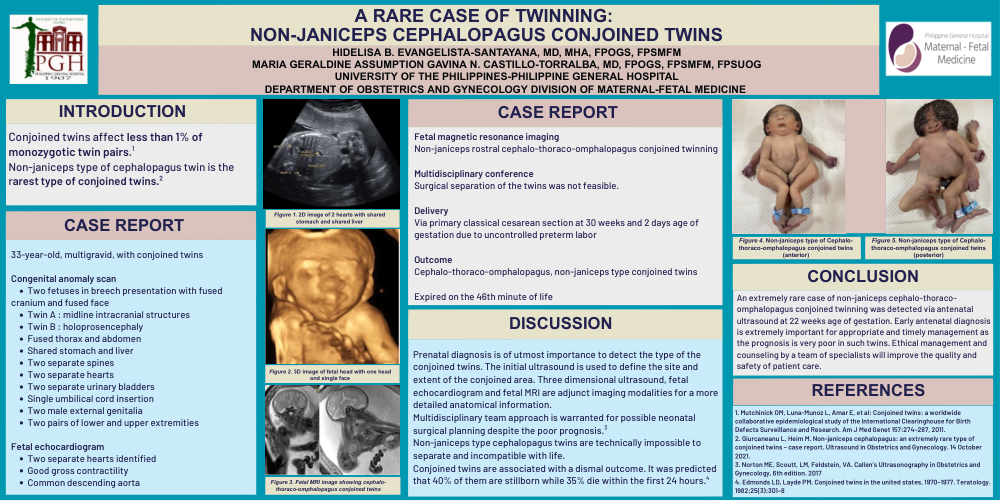
Congenital anomaly scan
- Two fetuses in breech presentation with fused
cranium and fused face
- Twin A : midline intracranial structures
- Twin B : holoprosencephaly
- Fused thorax and abdomen
- Shared stomach and liver
- Two separate spines
- Two separate hearts
- Two separate urinary bladders
- Single umbilical cord insertion
- Two male external genitalia
- Two pairs of lower and upper extremities
Fetal echocardiogram
- Two separate hearts identified
- Good gross contractility
- Common descending aorta
Fetal magnetic resonance imaging
Non-janiceps rostral cephalo-thoraco-omphalopagus conjoined twinning
Multidisciplinary conference
Surgical separation of the twins was not feasible.
Delivery
Via primary classical cesarean section at 30 weeks and 2 days age of gestation due to uncontrolled preterm labor
Outcome
Cephalo-thoraco-omphalopagus, non-janiceps type conjoined twins
Expired on the 46th minute of life
DISCUSSION
Prenatal diagnosis is of utmost importance to detect the type of the conjoined twins. The initial ultrasound is used to define the site and extent of the conjoined area. Three dimensional ultrasound, fetal echocardiogram and fetal MRI are adjunct imaging modalities for a more detailed anatomical information.
Multidisciplinary team approach is warranted for possible neonatal surgical planning despite the poor prognosis.3
Non-janiceps type cephalopagus twins are technically impossible to separate and incompatible with life.
Conjoined twins are associated with a dismal outcome. It was predicted that 40% of them are stillborn while 35% die within the first 24 hours.4
CONCLUSION
An extremely rare case of non-janiceps cephalo-thoraco-omphalopagus conjoined twinning was detected via antenatal ultrasound at 22 weeks age of gestation. Early antenatal diagnosis is extremely important for appropriate and timely management as the prognosis is very poor in such twins. Ethical management and counseling by a team of specialists will improve the quality and safety of patient care.
REFERENCES
1. Mutchinick OM, Luna-Munoz L, Amar E, et al: Conjoined twins: a worldwide collaborative epidemiological study of the International Clearinghouse for Birth Defects Surveillance and Research. Am J Med Genet 157:274–287, 2011.
2. Giurcaneanu L, Heim M. Non-janiceps cephalopagus: an extremely rare type of conjoined twins – case report. Ultrasound in Obstetrics and Gynecology. 14 October 2021.
3. Norton ME, Scoutt, LM, Feldstein, VA. Callen’s Ultrasonography in Obstetrics and Gynecology, 6th edition. 2017
4. Edmonds LD, Layde PM. Conjoined twins in the united states, 1970–1977. Teratology. 1982;25(3):301–8