2,281 posters, 63 videos, 56 audios, 43 topics, 18 sessions, 6,174 authors, 2,323 institutions
ePostersLive by SciGen Technologies S.A. All rights reserved.
RCOG World Congress 2025
June 23 - 25, 2025 | ExCeL London, UK
EP.1107
Battling the Odds: Tackling Obesity and Scarred Uterus in Emergency Caesarean Section
Poster Presenter
Authors
Affiliations
Part of Topic
High risk pregnancy
Title: Battling the Odds: Tackling Obesity and Scarred Uterus in Emergency Caesarean Section
Laxmi Saha; Hirsi Farah Suad;Eddyeffiom. J
Obstetrics and Gynaecology Department, George Eliot Hospital
Objective: To highlight the surgical and anaesthetic challenges encountered in the emergency delivery of a morbidly obese patient with a scarred uterus and to discuss strategies that optimize outcomes.
Case Report
A 35-year-old gravida 3, para 2 woman with a BMI of 60 and a history of gestational diabetes mellitus (GDM), fetal growth restriction (FGR), and a prior emergency caesarean section complicated by anaesthetic difficulties and wound infection was admitted at 37+3 weeks gestation for induction of labour (IOL) due to FGR and GDM. Initial cervical ripening with Dilapan® was unsuccessful, necessitating progression to a category 3 emergency caesarean section. Anaesthetic challenges included difficult airway management due to morbid obesity, reduced efficacy of the spinal block, and an increased risk of perioperative cardiorespiratory events. Despite these complexities, a well-coordinated multidisciplinary approach facilitated a successful surgical outcome, with delivery of a neonate in good condition.
Discussion
Introduction
Morbid obesity and previous caesarean sections compound both surgical and anaesthetic risks. This presentation examines the multifaceted challenges in airway management, regional anaesthetic efficacy, and surgical exposure that clinicians face during emergency delivery. The case reinforces the need for meticulous planning and a multidisciplinary, patient-centred approach.
Surgical Considerations:
Exposure & Operative Time: Increased adiposity jeopardizes surgical exposure and extends operative duration.
Wound Complications: Scarred tissues and obesity elevate the risk of infection and poor wound healing.
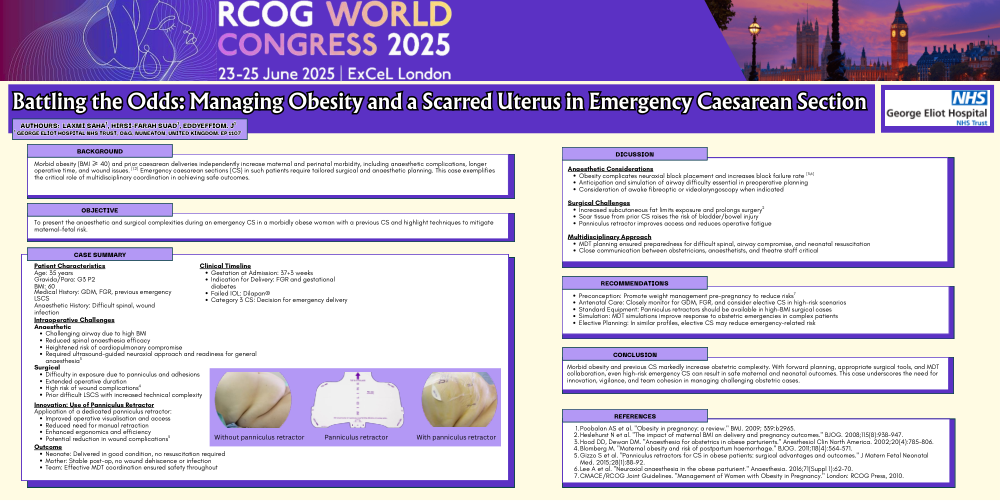
Use of Retractor: The Traxi Panniculus Retractor can enhance surgical site exposure during caesarean sections in women with a high BMI, reducing the need for manual retraction and optimizing visualization. Its use may improve operative efficiency, provider ergonomics, and patient comfort, potentially lowering complication risks.
Discussion
Anaesthetic Considerations:
Regional Techniques: Difficulties in positioning and reduced block efficacy require the use of advanced imaging (e.g., ultrasound-guided techniques) to optimize regional anaesthesia.
Airway Management: A high BMI and previous anaesthetic complications necessitate preparedness for rapid sequence induction and possible airway rescue techniques.
Multidisciplinary Approach:
Preoperative Planning: Detailed preoperative assessment, including risk stratification and simulation of anaesthetic contingencies, is essential.
Intraoperative Strategies: Tailored anaesthetic protocols and enhanced monitoring are critical, particularly in high-risk populations.
Collaborative Care: Coordination among obstetricians, anaesthetists, and neonatologists is vital to manage unexpected challenges effectively.
Preventative Measures for Future Cases:
Preconception Weight Management: Counselling and intervention prior to conception can reduce operative and perioperative risks.
Antenatal Surveillance: Close monitoring for complications such as FGR and GDM can promote timely and safer delivery decisions.
Elective Caesarean Section: Considering elective CS in similar high-risk cases may prevent emergencies and allow for better preparation.
Conclusion
This case underscores the immense challenges of managing a morbidly obese patient with a scarred uterus during an emergency caesarean section. The key lessons include:
The indispensability of a multidisciplinary team for planning and execution.
The importance of tailored anaesthetic techniques and the utilization of advanced imaging to maximize block success. A need for thorough preoperative planning and risk mitigation strategies to optimize maternal and neonatal outcomes.
This presentation highlights that meticulous planning, an adaptive anaesthetic approach, and close collaboration across specialties are cornerstones for successful management in such complex clinical scenarios.
Key Recommendations
For Clinicians:
Adopt preoperative planning protocols with contingency plans for airway and regional anaesthetic challenges.
Implement ultrasound-guidance where appropriate.
For Future Practice:
Emphasize preconception and antenatal interventions to manage modifiable risk factors.
Consider elective CS for high-risk patients.