2,281 posters, 63 videos, 56 audios, 43 topics, 18 sessions, 6,174 authors, 2,323 institutions
ePostersLive by SciGen Technologies S.A. All rights reserved.
RCOG World Congress 2025
June 23 - 25, 2025 | ExCeL London, UK
EP.1101
Successful continuation of Intrauterine pregnancy following Salpingectomy for ectopic pregnancy
Poster Presenter
Authors
Affiliations
Part of Topic
High risk pregnancy
Successful Continuation of Intrauterine Pregnancy Following Salpingectomy for Heterotopic Pregnancy - A Case Report
Priyanka N - Senior RegisTrar, Department Of Obstetrics And Gynaecology, Apollo Speciality Hospital, Chennai, India
BACKGROUND:
Heterotopic pregnancy (HP) - simultaneous intra-uterine and extra-uterine gestations remains rare in spontaneous conceptions but its incidence rises sharply with ovulation-induction or assisted-reproduction techniques (ART). Recent studies report rates ≥1 : 100 among ART cycles.(1)
CASE REPORT:
26-year-old primigravida, conceived on her sixth cycle of letrozole induction without additional medications.
At 9 weeks gestation, presented to ER with abdominal pain, shortness of breath and chest tightness lasting 6 hours
O/E - Her vitals were stable, chest clear, abdomen – RIF tenderness with guarding
PROGRESS:
Patient had worsening of abdominal pain and BP dropped to 92/66mmHg (previously 108/76).
Haemoglobin dropped to 80mg/dL (previously 112mg/dL)
Reviewed her previous medical records – had an ultrasound at 7 weeks and 3 days – Single, live intra uterine pregnancy(IUP), with foetal cardiac activity present. Considered urgent repeat USS.
OTHER INVESTIGATIONS:
Serum Beta HCG - 180000mIU/mL
Haematocrit - 25%
LFTs - normal
U/Es - normal
CRP - 5mg/L
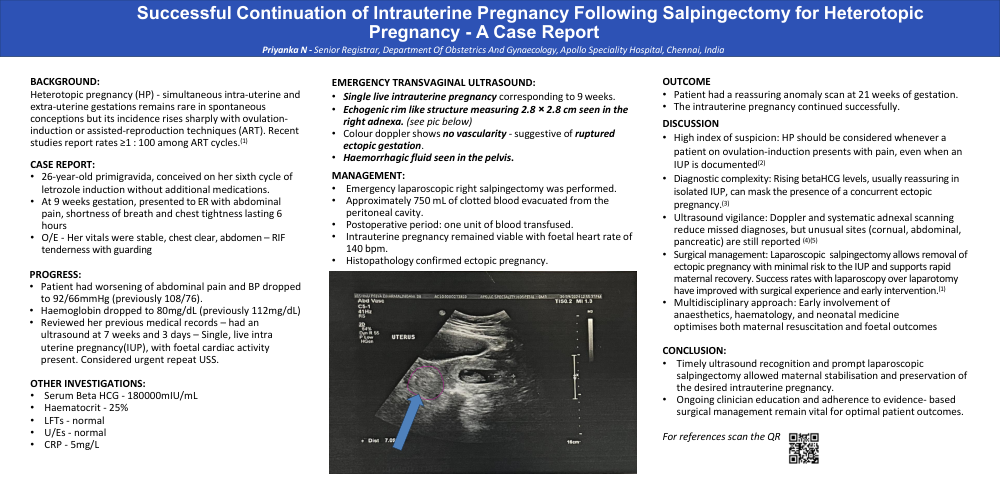
EMERGENCY TRANSVAGINAL ULTRASOUND:
Single live intrauterine pregnancy corresponding to 9 weeks.
Echogenic rim like structure measuring 2.8 × 2.8 cm seen in the right adnexa. (see pic below)
Colour doppler shows no vascularity - suggestive of ruptured ectopic gestation.
Haemorrhagic fluid seen in the pelvis.
MANAGEMENT:
Emergency laparoscopic right salpingectomy was performed.
Approximately 750 mL of clotted blood evacuated from the peritoneal cavity.
Postoperative period: one unit of blood transfused.
Intrauterine pregnancy remained viable with foetal heart rate of 140 bpm.
Histopathology confirmed ectopic pregnancy.
OUTCOME
Patient had a reassuring anomaly scan at 21 weeks of gestation.
The intrauterine pregnancy continued successfully.
DISCUSSION
High index of suspicion: HP should be considered whenever a patient on ovulation-induction presents with pain, even when an IUP is documented(2)
Diagnostic complexity: Rising betaHCG levels, usually reassuring in isolated IUP, can mask the presence of a concurrent ectopic pregnancy.(3)
Ultrasound vigilance: Doppler and systematic adnexal scanning reduce missed diagnoses, but unusual sites (cornual, abdominal, pancreatic) are still reported (4)(5)
Surgical management: Laparoscopic salpingectomy allows removal of ectopic pregnancy with minimal risk to the IUP and supports rapid maternal recovery. Success rates with laparoscopy over laparotomy have improved with surgical experience and early intervention.(1)
Multidisciplinary approach: Early involvement of anaesthetics, haematology, and neonatal medicine optimises both maternal resuscitation and foetal outcomes
CONCLUSION:
Timely ultrasound recognition and prompt laparoscopic salpingectomy allowed maternal stabilisation and preservation of the desired intrauterine pregnancy.
Ongoing clinician education and adherence to evidence- based surgical management remain vital for optimal patient outcomes.
For references scan the QR