2,281 posters, 63 videos, 56 audios, 43 topics, 18 sessions, 6,174 authors, 2,323 institutions
ePostersLive by SciGen Technologies S.A. All rights reserved.
RCOG World Congress 2025
June 23 - 25, 2025 | ExCeL London, UK
EP.1099
Concealed Pregnancy Near Term Complicated by Sepsis, PPH, AKI, and ICU Admission
Poster Presenter
Authors
Fatimah Al-Rufaye, Srabani Mukherjee, Shaimaa Badr, Charu Jain
Affiliations
Part of Topic
High risk pregnancy
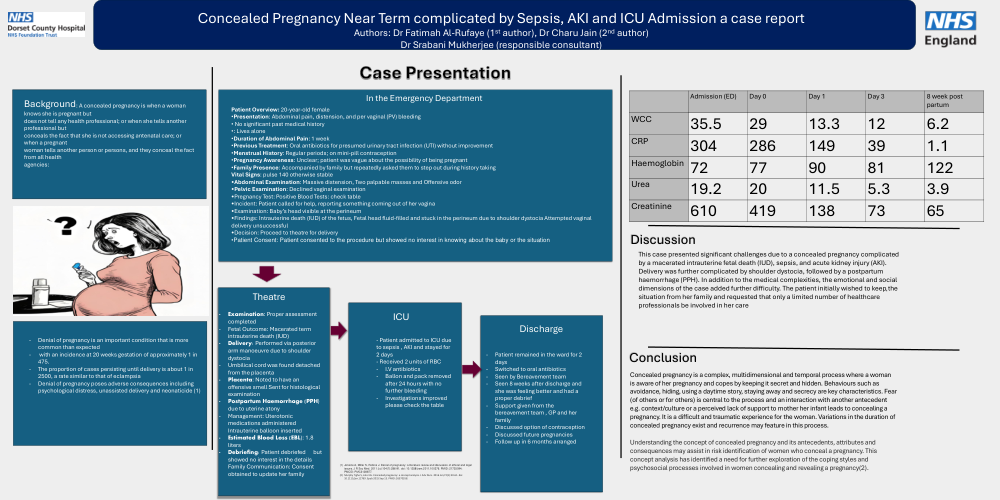
Background: A concealed pregnancy is when a woman knows she is pregnant but does not tell any health professional; or when she tells another professional but conceals the fact that she is not accessing antenatal care; or when a pregnant woman tells another person or persons, and they conceal the fact from all health agencies
-- -- Denial of pregnancy is an important condition that is more common than expected with an incidence at 20 weeks gestation of approximately 1 in 475. The proportion of cases persisting until delivery is about 1 in 2500, a rate similar to that of eclampsia Denial of pregnancy poses adverse consequences including psychological distress, unassisted delivery and neonaticide
Patient Overview: 20-year-old female
Vital Signs: pulse 140 otherwise stable
- Patient admitted to ICU due to sepsis , AKI and stayed for 2 days
- Received 2 units of RBC
This case presented significant challenges due to a concealed pregnancy complicated by a macerated intrauterine fetal death (IUD), sepsis, and acute kidney injury (AKI). Delivery was further complicated by shoulder dystocia, followed by a postpartum haemorrhage (PPH). In addition to the medical complexities, the emotional and social dimensions of the case added further difficulty. The patient initially wished to keep the situation from her family and requested that only a limited number of healthcare professionals be involved in her care
Concealed pregnancy is a complex, multidimensional and temporal process where a woman is aware of her pregnancy and copes by keeping it secret and hidden. Behaviours such as avoidance, hiding, using a daytime story, staying away and secrecy are key characteristics. Fear (of others or for others) is central to the process and an interaction with another antecedent e.g. context/culture or a perceived lack of support to mother her infant leads to concealing a pregnancy. It is a difficult and traumatic experience for the woman. Variations in the duration of concealed pregnancy exist and recurrence may feature in this process.
Understanding the concept of concealed pregnancy and its antecedents, attributes and consequences may assist in risk identification of women who conceal a pregnancy. This concept analysis has identified a need for further exploration of the coping styles and psychosocial processes involved in women concealing and revealing a pregnancy(2).