2,281 posters, 63 videos, 56 audios, 43 topics, 18 sessions, 6,174 authors, 2,323 institutions
ePostersLive by SciGen Technologies S.A. All rights reserved.
RCOG World Congress 2025
June 23 - 25, 2025 | ExCeL London, UK
EP.1097
EMERGENCY CERVICAL CERCLAGE IN A TWIN PREGNANCY WITH FIBROIDS; A CASE REPORT.
Poster Presenter
Authors
Affiliations
Part of Topic
High risk pregnancy
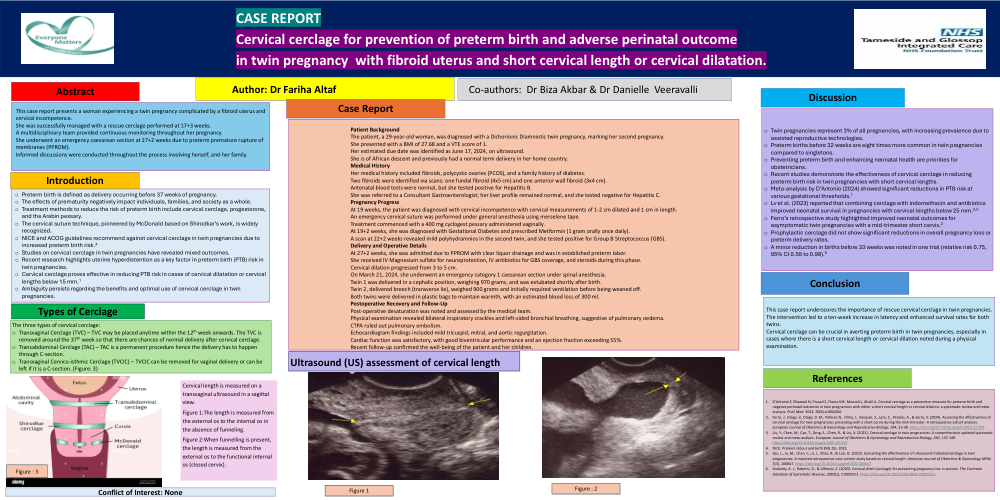
CASE REPORT
Cervical cerclage for prevention of preterm birth and adverse perinatal outcome in twin pregnancy with fibroid uterus and short cervical length or cervical dilatation.
Abstract
This case report presents a woman experiencing a twin pregnancy complicated by a fibroid uterus and cervical incompetence.
She was successfully managed with a rescue cerclage performed at 17+3 weeks.
A multidisciplinary team provided continuous monitoring throughout her pregnancy.
She underwent an emergency cesarean section at 27+2 weeks due to preterm premature rupture of membranes (PPROM).
Informed discussions were conducted throughout the process involving her and her family.
Introduction
Preterm birth is defined as delivery occurring before 37 weeks of pregnancy.
The effects of prematurity negatively impact individuals, families, and society as a whole.
Treatment methods to reduce the risk of preterm birth include cervical cerclage, progesterone, and the Arabin pessary.
The cervical suture technique, pioneered by McDonald based on Shirodkar’s work, is widely recognized.
NICE and ACOG guidelines recommend against cervical cerclage in twin pregnancies due to increased preterm birth risk.
Studies on cervical cerclage in twin pregnancies have revealed mixed outcomes.
Recent research highlights uterine hyperdistention as a key factor in preterm birth (PTB) risk in twin pregnancies.
Cervical cerclage proves effective in reducing PTB risk in cases of cervical dilatation or cervical lengths below 15 mm.
Ambiguity persists regarding the benefits and optimal use of cervical cerclage in twin pregnancies.
Case Report
Patient Background
The patient, a 29-year-old woman, was diagnosed with a dichorionic diamniotic twin pregnancy, marking her second pregnancy.
She presented with a BMI of 27.68 and a VTE score of 1.
Her estimated due date was identified as June 17, 2024, via ultrasound.
She is of African descent and previously had a normal term delivery in her home country.
Medical History
Her medical history included fibroids, polycystic ovaries (PCOS), and a family history of diabetes.
Two fibroids were identified via scans: one fundal fibroid (4x5 cm) and one anterior wall fibroid (3x4 cm).
Antenatal blood tests were normal, but she tested positive for Hepatitis B.
She was referred to a Consultant Gastroenterologist; her liver profile remained normal, and she tested negative for Hepatitis C.
Pregnancy Progress
At 19 weeks, the patient was diagnosed with cervical incompetence with cervical measurements of 1-2 cm dilated and 1 cm in length.
An emergency cervical suture was performed under general anesthesia using Merselene tape.
Treatment commenced with a 400 mg Cyclogest pessary administered vaginally.
At 19+2 weeks, she was diagnosed with gestational diabetes and prescribed metformin (1 gram orally once daily).
A scan at 22+2 weeks revealed mild polyhydramnios in the second twin, and she tested positive for Group B Streptococcus (GBS).
Delivery and Operative Details
At 27+2 weeks, she was admitted due to PPROM with clear liquor drainage and was in established preterm labor.
She received IV magnesium sulfate for neuroprotection, IV antibiotics for GBS coverage, and steroids during this phase.
Cervical dilation progressed from 3 to 5 cm.
On March 21, 2024, she underwent an emergency category 1 cesarean section under spinal anesthesia.
Twin 1 was delivered in a cephalic position, weighing 970 grams, and was extubated shortly after birth.
Twin 2, delivered breech (transverse lie), weighed 900 grams and initially required ventilation before being weaned off.
Both twins were delivered in plastic bags to maintain warmth, with an estimated blood loss of 300 ml.
Postoperative Recovery and Follow-Up
Post-operative desaturation was noted and assessed by the medical team.
Physical examination revealed bilateral inspiratory crackles and left-sided bronchial breathing, suggestive of pulmonary edema.
CTPA ruled out pulmonary embolism.
Echocardiogram findings included mild tricuspid, mitral, and aortic regurgitation.
Cardiac function was satisfactory, with good biventricular performance and an ejection fraction exceeding 55%.
Recent follow-up confirmed the well-being of the patient and her children.
Types of cervical cerclage:
Transvaginal Cerclage (TVC)—TVC may be placed anytime from the 12th week onwards. The TVC is removed around the 37th week so that there are chances of normal delivery after cervical cerclage.
Transabdominal Cerclage (TAC)—TAC is a permanent procedure; hence, the delivery has to happen through C-section.
Transvaginal Cervico-isthmic Cerclage (TVCIC)—TVCIC can be removed for vaginal delivery or can be left if it is a C-section.
Ultrasound (US) assessment of cervical length
Cervical length is measured on a transvaginal ultrasound in a sagittal view.
Figure 1: The length is measured from the external os to the internal os in the absence of funneling.
Figure 2: When funnelling is present, the length is measured from the external os to the functional internal OS (closed cervix)
Discussion
Twin pregnancies represent 3% of all pregnancies, with increasing prevalence due to assisted reproductive technologies.
Preterm births before 32 weeks are eight times more common in twin pregnancies compared to singletons.
Preventing preterm birth and enhancing neonatal health are priorities for obstetricians.
Recent studies demonstrate the effectiveness of cervical cerclage in reducing preterm birth risk in twin pregnancies with short cervical lengths.
Meta-analysis by D’Antonio (2024) showed significant reductions in PTB risk at various gestational thresholds.
Lv et al. (2023) reported that combining cerclage with indomethacin and antibiotics improved neonatal survival in pregnancies with cervical lengths below 25 mm.
Ferro’s retrospective study highlighted improved neonatal outcomes for asymptomatic twin pregnancies with a mid-trimester short cervix.
Prophylactic cerclage did not show significant reductions in overall pregnancy loss or preterm delivery rates.
A minor reduction in births before 33 weeks was noted in one trial (relative risk 0.75, 95% CI 0.58 to 0.98).
Despite ongoing debates, rescue cervical cerclage remains a pivotal intervention for high-risk twin pregnancies, offering increased pregnancy latency and improved survival rates.
Conclusion
This case report underscores the importance of rescue cervical cerclage in twin pregnancies.
The intervention led to a ten-week increase in latency and enhanced survival rates for both twins.
Cervical cerclage can be crucial in averting preterm birth in twin pregnancies, especially in cases where there is a short cervical length or cervical dilation noted during a physical examination.
References:
1. Antonio F, Eltaweel N, Prasad S, Flacco ME, Manzoli L, Khalil A. Cervical cerclage as a preventive measure for preterm birth and negative perinatal outcomes in twin pregnancies with either a short cervical length or cervical dilation: a systematic review and meta-analysis. PLoS Med. 2023; 20(8):e1004266.
2. Ferro, J., Diago, V., Diago, D. M., Pellicer, N., Olmo, I., Vázquez, S., Lara, C., Perales, A., & Serra, V. (2024). Assessing the effectiveness of cervical cerclage for twin pregnancies presenting with a short cervix during the mid-trimester: A retrospective cohort analysis. European Journal of Obstetrics & Gynecology and Reproductive Biology, 294, 33-38. https://doi.org/10.1016/j.ejogrb.2023.12.029
3. Liu, Y., Chen, M., Cao, T., Zeng, S., Chen, R., & Liu, X. (2021). Cervical cerclage in twin pregnancies: A comprehensive updated systematic review and meta-analysis. European Journal of Obstetrics & Gynecology and Reproductive Biology, 260, 137-149. https://doi.org/10.1016/j.ejogrb.2021.03.013
4. NICE. Preterm labor and birth (NG 25). 2022.
5. Qiu, L., Lv, M., Chen, C., Li, J., Zhao, B., & Luo, Q. (2023). Evaluating the effectiveness of ultrasound-indicated cerclage in twin pregnancies: A matched retrospective case-control study based on cervical length. American Journal of Obstetrics & Gynecology MFM, 5(3), 100847. https://doi.org/10.1016/j.ajogmf.2022.100847
6. Drakeley, A. J., Roberts, D., & Alfirevic, Z. (2003). Cervical stitch (cerclage) for preventing pregnancy loss in women. The Cochrane Database of Systematic Reviews, 2003(1), CD003253. https://doi.org/10.1002/14651858.CD003253.