2,281 posters, 63 videos, 56 audios, 43 topics, 18 sessions, 6,174 authors, 2,323 institutions
ePostersLive by SciGen Technologies S.A. All rights reserved.
RCOG World Congress 2025
June 23 - 25, 2025 | ExCeL London, UK
EP.1086
Successful Pregnancy Outcome in Alagille Syndrome
Poster Presenter
Authors
Affiliations
Part of Topic
High risk pregnancy
Successful Pregnancy Outcome in Alagille Syndrome
- Alagille syndrome(ALGS) is a rare autosomal dominant/de novo condition due to mutation in JAG1 or NOTCH2.
- It a multi-system disorder associated with hepatic and renal dysfunction, cholestasis, vertebral anomalies, hypertension, abnormal facial features, cardiac malformations and ocular conditions.
- There is an increased association with miscarriage, pre-eclampsia, obstetric cholestasis and intrauterine fetal growth restrictions.
- There are few documented successful pregnancy outcomes in women with Alagille syndrome
22 years old female-known ALGS manifesting with mild left pulmonary artery stenosis, posterior embryotoxon, low lying cerebellar tonsils, nasal polyposis and some renal & liver involvement.
Referred for consultant led care early-referred to local maternal medicine network. Plan for cardio(advised ECHO-no further concerns) & neuro MDT, with monthly LFTs, FGR pathway & thromboprophylaxis.
First trimester screening was low risk (QUAD test). Anomaly scan normal and uncomplicated first trimester. Regular follow ups with midwife.
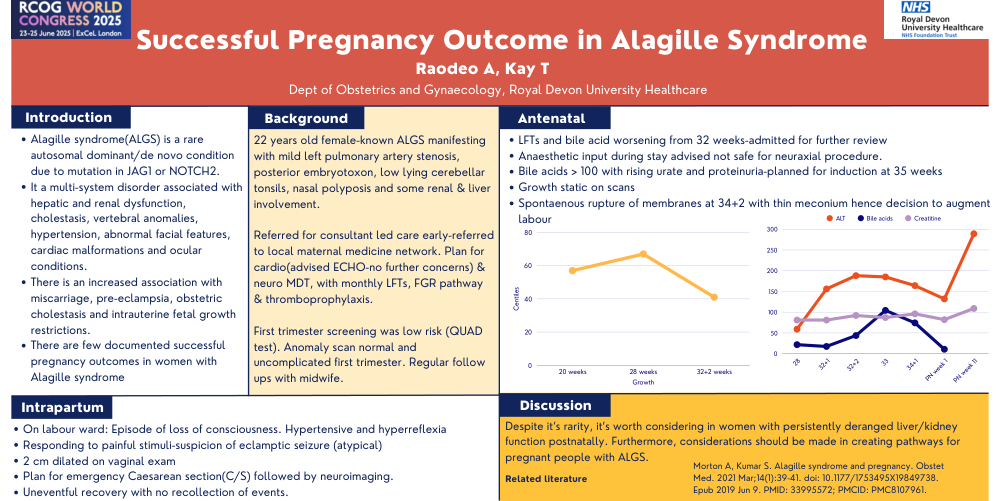
- LFTs and bile acid worsening from 32 weeks-admitted for further review
- Anaesthetic input during stay advised not safe for neuraxial procedure.
- Bile acids > 100 with rising urate and proteinuria-planned for induction at 35 weeks
- Growth static on scans
- Spontaenous rupture of membranes at 34+2 with thin meconium hence decision to augment labour
- On labour ward: Episode of loss of consciousness. Hypertensive and hyperreflexia
- Responding to painful stimuli-suspicion of eclamptic seizure (atypical)
- 2 cm dilated on vaginal exam
- Plan for emergency Caesarean section(C/S) followed by neuroimaging.
- Uneventful recovery with no recollection of events.
Despite it’s rarity, it’s worth considering in women withpersistently deranged liver/kidney function postnatally. Furthermore, considerations should be made in creating pathways for pregnant people with ALGS.