2,281 posters, 63 videos, 56 audios, 43 topics, 18 sessions, 6,174 authors, 2,323 institutions
ePostersLive by SciGen Technologies S.A. All rights reserved.
RCOG World Congress 2025
June 23 - 25, 2025 | ExCeL London, UK
EP.1076
Peripartum Cardiomyopathy - A clinical case and review
Poster Presenter
Authors
Affiliations
Part of Topic
High risk pregnancy
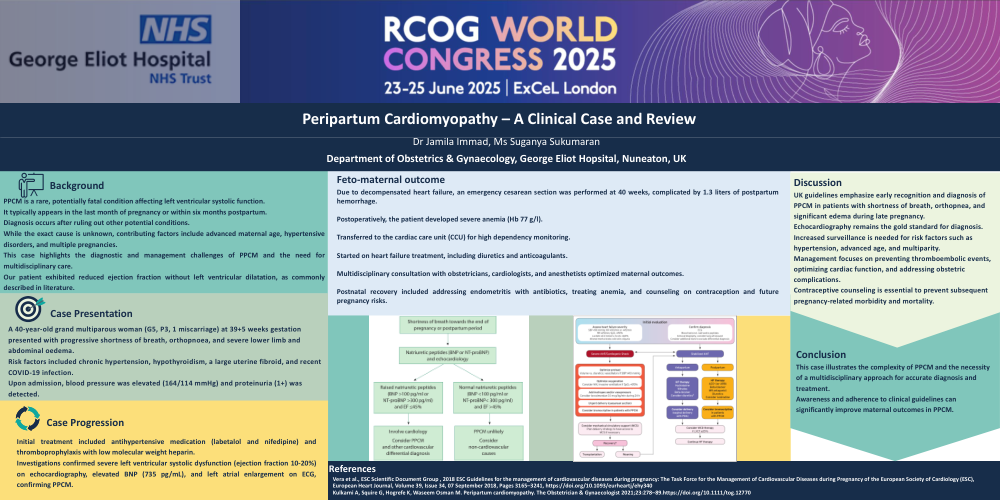
Peripartum Cardiomyopathy – A Clinical Case and Review
Authors: Ms Suganya Sukumaran, Dr Jamila Immad
Background
- PPCM is a rare, potentially fatal condition affecting left ventricular systolic function.
- It typically appears in the last month of pregnancy or within six months postpartum.
- Diagnosis occurs after ruling out other potential conditions.
- While the exact cause is unknown, contributing factors include advanced maternal age, hypertensive disorders, and multiple pregnancies.
- This case highlights the diagnostic and management challenges of PPCM and the need for multidisciplinary care.
- Our patient exhibited reduced ejection fraction without left ventricular dilatation, as commonly described in literature.
Case Presentation
- A 40-year-old grand multiparous woman (G5, P3, 1 miscarriage) at 39+5 weeks gestation presented with progressive shortness of breath, orthopnea, and severe lower limb and abdominal oedema.
- Risk factors included chronic hypertension, hypothyroidism, a large uterine fibroid, and recent COVID-19 infection.
- Upon admission, blood pressure was elevated (164/114 mmHg) and proteinuria (1+) was detected.
Case Progression
- Initial treatment included antihypertensive medication (labetalol and nifedipine) and thromboprophylaxis with low molecular weight heparin.
- Investigations confirmed severe left ventricular systolic dysfunction (ejection fraction 10-20%) on echocardiography, elevated BNP (735 pg/mL), and left atrial enlargement on ECG, confirming PPCM.
- Due to decompensated heart failure, an emergency cesarean section was performed at 40 weeks, complicated by 1.3 liters of postpartum hemorrhage.
- Postoperatively, the patient developed severe anemia (Hb 77 g/l).
Feto-maternal Outcome
- Transferred to the cardiac care unit (CCU) for high dependency monitoring.
- Started on heart failure treatment, including diuretics and anticoagulants.
- Multidisciplinary consultation with obstetricians, cardiologists, and anesthetists optimized maternal outcomes.
- Postnatal recovery included addressing endometritis with antibiotics, treating anemia, and counseling on contraception and future pregnancy risks.
Discussion
- UK guidelines emphasize early recognition and diagnosis of PPCM in patients with shortness of breath, orthopnea, and significant edema during late pregnancy.
- Echocardiography remains the gold standard for diagnosis.
- Increased surveillance is needed for risk factors such as hypertension, advanced age, and multiparity.
- Management focuses on preventing thromboembolic events, optimizing cardiac function, and addressing obstetric complications.
- Contraceptive counseling is essential to prevent subsequent pregnancy-related morbidity and mortality.
Conclusion
- This case illustrates the complexity of PPCM and the necessity of a multidisciplinary approach for accurate diagnosis and treatment.
- Awareness and adherence to clinical guidelines can significantly improve maternal outcomes in PPCM.
References
-
Vera et al., ESC Scientific Document Group , 2018 ESC Guidelines for the management of cardiovascular diseases during pregnancy: The Task Force for the Management of Cardiovascular Diseases during Pregnancy of the European Society of Cardiology (ESC), European Heart Journal, Volume 39, Issue 34, 07 September 2018, Pages 3165–3241, https://doi.org/10.1093/eurheartj/ehy340
- Kulkarni A, Squire G, Hogrefe K, Waseem Osman M. Peripartum cardiomyopathy. The Obstetrician & Gynaecologist 2021;23:278–89.https://doi.org/10.1111/tog.12770