2,281 posters, 63 videos, 56 audios, 43 topics, 18 sessions, 6,174 authors, 2,323 institutions
ePostersLive by SciGen Technologies S.A. All rights reserved.
RCOG World Congress 2025
June 23 - 25, 2025 | ExCeL London, UK
EP.0107
UNVEILING THE BLUE CERVIX: A Rare Finding with Multidisciplinary Insights.
Poster Presenter
Authors
Affiliations
Part of Topic
Colposcopy & cervical pathology
UNVEILING THE BLUE CERVIX: A Rare Finding with Multidisciplinary Insights
Authors:
1. Mary Guirguis – MBChB (Hons.),MRCOG. Obstetrics and Gynaecology Registrar
2. Ms Lavanya Buddha – MBChB,MRCOG. Obstetrics and Gynaecology Consultant
Objective:
We present a case of incidental discovery of a Blue Cervix, in a patient who attended two-week rule clinic for Postmenopausal Ovarian cyst.
Case Report:
A 61 years of age presented to the two-week rule clinic with an USS showing a 6cm left ovarian cyst with normal CA125.
She does not report any Red Flag symptoms. Her smear history is normal and up to date. She has had one caesarean section. she has family history of breast cancer; she is a non-smoker. She has been on HRT and Mepacrine for lupus.
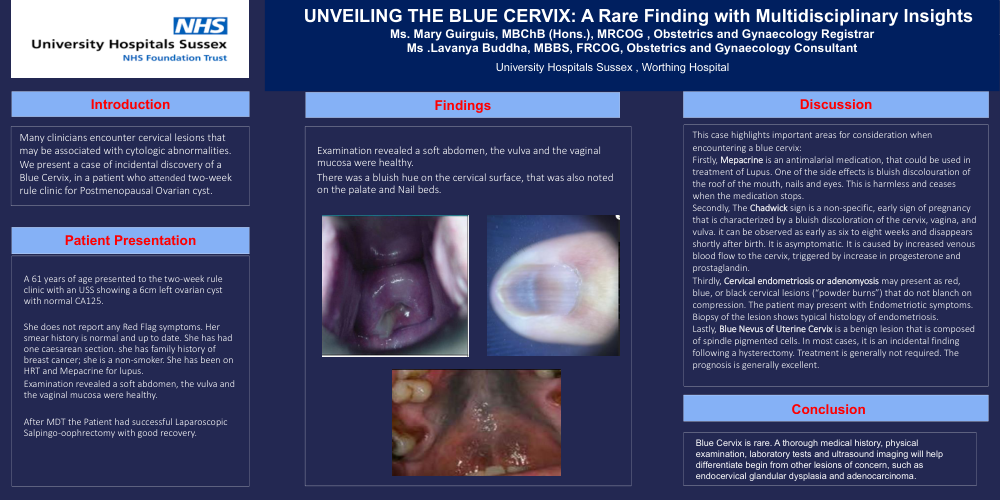
Examination revealed a soft abdomen, the vulvaand the vaginal mucosa were healthy. There was a bluish hue on the cervical surface, that was also noted on the palate and Nail beds.
After MDT the Patient had successful Laparoscopic Salpingo-oophrectomy with good recovery.
Discussion:
Many clinicians encounter cervical lesions that may be associated with cytologic abnormalities. This case highlights important areas for consideration when encountering a blue cervix.
Firstly, Mepacrine is an antimalarial medication, that could be used in treatment of Lupus. One of the side effects is bluish discolouration of the roof of the mouth, nails and eyes. This is harmless and ceases when the medication stops.
Secondly, The Chadwick sign is a non-specific, early sign of pregnancy that is characterized by a bluish discoloration of the cervix, vagina, and vulva. it canbe observed as early as six to eight weeks and disappears shortly after birth. It is asymptomatic. It is caused by increased venous blood flow to the cervix, triggeredby increasein progesterone and prostaglandin.
Thirdly,Cervical endometriosis or adenomyosismay present as red, blue, or black cervical lesions (“powder burns”) that do not blanch on compression. The patient may present with Endometrioticsymptoms. Biopsy of the lesion shows typical histology of endometriosis.
Lastly, Blue Nevus of Uterine Cervix is a benign lesion that is composed of spindle pigmented cells. In most cases, it is an incidental finding following a hysterectomy. Treatment is generally notrequired. The prognosis is generally excellent.
Conclusion:
Blue Cervix is rare. A thorough medical history, physical examination, laboratory tests and ultrasound imagingwill help differentiate begin from other lesions of concern, such as endocervical glandular dysplasia and adenocarcinoma.