2,281 posters, 63 videos, 56 audios, 43 topics, 18 sessions, 6,174 authors, 2,323 institutions
ePostersLive by SciGen Technologies S.A. All rights reserved.
RCOG World Congress 2025
June 23 - 25, 2025 | ExCeL London, UK
EP.1074
Management of Postpartum Hemorrhage with Uterine Artery Embolization
Poster Presenter
Authors
Affiliations
Part of Topic
High risk pregnancy
Video
Audio
Title: Management of postpartum Hemorrhage with uterine artery embolisation.
Introduction:
Primary PPH is defined as blood loss of more than 500 mL in the first 24 hours following birth.
Secondary PPH is defined as blood loss of more than 500 mL after the first day and up to six
weeks after birth.Obstetric hemorrhage is one of the major causes of maternal mortality. Initial
conservative treatment methods for postpartum hemorrhage (PPH) include administration of
uterotonic agents, uterine massage, and vaginal packing. Recently, intrauterine balloon
tamponade has been attempted. However, when the conservative treatments fail, surgery or
transcatheter arterial embolization (TAE) should be considered as they have been accepted as
one of the most effective treatments for intractable PPH, with high success rates.The most
commonly used material in UAE for PPH is gelatin sponge particles, and these help in
spontaneous resolution within three to six weeks preventing negative impact on fertility owing to
permanent devascularization of the uterus.
Case report Case1 :
Case of 39 year old G2 P1 L1 37 weeks previous Caesarean with Central placenta previa with
severe preeclampsia. In this case postpartum haemorrhage was anticipated.Preoperative
Balloon stenting of bilateral uterine arteries were done. Immediately after delivery of baby,
during Caesarean balloon catheters were inflated. Blood loss was minimal due to occlusion of
both uterine arteries.Haemostasis was double checked after placenta delivery and slowly
catheter balloon was deflated and checked again for haemostasis. Meanwhile, routine
prophylactic drugs were given to control the atonic uterus. Uterus was conserved . Catheters
were removed in the immediate post-operative period.
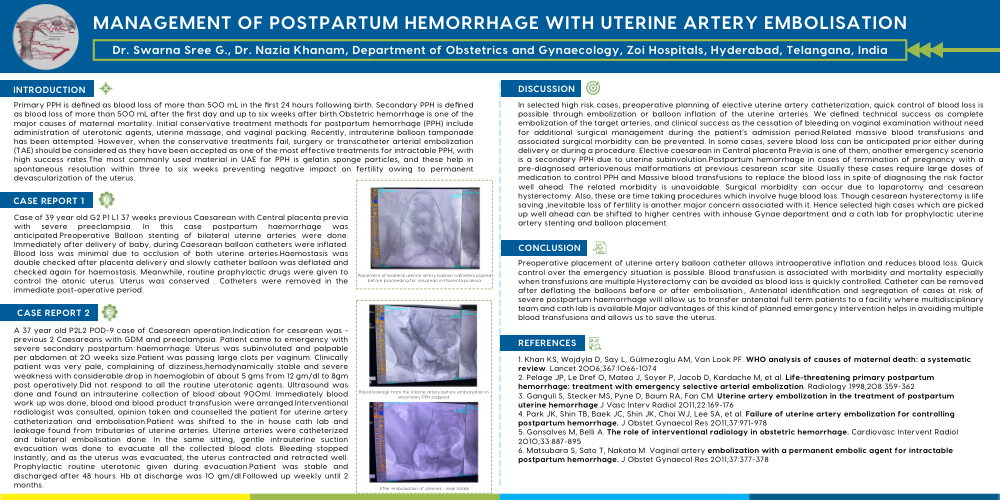
Placement of bilateral uterine artery balloon catheters placed before proceeding for cesarean in Placenta praeviaBlood leakage from the Uterine artery before embolisation in secondary PPHAfter embolisation of uterines - leak totally
stopped.
Case report 2:
A 37 year old P2L2 POD-9 case of Caesarean operation.Indication for cesarean was - previous
2 Caesareans with GDM and preeclampsia. Patient came to emergency with severe secondary
postpartum haemorrhage. Uterus was subinvoluted and palpable per abdomen at 20 weeks
size.Patient was passing large clots per vaginum. Clinically patient was very pale, complaining
of dizziness,hemodynamically stable and severe weakness with considerable drop in
haemoglobin of about 5 gms from 12 gm/dl to 8gm post operatively.Did not respond to all the
routine uterotonic agents. Ultrasound was done and found an intrauterine collection of blood
about 900ml. Immediately blood work up was done, blood and blood product transfusion were
arranged.Interventional radiologist was consulted, opinion taken and counselled the patient for
uterine artery catheterization and embolisation.Patient was shifted to the in house cath lab and
leakage found from tributaries of uterine arteries. Uterine arteries were catheterized and
bilateral embolisation done. In the same sitting, gentle intrauterine suction evacuation was done
to evacuate all the collected blood clots. Bleeding stopped instantly, and as the uterus was
evacuated, the uterus contracted and retracted well. Prophylactic routine uterotonic given
during evacuation.Patient was stable and discharged after 48 hours. Hb at discharge was 10
gm/dl.Followed up weekly until 2 months.Discussion:
In selected high risk cases, preoperative planning of elective uterine artery catheterization, quick
control of blood loss is possible through embolization or balloon inflation of the uterine arteries.
We defined technical success as complete embolization of the target arteries, and clinical
success as the cessation of bleeding on vaginal examination without need for additional surgical
management during the patient’s admission period.Related massive blood transfusions and
associated surgical morbidity can be prevented. In some cases, severe blood loss can be
anticipated prior either during delivery or during a procedure. Elective caesarean in Central
placenta Previa is one of them; another emergency scenario is a secondary PPH due to uterine
subinvolution.Postpartum hemorrhage in cases of termination of pregnancy with a
pre-diagnosed arteriovenous malformations at previous cesarean scar site. Usually these
cases require large doses of medication to control PPH and Massive blood transfusions to
replace the blood loss in spite of diagnosing the risk factor well ahead. The related morbidity is
unavoidable. Surgical morbidity can occur due to laparotomy and cesarean hysterectomy. Also,
these are time taking procedures which involve huge blood loss. Though cesarean
hysterectomy is life saving ,inevitable loss of fertility is another major concern associated with
it.Hence selected high cases which are picked up well ahead can be shifted to higher centres
with inhouse Gynae department and a cath lab for prophylactic uterine artery stenting and
balloon placement.
Conclusion:
Preoperative placement of uterine artery balloon catheter allows intraoperative inflation and
reduces blood loss.Quick control over the emergency situation is possible. Blood transfusion is
associated with morbidity and mortality especially when transfusions are multiple.Hysterectomy
can be avoided as blood loss is quickly controlled. Catheter can be removed after deflating the
balloons before or after embolisation., Antenatal identification and segregation of cases at risk
of severe postpartum haemorrhage will allow us to transfer antenatal full term patients to a
facility where multidisciplinary team and cath lab is available.Major advantages of this kind of
planned emergency intervention helps in avoiding multiple blood transfusions and allows us to
save the uterus.
1. Khan KS, Wojdyla D, Say L, Gülmezoglu AM, Van Look PF. WHO analysis of causes of
maternal death: a systematic review. Lancet 2006;367:1066-1074
2. Pelage JP, Le Dref O, Mateo J, Soyer P, Jacob D, Kardache M, et al. Life-threatening primary
postpartum hemorrhage: treatment with emergency selective arterial embolization. Radiology
1998;208:359-362
3. Ganguli S, Stecker MS, Pyne D, Baum RA, Fan CM. Uterine artery embolization in the
treatment of postpartum uterine hemorrhage.J Vasc Interv Radiol 2011;22:169-176
4. Park JK, Shin TB, Baek JC, Shin JK, Choi WJ, Lee SA, et al. Failure of uterine artery
embolization for controlling postpartum hemorrhage. J Obstet Gynaecol Res 2011;37:971-978
5. Gonsalves M, Belli A. The role of interventional radiology in obstetric hemorrhage.
Cardiovasc Intervent Radiol 2010;33:887-895
6. Matsubara S, Sato T, Nakata M. Vaginal artery embolization with a permanent embolic agent
for intractable postpartum hemorrhage. J Obstet Gynaecol Res 2011;37:377-378