2,281 posters, 63 videos, 56 audios, 43 topics, 18 sessions, 6,174 authors, 2,323 institutions
ePostersLive by SciGen Technologies S.A. All rights reserved.
RCOG World Congress 2025
June 23 - 25, 2025 | ExCeL London, UK
EP.1066
A Case Report of a Third Trimester Pemphigoid Gestationis
Poster Presenter
Authors
Affiliations
Part of Topic
High risk pregnancy
A Case Report of a Third Trimester Pemphigoid Gestationis
Kristine Quibar, M.D.
Aileen Ona-Suguitan, M.D.
Rizal Medical Center- Philippines
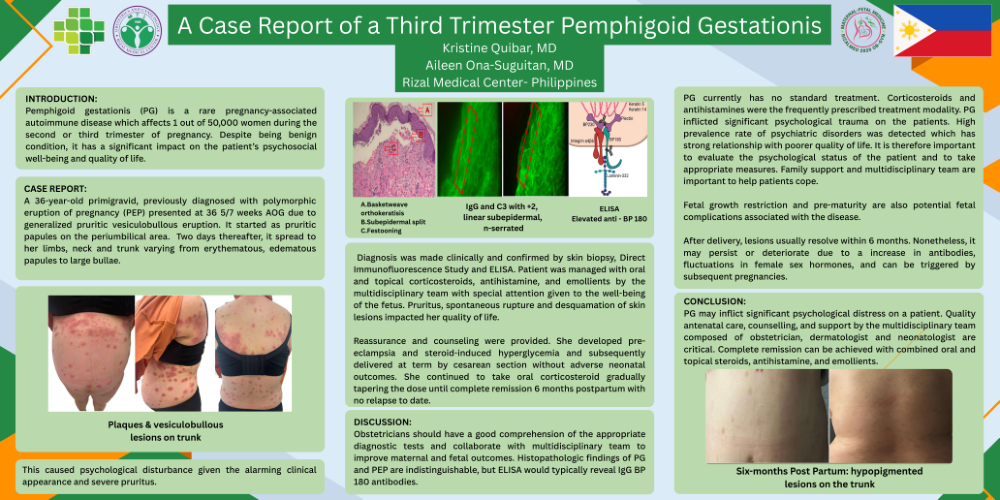
INTRODUCTION: Pemphigoid gestationis (PG) is a rare pregnancy-associated autoimmune disease which affects 1 out of 50,000 women during the second or third trimester of pregnancy. Despite being benign condition, it has a significant impact on the patient’s psychosocial well-being and quality of life.
CASE REPORT: A 36-year-old primigravid, previously diagnosed with polymorphic eruption of pregnancy (PEP) presented at 36 5/7 weeks AOG due to generalized pruritic vesiculobullous eruption. It started as pruritic papules on the periumbilical area. Two days thereafter, it spread to her limbs, neck and trunk varying from erythematous, edematous papules to large bullae. This caused psychological disturbance given the alarming clinical appearance and severe pruritus. Diagnosis was made clinically and confirmed by skin biopsy, DirectImmunofluorescence Study and ELISA. Patient was managed with oral and topical corticosteroids, antihistamine, and emollients by the multidisciplinary team with special attention given to the well-being of the fetus. Pruritus, spontaneous rupture and desquamation of skin lesions impacted her quality of life. Reassurance and counseling were provided. She developed pre-eclampsia and steroid-induced hyperglycemia and subsequently delivered at term by cesarean section without adverse neonatal outcomes. She continued to take oral corticosteroid gradually tapering the dose until complete remission 6 months postpartum with no relapse to date.
DISCUSSION: Obstetricians should have a good comprehension of the appropriate diagnostic tests and collaborate with multidisciplinary team to improve maternal and fetal outcomes. Histopathologic findings of PG and PEP are indistinguishable, but ELISA would typically reveal IgG BP 180 antibodies. PG currently has no standard treatment. Corticosteroids and antihistamines were the frequently prescribed treatment modality. PG inflicted significant psychological trauma on the patients. High prevalence rate of psychiatric disorders was detected which has strong relationship with poorer quality of life. It is therefore important to evaluate the psychological status of the patient and to take appropriate measures. Family support and multidisciplinary team are important to help patients cope. Fetal growth restriction and pre-maturity are also potential fetal complications associated with the disease. After delivery, lesions usually resolve within 6 months. Nonetheless, it may persist or deteriorate due to a increase in antibodies, fluctuations in female sex hormones, and can be triggered by subsequent pregnancies.
CONCLUSION: PG may inflict significant psychological distress on a patient. Quality antenatal care, counselling, and support by the multidisciplinary team composed of obstetrician, dermatologist and neonatologist are critical. Complete remission can be achieved with combined oral and topical steroids, antihistamine, and emollients.