2,281 posters, 63 videos, 56 audios, 43 topics, 18 sessions, 6,174 authors, 2,323 institutions
ePostersLive by SciGen Technologies S.A. All rights reserved.
RCOG World Congress 2025
June 23 - 25, 2025 | ExCeL London, UK
EP.1064
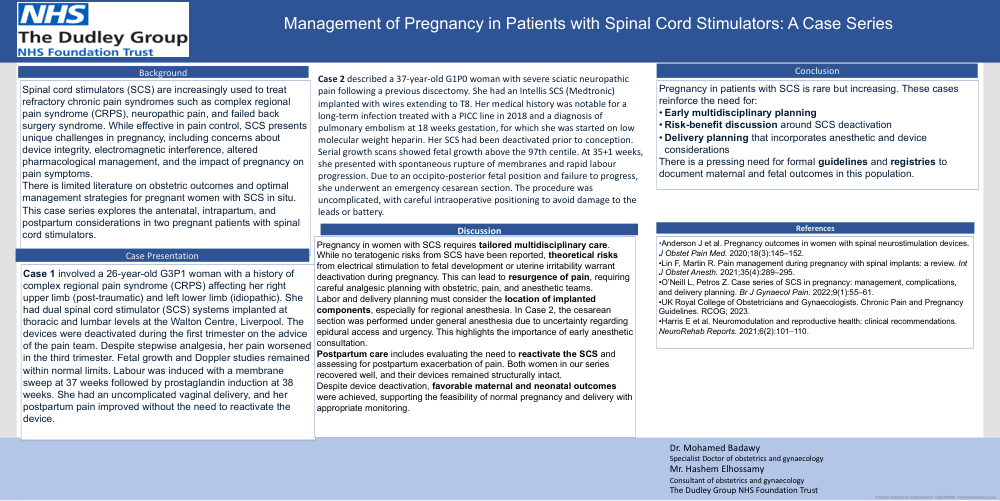
Management of Pregnancy in Patients with Spinal Cord Stimulators: A Case Series
Poster Presenter
Part of Topic
High risk pregnancy
Management of Pregnancy in Patients with Spinal Cord Stimulators:
Background
Conclusion
Spinal cord stimulators (SCS) are increasingly used to treat
refractory chronic pain syndromes such as complex regional
pain syndrome (CRPS), neuropathic pain, and failed back
surgery syndrome. While effective in pain control, SCS presents
unique challenges in pregnancy, including concerns about
device integrity, electromagnetic interference, altered
pharmacological management, and the impact of pregnancy on
pain symptoms.
There is limited literature on obstetric outcomes and optimal
management strategies for pregnant women with SCS in situ.
This case series explores the antenatal, intrapartum, and
postpartum considerations in two pregnant patients with spinal
cord stimulators.
Case Presentation
Case 1 involved a 26-year-old G3P1 woman with a history of
complex regional pain syndrome (CRPS) affecting her right
upper limb (post-traumatic) and left lower limb (idiopathic). She
had dual spinal cord stimulator (SCS) systems implanted at
thoracic and lumbar levels at the Walton Centre, Liverpool. The
devices were deactivated during the first trimester on the advice
of the pain team. Despite stepwise analgesia, her pain worsened
in the third trimester. Fetal growth and Doppler studies remained
within normal limits. Labour was induced with a membrane
sweep at 37 weeks followed by prostaglandin induction at 38
weeks. She had an uncomplicated vaginal delivery, and her
postpartum pain improved without the need to reactivate the
device.
Case 2 described a 37-year-old G1P0 woman with severe sciatic neuropathic
pain following a previous discectomy. She had an Intellis SCS (Medtronic)
implanted with wires extending to T8. Her medical history was notable for a
long-term infection treated with a PICC line in 2018 and a diagnosis of
pulmonary embolism at 18 weeks gestation, for which she was started on low
molecular weight heparin. Her SCS had been deactivated prior to conception.
Serial growth scans showed fetal growth above the 97th centile. At 35+1 weeks,
she presented with spontaneous rupture of membranes and rapid labour
progression. Due to an occipito-posterior fetal position and failure to progress,
she underwent an emergency cesarean section. The procedure was
uncomplicated, with careful intraoperative positioning to avoid damage to the
leads or battery
Discussion
Pregnancy in women with SCS requires tailored multidisciplinary care.
While no teratogenic risks from SCS have been reported, theoretical risks
from electrical stimulation to fetal development or uterine irritability warrant
deactivation during pregnancy. This can lead to resurgence of pain, requiring
careful analgesic planning with obstetric, pain, and anesthetic teams.
Labor and delivery planning must consider the location of implanted
components, especially for regional anesthesia. In Case 2, the cesarean
section was performed under general anesthesia due to uncertainty regarding
epidural access and urgency. This highlights the importance of early anesthetic
consultation.
Postpartum care includes evaluating the need to reactivate the SCS and
assessing for postpartum exacerbation of pain. Both women in our series
recovered well, and their devices remained structurally intact.
Despite device deactivation, favorable maternal and neonatal outcomes
were achieved, supporting the feasibility of normal pregnancy and delivery with
appropriate monitoring.
conclusion
Pregnancy in patients with SCS is rare but increasing. These cases
reinforce the need for:
• Early multidisciplinary planning
• Risk-benefit discussion around SCS deactivation
• Delivery planning that incorporates anesthetic and device
considerations
There is a pressing need for formal guidelines and registries to
document maternal and fetal outcomes in this population.
referrences
Anderson J et al. Pregnancy outcomes in women with spinal neurostimulation devices.
J Obstet Pain Med. 2020;18(3):145–152.
•Lin F, Martin R. Pain management during pregnancy with spinal implants: a review. Int
J Obstet Anesth. 2021;35(4):289–295.
•O’Neill L, Petros Z. Case series of SCS in pregnancy: management, complications,
and delivery planning. Br J Gynaecol Pain. 2022;9(1):55–61.
•UK Royal College of Obstetricians and Gynaecologists. Chronic Pain and Pregnancy
Guidelines. RCOG; 2023.
•Harris E et al. Neuromodulation and reproductive health: clinical recommendations.
NeuroRehab Reports. 2021;6(2):101–110.