2,281 posters, 63 videos, 56 audios, 43 topics, 18 sessions, 6,174 authors, 2,323 institutions
ePostersLive by SciGen Technologies S.A. All rights reserved.
RCOG World Congress 2025
June 23 - 25, 2025 | ExCeL London, UK
EP.1063
A successful outcome to pregnancy in a rudimentary uterine horn.
Poster Presenter
Part of Topic
High risk pregnancy
A Rare case of successful management of ruptured rudimentary horn viable pregnancy. Dr Ashish Singh, Dr Sonia Naik, Dr Heera P, Dr Tanya B Rohatgi
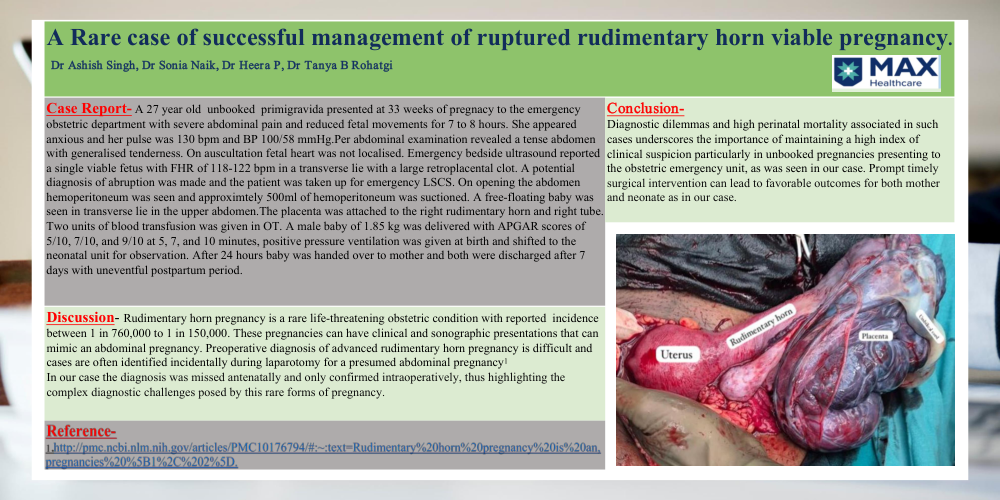
Case Report- A 27 year old unbooked primigravida presented at 33 weeks of pregnacy to the emergency obstetric department with severe abdominal pain and reduced fetal movements for 7 to 8 hours. She appeared anxious and her pulse was 130 bpm and BP 100/58 mmHg.Per abdominal examination revealed a tense abdomen with generalised tenderness. On auscultation fetal heart was not localised. Emergency bedside ultrasound reported a single viable fetus with FHR of 118-122 bpm in a transverse lie with a large retroplacental clot. A potential diagnosis of abruption was made and the patient was taken up for emergency LSCS. On opening the abdomen hemoperitoneum was seen and approximtely 500ml of hemoperitoneum was suctioned. A free-floating baby was seen in transverse lie in the upper abdomen.The placenta was attached to the right rudimentary horn and right tube. Two units of blood transfusion was given in OT. A male baby of 1.85 kg was delivered with APGAR scores of 5/10, 7/10, and 9/10 at 5, 7, and 10 minutes, positive pressure ventilation was given at birth and shifted to the neonatal unit for observation. After 24 hours baby was handed over to mother and both were discharged after 7 days with uneventful postpartum period.
Discussion- Rudimentary horn pregnancy is a rare life-threatening obstetric condition with reported incidence between 1 in 760,000 to 1 in 150,000. These pregnancies can have clinical and sonographic presentations that can mimic an abdominal pregnancy. Preoperative diagnosis of advanced rudimentary horn pregnancy is difficult and cases are often identified incidentally during laparotomy for a presumed abdominal pregnancy1 In our case the diagnosis was missed antenatally and only confirmed intraoperatively, thus highlighting the complex diagnostic challenges posed by this rare forms of pregnancy.
Conclusion- Diagnostic dilemmas and high perinatal mortality associated in such cases underscores the importance of maintaining a high index of clinical suspicion particularly in unbooked pregnancies presenting to the obstetric emergency unit, as was seen in our case. Prompt timely surgical intervention can lead to favorable outcomes for both mother and neonate as in our case.
Reference- 1.http://pmc.ncbi.nlm.nih.gov/articles/PMC10176794/#:~:text=Rudimentary%20horn%20pregnancy%20is%20an,pregnancies%20%5B1%2C%202%5D.