2,281 posters, 63 videos, 56 audios, 43 topics, 18 sessions, 6,174 authors, 2,323 institutions
ePostersLive by SciGen Technologies S.A. All rights reserved.
RCOG World Congress 2025
June 23 - 25, 2025 | ExCeL London, UK
EP.1057
Massive Ascites in Severe Preeclampsia Patient With HELLP Syndrome : A Case Report
Poster Presenter
Authors
Entesar Seddiq Zaman MRCOG, Safa Al Qahtani, Aysha Zaman, Huda Al Nasheet, Yahya Zaman
Affiliations
Part of Topic
High risk pregnancy
Massive Ascites in Severe Preeclampsia Patient With HELLP Syndrome : A Case Report
Objective:
Pregnancy with Severe preeclampsia especially resistant cases , may develop complications such as HELLP syndrome ( Hemolysis , elevated liver enzymes , low platelets ) not just antenatally but even postnatally and may be more severe . Generalised pulmonary oedema or ascites may develop in severe cases . In our case , massive ascites has occurred & just started postnatally with a total of 10 litres of ascitic fluid drained in the postnatal periods..
Case Report :
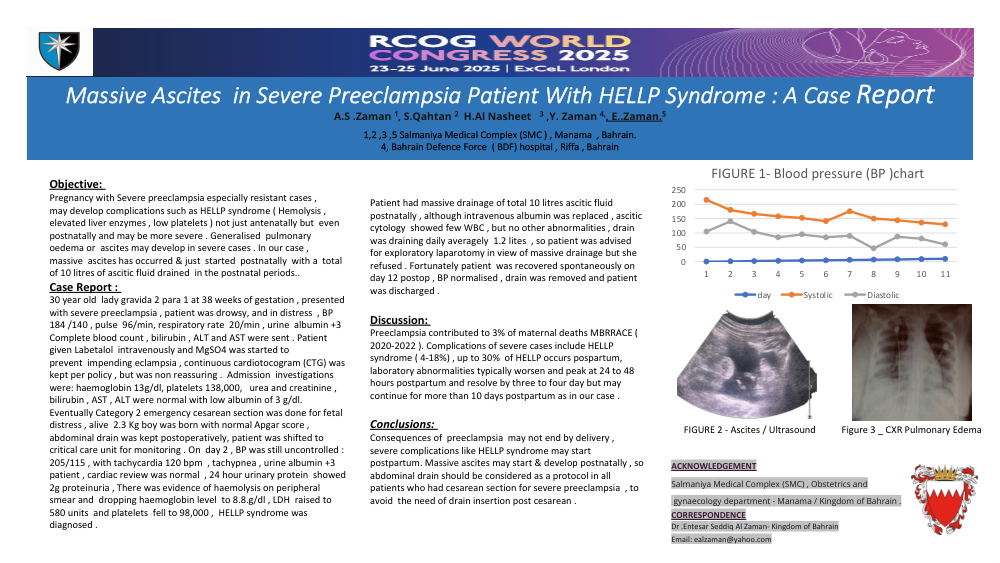
30 year old lady gravida 2 para 1 at 38 weeks of gestation , presented with severe preeclampsia , patient was drowsy, and in distress , BP 184 /140 , pulse 96/min, respiratory rate 20/min , urine albumin +3 Complete blood count , bilirubin , ALT and AST were sent . Patient given Labetalol intravenously and MgSO4 was started to prevent impending eclampsia , continuous cardiotocogram (CTG) was kept per policy , but was non reassuring . Admission investigations were: haemoglobin 13g/dl, platelets 138,000, urea and creatinine , bilirubin , AST , ALT were normal with low albumin of 3 g/dl.
Eventually Category 2 emergency cesarean section was done for fetal distress , alive 2.3 Kg boy was born with normal Apgar score , abdominal drain was kept postoperatively, patient was shifted to critical care unit for monitoring . On day 2 , BP was still uncontrolled : 205/115 , with tachycardia 120 bpm , tachypnea , urine albumin +3 patient , cardiac review was normal , 24 hour urinary protein showed 2g proteinuria , There was evidence of haemolysis on peripheral smear and dropping haemoglobin level to 8.8.g/dl , LDH raised to 580 units and platelets fell to 98,000 , HELLP syndrome was diagnosed .
Patient had massive drainage of total 10 litres ascitic fluid postnatally , although intravenous albumin was replaced , ascitic cytology showed few WBC , but no other abnormalities , drain was draining daily averagely 1.2 lites , so patient was advised for exploratory laparotomy in view of massive drainage but she refused . Fortunately patient was recovered spontaneously on day 12 postop , BP normalised , drain was removed and patient was discharged .
Discussion:
Preeclampsia contributed to 3% of maternal deaths MBRRACE ( 2020-2022 ). Complications of severe cases include HELLP syndrome ( 4-18%) , up to 30% of HELLP occurs pospartum, laboratory abnormalities typically worsen and peak at 24 to 48 hours postpartum and resolve by three to four day but may continue for more than 10 days postpartum as in our case .
Conclusions:
Consequences of preeclampsia may not end by delivery , severe complications like HELLP syndrome may start postpartum. Massive ascites may start & develop postnatally , so abdominal drain should be considered as a protocol in all patients who had cesarean section for severe preeclampsia , to avoid the need of drain insertion post cesarean