2,281 posters, 63 videos, 56 audios, 43 topics, 18 sessions, 6,174 authors, 2,323 institutions
ePostersLive by SciGen Technologies S.A. All rights reserved.
RCOG World Congress 2025
June 23 - 25, 2025 | ExCeL London, UK
EP.1043
Management of listeriosis in pregnancy
Poster Presenter
Part of Topic
High risk pregnancy
Management of listeriosis in pregnancy
Dr Saraanyaa S/ Dr Prabha Sivaraman/ Rania Ellabany/ Emmanuella Adu-Peprah
Objective :
Listeriosis is a notifiable disease, and pregnant women are about 12-20 times more likely to contract the infection than other healthy adults. It can result in miscarriage or stillbirth, low birth weight, septicaemia, or meningitis in the new-born. We report a case of Listeriosis in a recent immigrant from Sudan in the third trimester of her first pregnancy.
Introduction:
Listeria monocytogenes (LM) is an intracellular, aerobic and facultative anaerobic, Gram-positive bacterium, which is primarily transmitted to humans orally via food. Once contaminated food has been ingested,Listeria can be phagocytosed by gastrointestinal cells and can enter the host without disrupting the integrity of the gastrointestinal tract. Once the organism has reached the host cytoplasm, it rapidly divides and pushes up against the cell membrane; it can then be ingested by adjacent cells. Through this series of steps, Listeria can multiply and spread without being exposed to antibodies, neutrophils, or antibiotics in the extracellular fluid . This explains why maternal listeria illness can be mild or even asymptomatic. Cell-mediated immunity is the host’s defence againstListeria, and any condition that reduces cell mediated immunity, such as pregnancy, can predispose to infection.
Case report:
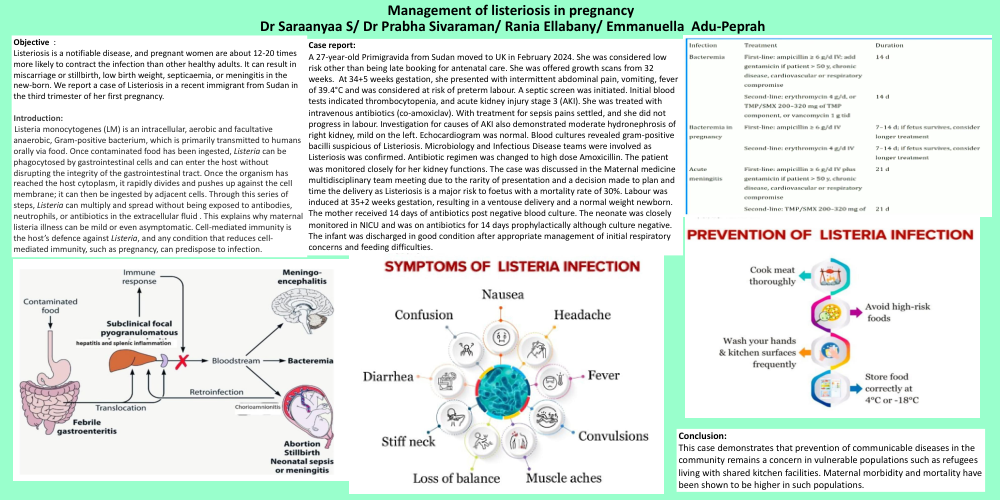
A 27-year-old Primigravida from Sudan moved to UK in February 2024. She was considered low risk other than being late booking for antenatal care. She was offered growth scans from 32 weeks. At 34+5 weeks gestation, she presented with intermittent abdominal pain, vomiting, fever of 39.4°C and was considered at risk of preterm labour. A septic screen was initiated. Initial blood tests indicated thrombocytopenia, and acute kidney injury stage 3 (AKI). She was treated with intravenous antibiotics (co-amoxiclav). With treatment for sepsis pains settled, and she did not progress in labour. Investigation for causes of AKI also demonstrated moderate hydronephrosis of right kidney, mild on the left. Echocardiogram was normal. Blood cultures revealed gram-positive bacilli suspicious of Listeriosis. Microbiology and Infectious Disease teams were involved as Listeriosis was confirmed. Antibiotic regimen was changed to high dose Amoxicillin. The patient was monitored closely for her kidney functions. The case was discussed in the Maternal medicine multidisciplinary team meeting due to the rarity of presentation and a decision made to plan and time the delivery as Listeriosis is a major risk to foetus with a mortality rate of 30%. Labour was induced at 35+2 weeks gestation, resulting in a ventouse delivery and a normal weight newborn. The mother received 14 days of antibiotics post negative blood culture. The neonate was closely monitored in NICU and was on antibiotics for 14 days prophylactically although culture negative. The infant was discharged in good condition after appropriate management of initial respiratory concerns and feeding difficulties.
Conclusion:
This case demonstrates that prevention of communicable diseases in the community remains a concern in vulnerable populations such as refugees living with shared kitchen facilities. Maternal morbidity and mortality have been shown to be higher in such populations.