2,281 posters, 63 videos, 56 audios, 43 topics, 18 sessions, 6,174 authors, 2,323 institutions
ePostersLive by SciGen Technologies S.A. All rights reserved.
RCOG World Congress 2025
June 23 - 25, 2025 | ExCeL London, UK
EP.1041
Viral pneumonia and rectus muscle haematoma in pregnancy: Challenges and Management
Poster Presenter
Authors
Affiliations
Part of Topic
High risk pregnancy
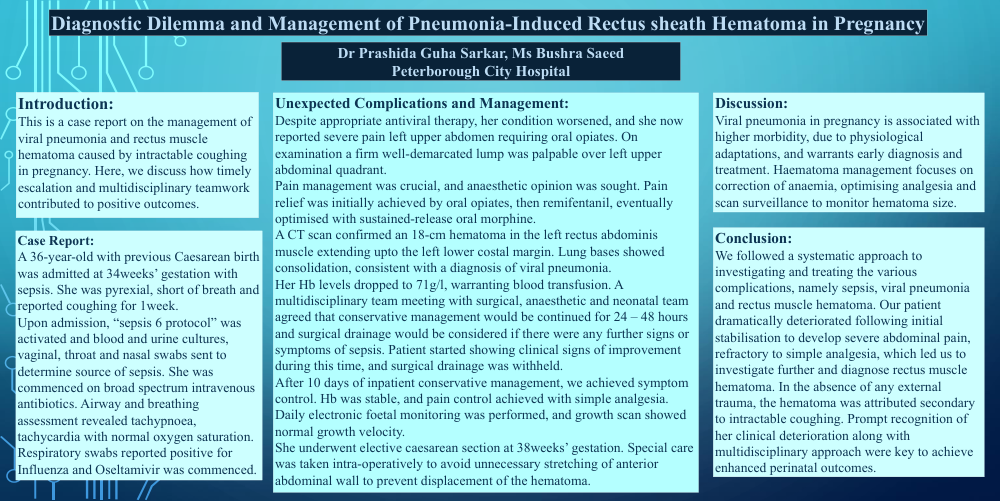
Title - Diagnostic Dilemma and Management of Pneumonia-Induced Rectus sheath Hematoma in Pregnancy
Authors - Dr Prashida Guha Sarkar, Ms Bushra Saeed, Peterborough City Hospital
Introduction: This is a case report on the management of viral pneumonia and rectus muscle hematoma caused by intractable coughing in pregnancy. Here, we discuss how timely escalation and multidisciplinary teamwork contributed to positive outcomes.
Case Report: A 36-year-old with previous Caesarean birth was admitted at 34weeks’ gestation with sepsis. She was pyrexial, short of breath and reported coughing for 1week. Upon admission, “sepsis 6 protocol” was activated and blood and urine cultures, vaginal, throat and nasal swabs sent to determine source of sepsis. She was commenced on broad spectrum intravenous antibiotics. Airway and breathing assessment revealed tachypnoea, tachycardia with normal oxygen saturation. Respiratory swabs reported positive for Influenza and Oseltamivir was commenced.
Unexpected Complications and Management: Despite appropriate antiviral therapy, her condition worsened, and she now reported severe pain left upper abdomen requiring oral opiates. On examination a firm well-demarcated lump was palpable over left upper abdominal quadrant. Pain management was crucial, and anaesthetic opinion was sought. Pain relief was initially achieved by oral opiates, then remifentanil, eventually optimised with sustained-release oral morphine. A CT scan confirmed an 18-cm hematoma in the left rectus abdominis muscle extending upto the left lower costal margin. Lung bases showed consolidation, consistent with a diagnosis of viral pneumonia. Her Hb levels dropped to 71g/l, warranting blood transfusion. A multidisciplinary team meeting with surgical, anaesthetic and neonatal team agreed that conservative management would be continued for 24 – 48 hours and surgical drainage would be considered if there were any further signs or symptoms of sepsis. Patient started showing clinical signs of improvement during this time, and surgical drainage was withheld. After 10 days of inpatient conservative management, we achieved symptom control. Hb was stable, and pain control achieved with simple analgesia. Daily electronic foetal monitoring was performed, and growth scan showed normal growth velocity. She underwent elective caesarean section at 38weeks’ gestation. Special care was taken intra-operatively to avoid unnecessary stretching of anterior abdominal wall to prevent displacement of the hematoma.
Discussion: Viral pneumonia in pregnancy is associated with higher morbidity, due to physiological adaptations, and warrants early diagnosis and treatment. Haematoma management focuses on correction of anaemia, optimising analgesia and scan surveillance to monitor hematoma size.
Conclusion: We followed a systematic approach to investigating and treating the various complications, namely sepsis, viral pneumonia and rectus muscle hematoma. Our patient dramatically deteriorated following initial stabilisation to develop severe abdominal pain, refractory to simple analgesia, which led us to investigate further and diagnose rectus muscle hematoma. In the absence of any external trauma, the hematoma was attributed secondary to intractable coughing. Prompt recognition of her clinical deterioration along with multidisciplinary approach were key to achieve enhanced perinatal outcomes.