2,281 posters, 63 videos, 56 audios, 43 topics, 18 sessions, 6,174 authors, 2,323 institutions
ePostersLive by SciGen Technologies S.A. All rights reserved.
RCOG World Congress 2025
June 23 - 25, 2025 | ExCeL London, UK
EP.1039
Conservative Management of Placenta Accreta Following Vaginal Birth
Poster Presenter
Authors
Affiliations
Part of Topic
High risk pregnancy
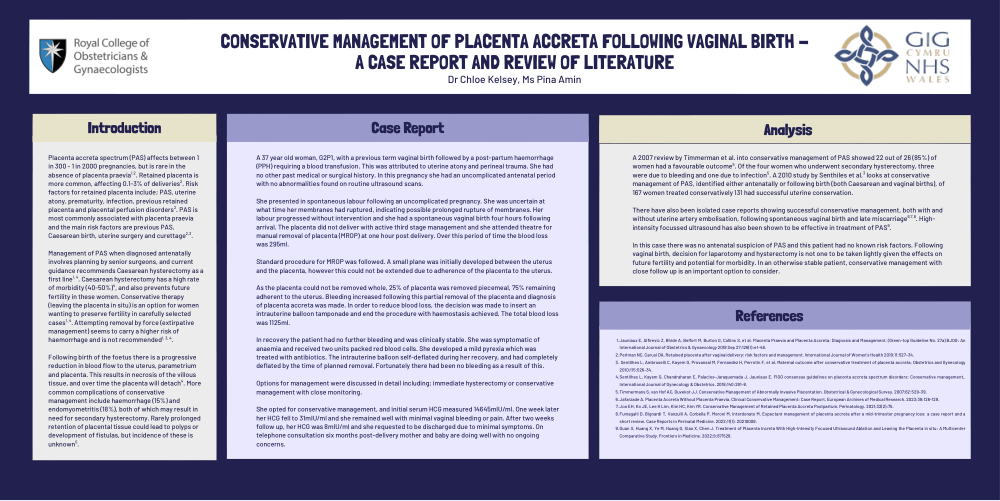
CONSERVATIVE MANAGEMENT OF PLACENTA ACCRETA FOLLOWING VAGINAL BIRTH - A CASE REPORT AND REVIEW OF LITERATURE
Introduction:
Placenta accreta spectrum (PAS) affects between 1 in 300 - 1 in 2000 pregnancies, but is rare in the absence of placenta praevia . Retained placenta is more common, affecting 0.1-3% of deliveries . Risk factors for retained placenta include; PAS, uterine atony, prematurity, infection, previous retained placenta and placental perfusion disorders . PAS is most commonly associated with placenta praevia and the main risk factors are previous PAS, Caesarean birth, uterine surgery and curettage . Management of PAS when diagnosed antenatally involves planning by senior surgeons, and current guidance recommends Caesarean hysterectomy as a first line . Caesarean hysterectomy has a high rate of morbidity (40-50%) , and also prevents future fertility in these women. Conservative therapy (leaving the placenta in situ) is an option for women wanting to preserve fertility in carefully selected cases . Attempting removal by force (extirpative management) seems to carry a higher risk of haemorrhage and is not recommended . Following birth of the foetus there is a progressive reduction in blood flow to the uterus, parametrium and placenta. This results in necrosis of the villous tissue, and over time the placenta will detach . More common complications of conservative management include haemorrhage (15%) and endomyometritis (18%), both of which may result in need for secondary hysterectomy. Rarely prolonged retention of placental tissue could lead to polyps or development of fistulas, but incidence of these is unknown .
Case Report:
A 37 year old woman, G2P1, with a previous term vaginal birth followed by a post-partum haemorrhage (PPH) requiring a blood transfusion. This was attributed to uterine atony and perineal trauma. She had no other past medical or surgical history. In this pregnancy she had an uncomplicated antenatal period with no abnormalities found on routine ultrasound scans. She presented in spontaneous labour following an uncomplicated pregnancy. She was uncertain at what time her membranes had ruptured, indicating possible prolonged rupture of membranes. Her labour progressed without intervention and she had a spontaneous vaginal birth four hours following arrival. The placenta did not deliver with active third stage management and she attended theatre for manual removal of placenta (MROP) at one hour post delivery. Over this period of time the blood loss was 295ml. Standard procedure for MROP was followed. A small plane was initially developed between the uterus and the placenta, however this could not be extended due to adherence of the placenta to the uterus. As the placenta could not be removed whole, 25% of placenta was removed piecemeal, 75% remaining adherent to the uterus. Bleeding increased following this partial removal of the placenta and diagnosis of placenta accreta was made. In order to reduce blood loss, the decision was made to insert an intrauterine balloon tamponade and end the procedure with haemostasis achieved. The total blood loss was 1125ml. In recovery the patient had no further bleeding and was clinically stable. She was symptomatic of anaemia and received two units packed red blood cells. She developed a mild pyrexia which was treated with antibiotics. The intrauterine balloon self-deflated during her recovery, and had completely deflated by the time of planned removal. Fortunately there had been no bleeding as a result of this. Options for management were discussed in detail including; immediate hysterectomy or conservative management with close monitoring. She opted for conservative management, and initial serum HCG measured 14645mIU/ml. One week later her HCG fell to 31mIU/ml and she remained well with minimal vaginal bleeding or pain. After two weeks follow up, her HCG was 8mIU/ml and she requested to be discharged due to minimal symptoms. On telephone consultation six months post-delivery mother and baby are doing well with no ongoing concerns.
Analysis:
A 2007 review into conservative management of PAS showed 22 out of 26 (85%) of women had a favourable outcome . Of the four women who underwent secondary hysterectomy, three were due to bleeding and one due to infection . A 2010 study by Senthiles et al. looks at conservative management of PAS, identified either antenatally or following birth (both Caesarean and vaginal births), of 167 women treated conservatively 131 had successful uterine conservation. There have also been isolated case reports showing successful conservative management, both with and without uterine artery embolisation, following spontaneous vaginal birth and late miscarriage . Highintensity focussed ultrasound has also been shown to be effective in treatment of PAS . In this case there was no antenatal suspicion of PAS and this patient had no known risk factors. Following vaginal birth, decision for laparotomy and hysterectomy is not one to be taken lightly given the effects on future fertility and potential for morbidity. In an otherwise stable patient, conservative management with close follow up is an important option to consider.