2,281 posters, 63 videos, 56 audios, 43 topics, 18 sessions, 6,174 authors, 2,323 institutions
ePostersLive by SciGen Technologies S.A. All rights reserved.
RCOG World Congress 2025
June 23 - 25, 2025 | ExCeL London, UK
EP.1038
Successful Pregnancy outcome in Acromegalic female with Pituitary Adenoma : Transsphenoidal Pituitary Adenectomy
Poster Presenter
Authors
Affiliations
Part of Topic
High risk pregnancy
Abstract
Pregnancy is rare event in patients with acromegaly due to hyperprolactinemia and altered
gonadotrophins.Literature review reveled very few cases of pregnancy in acromegalic
patients.We report here case of 28 year old female presented in OPD with c/o inability to
conceive for 6 years and enlargement of hands , feet and skin tags for 4 years.Her investigations
showed raised serum growth hormone and serum prolactin levels.Her imaging studies showed
pituitary adenoma ,for which she underwent Transsphenoidal pituitary adenectomy.she was
started tablet Bromocriptine ,after 7 months she spontaneously conceived and delivered female
baby weighing 2100 gm at 33 weeks by elective LSCS .
Introduction
Acromegaly is a rare clinical disorder in which there is progressive somatic disfigurement and a
wide spectrum of systemic complications which include gonadotrophic dysfunction, menstrual
irregularities and infertility.Pregnancy in patients with acromegaly is a rare condition. Evidence
about the use of somatostatin analogs (SSAs) in pregnant patient is limited.Pituitary ademonas
are common pituitary tumors.these are functioning and nonfunctioning.75% pituitary adenomas
are endocrinologically active.Few cases of successful pregnancy are recorded in patients with
acromegaly due to pituitary adenomas. 1 We report a case of acromegalic subfertile female with
pituitary macroadenoma and hyperprolactinemia who had successful pregnancy outcome after
transsphenoidal pituitary adenectomy.
Case Reports
26 year old female presented in Gynae OPD in 2012. She had history of primary subfertility for
6 years and enlargement of hands, feet and skin tags for 4 years.There was history of menstrual
irregularities ,no history of amenorrhoea and galatorrhoea.
Clinical examination revealed young female well oriented in time place and person.Her height
was 5 feet and 8 inches.she had markedly enlarged hands and feet.Her systemic and pelvic
examination was normal.On investigation her Growth hormone level was 108 (normal 0-
14mIU/ml).S.Prolactin level was 804 ng/ml ( normal 3.8-208 ng/ml).Her Gonadotrophins and
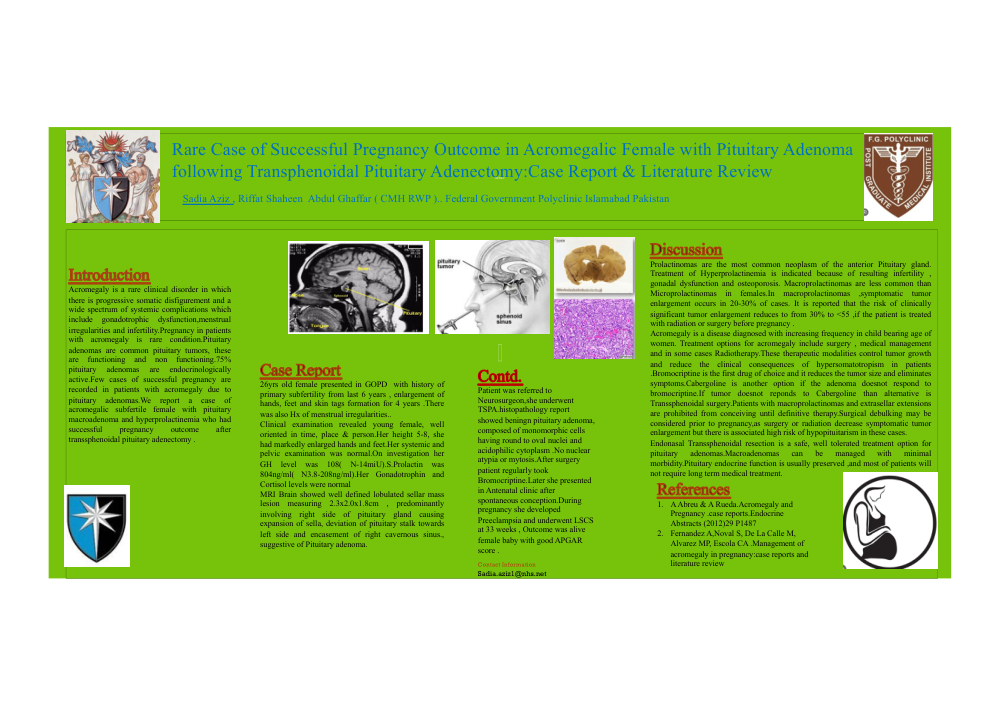
cortisol levels were normal.Her MRI Brain showed well defined lobulated sellar mass lesion
measuring 2.3x2.0x1.8cm( TxAPxCC) predominantly involving the right side of pituitary gland
causing expansion of sella,deviation of the pituitary stalk towards left side and encasement of the
right cavernous sinus.this is suggestive of pituitary adenoma.
Patient was referred to Neurosurgeon,she underwent TSPA.Histopathology report showed
benign tumor pituitary adenoma,composed of monomorphic cells having round to oval nuclei
and acidophilic cytoplasm.No nuclear atypia or mitosis.
After surgery patient regulary took tablet bromocriptine .In 2014 she presented in Gynae OPD
for antenatal checkup as she conceived spontaneously.During pregnancy she developed
preeclampsia and underwent Elective LSCS at 33 weeks gestation ,baby girl delivered weighing
2100 gm with good apgar score.Baby had port wine stain on left side of face.
Discussion
Prolactinomas are the most common neoplasm of the anterior pituitary gland. Treatment of
hyperprolactinemia is indicated because of resulting infertility, gonadal dysfunction and
osteoporosis. 4
Macroprolactinomas are less common than microprolactinomas in females. In
macroprolactinoma, symptomatic tumor enlargement occurs in 20–30% of cases . It is reported
that the risk of clinically significant tumor enlargement reduces from 30 to <5%, if the patient is
treated with radiation or surgery before pregnancy. 3
Acromegaly is a disease diagnosed with increasing frequency in child-bearing age of
women. Treatments options for acromegaly include surgery, drug treatment and, in some cases,
radiotherapy. These therapeutic modalities control tumor growth and reduce the clinical
consequences of hypersomatotropism in patients. 2 Bromocriptine is the first drug of choice, and
it reduces the tumor size and eliminates symptoms . Cabergoline is another option if the adenoma
does not respond to bromocriptine. If the enlarged tumor does not respond to cabergoline
therapy, alternatives is transsphenoidal surgery.Patients with macroprolactinomas and extrasellar
extension are prohibited from conceiving until definitive therapy. Surgical debulking may be
considered prior to pregnancy, as surgery or radiation decrease symptomatic tumor enlargement
but there is associated high risk of hypopituitarism in these cases. 3
Endonasal transsphenoidal resection is a safe, well-tolerated treatment option for pituitary
adenomas. Macroadenomas can be managed with minimal morbidity. Pituitary endocrine
function is usually preserved, and most of patients will not require prolong medical treatment. 4
References
1.A Abreu & A Rueda.Acromegaly and pregnancy: case reports. Endocrine Abstracts (2012) 29
P1487
2 Fernández A, Noval S, De La Calle M, Álvarez MP, Escolá CA.Management of acromegaly in
pregnancy: Case report and literature review. endoen.2012
3. Almalki MH , Alzahrani S, Alshahrani F, Alsherbeni S, Almoharib O, Aljohani N et al.
Managing Prolactinomas during Pregnancy.Front Endocrinol (Lausanne). 2015; 6: 85.
4. Tarapore PE, Sughrue ME, Blevins L, Auguste KI, Gupta N, Kunwar S. Microscopic
endonasal transsphenoidal pituitary adenomectomy in the pediatric population.J Neurosurg
Pediatr. 2011 May;7(5):501-9.