2,281 posters, 63 videos, 56 audios, 43 topics, 18 sessions, 6,174 authors, 2,323 institutions
ePostersLive by SciGen Technologies S.A. All rights reserved.
RCOG World Congress 2025
June 23 - 25, 2025 | ExCeL London, UK
EP.1033
Regular Audits and the Quality of Care for Pregnant People with Diabetes
Poster Presenter
Authors
Affiliations
Part of Topic
High risk pregnancy
Objective:
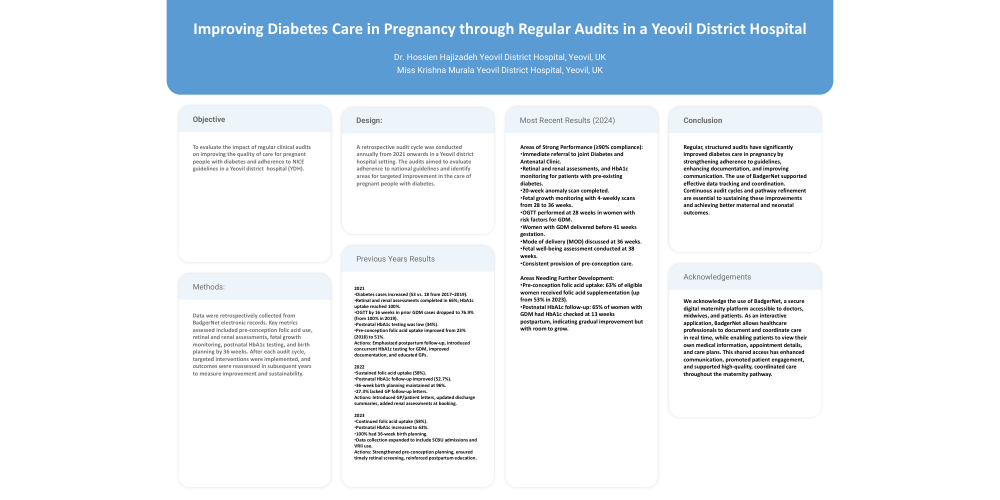
To evaluate the impact of regular clinical audits on improving the quality of care for pregnant people with diabetes and adherence to NICE guidelines in a Yeovil district hospital (YDH).
Design:
A retrospective audit cycle was conducted annually from 2021 onwards in a Yeovil district hospital setting. The audits aimed to evaluate adherence to national guidelines and identify areas for targeted improvement in the care of pregnant people with diabetes.
Methods:
Data were retrospectively collected from BadgerNet electronic records. Key metrics assessed included pre-conception folic acid use, retinal and renal assessments, fetal growth monitoring, postnatal HbA1c testing, and birth planning by 36 weeks. After each audit cycle, targeted interventions were implemented, and outcomes were reassessed in subsequent years to measure improvement and sustainability.
Previous Years Results:
2021
Actions: Emphasized postpartum follow-up, introduced concurrent HbA1c testing for GDM, improved documentation, and educated GPs.
2022
Actions: Introduced GP/patient letters, updated discharge summaries, added renal assessments at booking.
2023
Actions: Strengthened pre-conception planning, ensured timely retinal screening, reinforced postpartum education.
Most Recent Results (2024)
Areas of Strong Performance (≥90% compliance):
•Immediate referral to joint Diabetes and Antenatal Clinic.
•Retinal and renal assessments, and HbA1c monitoring for patients with pre-existing diabetes.
•20-week anomaly scan completed.
•Fetal growth monitoring with 4-weekly scans from 28 to 36 weeks.
•OGTT performed at 28 weeks in women with risk factors for GDM.
•Women with GDM delivered before 41 weeks gestation.
•Mode of delivery (MOD) discussed at 36 weeks.
•Fetal well-being assessment conducted at 38 weeks.
•Consistent provision of pre-conception care.
Areas Needing Further Development:
•Pre-conception folic acid uptake: 63% of eligible women received folic acid supplementation (up from 53% in 2023).
•Postnatal HbA1c follow-up: 65% of women with GDM had HbA1c checked at 13 weeks postpartum, indicating gradual improvement but with room to grow.
Conclusion:
Regular, structured audits have significantly improved diabetes care in pregnancy by strengthening adherence to guidelines, enhancing documentation, and improving communication. The use of BadgerNet supported effective data tracking and coordination. Continuous audit cycles and pathway refinement are essential to sustaining these improvements and achieving better maternal and neonatal outcomes.
Acknowledgements:
We acknowledge the use of BadgerNet, a secure digital maternity platform accessible to doctors, midwives, and patients. As an interactive application, BadgerNet allows healthcare professionals to document and coordinate care in real time, while enabling patients to view their own medical information, appointment details, and care plans. This shared access has enhanced communication, promoted patient engagement, and supported high-quality, coordinated care throughout the maternity pathway.