2,281 posters, 63 videos, 56 audios, 43 topics, 18 sessions, 6,174 authors, 2,323 institutions
ePostersLive by SciGen Technologies S.A. All rights reserved.
RCOG World Congress 2025
June 23 - 25, 2025 | ExCeL London, UK
EP.1031
Pregnancy with Fibroids: Unraveling Maternal & Perinatal Outcomes in a Tertiary Care Setting
Poster Presenter
Authors
Azra Amerjee, Sumaira Naz, Fizza Ansar, Farah Jabeen, Irfan Sheikh
Affiliations
Part of Topic
High risk pregnancy
Title
Pregnancy with Fibroids: Unraveling Maternal & Perinatal Outcomes in a Tertiary Care Setting
Abstract
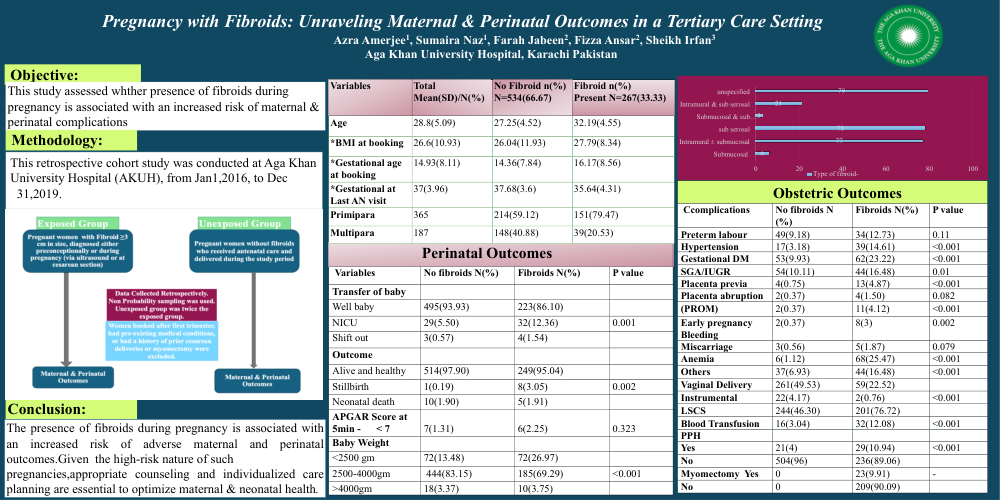
Objective:This study aimed to assess whether the presence of Hbroids during pregnancy is associated
with an increased risk of maternal and perinatal complications.
Study Design:This retrospective cohort study included an exposed group comprising women with Hbroids ≥3 cm in size, diagnosed either preconceptionally or during pregnancy (via ultrasound or at cesarean section), and an unexposed group of women without Hbroids who received antenatal care and delivered during the study period. Pregnancy outcomes were evaluated through a retrospective review of medical records.
Methods:The study was conducted at Aga Khan University Hospital (AKUH), Karachi, from January 1, 2016, to December 31, 2019.Non-probability consecutive sampling was used for the exposed group, while the unexposed group, twice the size of the exposed group, was selected randomly. Women who booked after the Hrst trimester, had pre-existing medical conditions, or had a history of prior cesarean deliveries or myomectomy were excluded. Data were analyzed using descriptive statistics (mean ± SD, median [range], and percentages). Categorical variables were assessed using Pearson’s χ2 test and Fisher’s exact test, while continuous variables were analyzed using the Student’s t-test or Mann-Whitney U test, as appropriate. Multivariate regression analysis was performed to evaluate the impact of Hbroids on maternal and neonatal outcomes, with odds ratios (ORs) and 95% conHdence intervals (CIs) reported. A p-value of <0.05 was considered statistically signiHcant.
Results:Among 801 pregnant women included in the study, 267 (33.3%) had Hbroids >3 cm, while 534 (66.7%) did not. Women without Hbroids were more likely to be multiparous (p < 0.001). Pregnancies complicated by Hbroids were associated with signiHcantly higher rates of hypertension, gestational diabetes, fetal growth restriction, placenta previa, premature rupture of membranes, and anemia (p < 0.05). Women with Hbroids also had a signiHcantly increased likelihood of cesarean delivery, postpartum hemorrhage, and blood transfusion (p < 0.001).
Neonatal outcomes revealed that infants born to women with Hbroids had a signiHcantly higher risk of NICU admission (p = 0.001) and stillbirth (p = 0.002). Low birth weight (<2500 g) was also more prevalent in the Hbroid group (p < 0.001). However, no signiHcant differences were observed in neonatal death or APGAR scores <7 at 5 minutes between the groups.
Conclusion:The presence of Hbroids during pregnancy is associated with an increased risk of adverse maternal and perinatal outcomes. Given the high-risk nature of such pregnancies, appropriate counseling and individualized care planning are essential to optimize maternal and neonatal health.