2,281 posters, 63 videos, 56 audios, 43 topics, 18 sessions, 6,174 authors, 2,323 institutions
ePostersLive by SciGen Technologies S.A. All rights reserved.
RCOG World Congress 2025
June 23 - 25, 2025 | ExCeL London, UK
EP.1020
Special Needs In Pregnancy Service Review
Poster Presenter
Authors
Affiliations
Part of Topic
High risk pregnancy
Special Needs In Pregnancy (SNiPS) Service Review
Princess’ Royal Maternity Unit, NHS Greater Glasgow and Clyde
Sophie Coyle ST6, Shona MacKinnon GPST2
Introduction
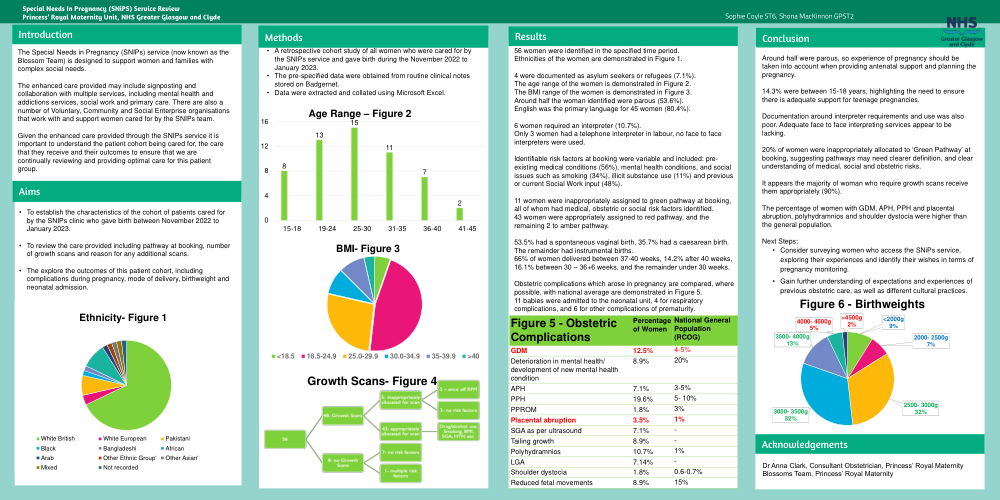
The Special Needs in Pregnancy (SNIPs) service (now known as the Blossom Team) is designed to support women and families with complex social needs.
The enhanced care provided may include signposting and collaboration with multiple services, including mental health and addictions services, social work and primary care. There are also a number of Voluntary, Community and Social Enterprise organisations that work with and support women cared for by the SNIPs team.
Given the enhanced care provided through the SNIPs service it is important to understand the patient cohort being cared for, the care that they receive and their outcomes to ensure that we are continually reviewing and providing optimal care for this patient group.
Aims
Results
56 women were identified in the specified time period.
Ethnicities of the women are demonstrated in Figure 1.
4 were documented as asylum seekers or refugees (7.1%).
The age range of the women is demonstrated in Figure 2.
The BMI range of the women is demonstrated in Figure 3.
Around half the woman identified were parous (53.6%).
English was the primary language for 45 women (80.4%).
6 women required an interpreter (10.7%).
Only 3 women had a telephone interpreter in labour, no face to face interpreters were used.
Identifiable risk factors at booking were variable and included: pre-existing medical conditions (56%), mental health conditions, and social issues such as smoking (34%), illicit substance use (11%) and previous or current Social Work input (48%).
11 women were inappropriately assigned to green pathway at booking, all of whom had medical, obstetric or social risk factors identified.
43 women were appropriately assigned to red pathway, and the remaining 2 to amber pathway.
53.5% had a spontaneous vaginal birth, 35.7% had a caesarean birth. The remainder had instrumental births.
66% of women delivered between 37-40 weeks, 14.2% after 40 weeks, 16.1% between 30 – 36+6 weeks, and the remainder under 30 weeks.
Obstetric complications which arose in pregnancy are compared, where possible, with national average are demonstrated in Figure 5.
11 babies were admitted to the neonatal unit, 4 for respiratory complications, and 6 for other complications of prematurity.
Conclusion
Around half were parous, so experience of pregnancy should be taken into account when providing antenatal support and planning the pregnancy.
14.3% were between 15-18 years, highlighting the need to ensure there is adequate support for teenage pregnancies.
Documentation around interpreter requirements and use was also poor. Adequate face to face interpreting services appear to be lacking.
20% of women were inappropriately allocated to ‘Green Pathway’ at booking, suggesting pathways may need clearer definition, and clear understanding of medical, social and obstetric risks.
It appears the majority of woman who require growth scans receive them appropriately (90%).
The percentage of women with GDM, APH, PPH and placental abruption, polyhydramnios and shoulder dystocia were higher than the general population.
Next Steps;