2,281 posters, 63 videos, 56 audios, 43 topics, 18 sessions, 6,174 authors, 2,323 institutions
ePostersLive by SciGen Technologies S.A. All rights reserved.
RCOG World Congress 2025
June 23 - 25, 2025 | ExCeL London, UK
EP.1010
Diagnostic accuracy of b hcg for predicting pre-eclampsia
Poster Presenter
Authors
Affiliations
Part of Topic
High risk pregnancy
Diagnostic Accuracy of β hCG in Predicting Pre-eclampsia Between 14-20 weeks Gestation
Introduction
Pre-eclampsia (PE) is an important cause of perinatal morbidity and mortality and complicates 2%–8% of pregnancies.Some studies indicated that β-human chorionic gonadotropin (β-hCG) is involved in PE, and β-hCG has been recommended as a serum maker for screening PE at 8-14 weeks of gestation.The study was conducted todetermine the diagnostic accuracy of β hCG for predicting pre-eclampsia, taking pre-eclampsia occurrence as gold standard
Objective
To determine the diagnostic accuracy of β hCG for predicting pre-eclampsia among normal females between 14 to 20 weeks of gestation, taking pre-eclampsia occurrence as gold standard
Materials and methods
This validation cross sectional study was conducted at KRL hospital Islamabad Pakistan from 20th October 2022 to 19th April 2023. A total of 160 women with singleton pregnancy (assessed on ultrasonography) of gestational age 14-20 weeks of age between 18 to 45 years were included. Patients with multiple pregnancies, history of smoking, diabetes mellitus, chronic hypertension, cardiac and liver or lung disease were excluded.β hCG levels were assessed quantitatively using blood sample. Presence or absence of pre-eclampsia was noted as per operational definition. All women were followed up by the researcher and occurrence of pre-eclampsia (yes/no) till delivery was noted.
Results
Age range in this study was from 18-45 years with mean age of 27.41 ± 4.41 years. Majority of the patients (75.63%) were between 18-30 years of age. Mean gestational age was 16.63 ± 1.87 weeks Mean β HCG levels were 21344.33 ± 134.72 IU/l.
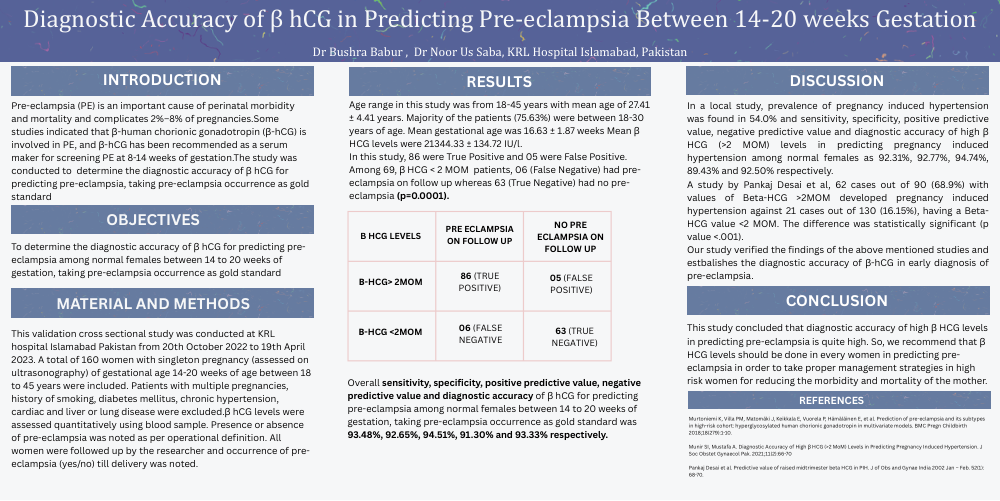
In this study, 86 were True Positive and 05 were False Positive. Among 69, β HCG < 2 MOMpatients, 06 (False Negative) had pre-eclampsia on follow up whereas 63 (True Negative) had no pre-eclampsia (p=0.0001).
Overall sensitivity, specificity, positive predictive value, negative predictive value and diagnostic accuracy of β hCG for predicting pre-eclampsia among normal females between 14 to 20 weeks of gestation, taking pre-eclampsia occurrence as gold standard was93.48%, 92.65%, 94.51%, 91.30% and 93.33% respectively.
Discussion
In a local study, prevalence of pregnancy induced hypertension was found in 54.0% and sensitivity, specificity, positive predictive value, negative predictive value and diagnostic accuracy of high β HCG (>2 MOM) levels in predicting pregnancy induced hypertension among normal females as 92.31%, 92.77%, 94.74%, 89.43% and 92.50% respectively.
A study by Pankaj Desai et al, 62 cases out of 90 (68.9%) with values of Beta-HCG >2MOM developed pregnancy induced hypertension against 21 cases out of 130 (16.15%), having a Beta-HCG value <2 MOM. The difference was statistically significant (p value <.001).
Our study verified the findings of the above mentioned studies andestbalishes the diagnostic accuracy of β-hCG in early diagnosis of pre-eclampsia.
Conclusion
This study concluded that diagnostic accuracy of high β HCG levels in predicting pre-eclampsia is quite high. So, we recommend that β HCG levels should be done in every women in predicting pre-eclampsia in order to take proper management strategies in high risk women for reducing the morbidity and mortality of the mother.