2,281 posters, 63 videos, 56 audios, 43 topics, 18 sessions, 6,174 authors, 2,323 institutions
ePostersLive by SciGen Technologies S.A. All rights reserved.
RCOG World Congress 2025
June 23 - 25, 2025 | ExCeL London, UK
EP.1008
BETA HCG IN CERVICO-VAGINAL SECRETION AS A PREDICTOR OF PRETERM DELIVERY
Poster Presenter
Authors
Affiliations
Part of Topic
High risk pregnancy
BETA HCG IN CERVICO-VAGINAL SECRETION AS A PREDICTOR OF PRETERM DELIVERY
Introduction
Preterm delivery is the largest contributor to perinatal morbidity and mortality throughout the world. It is still a challenging obstetric problem. Despite the availability of tocolytic drugs, aggressive surveillance techniques, and other treatment and prevention strategies, no change has been observed in the premature delivery rate. Identifications of accurate marker to determine whether a pregnant women is at high risk of premature delivery would potentially allow improved surveillance and more timely intervention to avert this devastating outcome. Many researchers have tried to find out the way to predict preterm delivery and recently using of biochemical markers in prediction of preterm labor is becoming popular and the researcher found out their usefulness and several investigators have reported that the presence of beta hCG in cervico-vaginal secretion may be an accurate predictors of preterm delivery.
Methods and Materials
OBJECTIVE : to determine whether concentration of beta HCG in cervico-vaginal secretion could be used to predict preterm delivery in women presenting with signs and symptoms suggestive of preterm labour
DESIGN : Hospital based prospective study
METHOD : This study was conducted in Central Women’s Hospital, Yangon, Myanmar. It included a total of 148 pregnant women presenting with signs and symptoms suggestive of preterm labour between 24 to 34 weeks of gestation. Exclusion criteria included those with foetal congenital anomalies, vaginal bleeding, foetal growth restriction, foetal distress, multiple gestation, cervical dilatation ≥3 cm or preterm rupture of membrane. Eligible pregnant women were offered for participation in the study. Concentration of beta HCG in the cervico-vaginal secretion was detected by qualitative beta HCG one step pregnancy test strip. The result obtained was kept confidential and all the patients were managed as per protocol for suspected preterm labour. Follow up of the outcome, either term or preterm delivery, was recorded.
Results
•The majority of the patients in this study were 27.73(6.24) years.
• Nulliparity group constituted 56.1% and history of preterm delivery was present in 10 patients among 65 multiparous patient.
• Mean gestational age at the time of presentation of the study group was 31.39 ± 2.7 weeks.
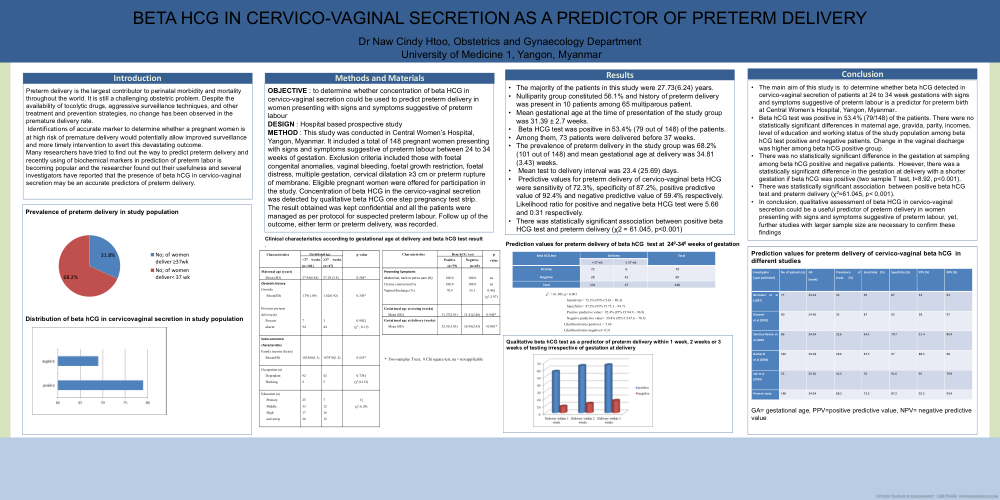
• Beta HCG test was positive in 53.4% (79 out of 148) of the patients.
• Among them, 73 patients were delivered before 37 weeks.
• The prevalence of preterm delivery in the study group was 68.2% (101 out of 148) and mean gestational age at delivery was 34.81 (3.43) weeks.
• Mean test to delivery interval was 23.4 (25.69) days.
• Predictive values for preterm delivery of cervico-vaginal beta HCG were sensitivity of 72.3%, specificity of 87.2%, positive predictive value of 92.4% and negative predictive value of 59.4% respectively. Likelihood ratio for positive and negative beta HCG test were 5.66 and 0.31 respectively.
• There was statistically significant association between positive beta HCG test and preterm delivery (χ2 = 61.045, p<0.001)
Conclusion
• The main aim of this study is to determine whether beta hCG detected in cervico-vaginal secretion of patients at 24 to 34 week gestations with signs and symptoms suggestive of preterm labour is a predictor for preterm birth at Central Women’s Hospital, Yangon, Myanmar..
• Beta hCG test was positive in 53.4% (79/148) of the patients. There were no statistically significant differences in maternal age, gravida, parity, incomes, level of education and working status of the study population among beta hCG test positive and negative patients. Change in the vaginal discharge was higher among beta hCG positive group.
• There was no statistically significant difference in the gestation at sampling among beta hCG positive and negative patients. However, there was a statistically significant difference in the gestation at delivery with a shorter gestation if beta hCG was positive (two sample T test, t=8.92, p<0.001).
• There was statistically significant association between positive beta hCG test and preterm delivery (χ 2=61.045, p< 0.001).
• In conclusion, qualitative assessment of beta HCG in cervico-vaginal secretion could be a useful predictor of preterm delivery in women presenting with signs and symptoms suggestive of preterm labour, yet, further studies with larger sample size are necessary to confirm these findings