2,281 posters, 63 videos, 56 audios, 43 topics, 18 sessions, 6,174 authors, 2,323 institutions
ePostersLive by SciGen Technologies S.A. All rights reserved.
RCOG World Congress 2025
June 23 - 25, 2025 | ExCeL London, UK
EP.1007
Non-spontaneous Preterm Births and Health Equity in a Large Maternity Unit
Poster Presenter
Authors
Affiliations
Part of Topic
High risk pregnancy
Objective:
To examine the causes and neonatal outcomes of non-spontaneous preterm births (PTBs) in Leeds Teaching Hospitals NHS Trust, a large maternity unit with a Level 3 neonatal intensive care unit and neonatal surgery facilities, with a focus on health equity.
Background:
The Saving Babies Lives1 bundle aims to reduce perinatal mortality, with element 5 focusing on reducing preterm birth, while elements 2 (fetal growth restriction) and 3 (reduced fetal movements) advocate offering early birth for women at risk of stillbirth. Interventions to reduce preterm birth such as through cervical length scanning target women at risk of spontaneous preterm birth, however many women have non-spontaneous preterm births, and anecdotally these babies have poorer outcomes. This review aimed to capture the data to see if there is an area we can focus on to further reduce perinatal mortality.
Design:
A retrospective case review was conducted, analysing preterm births over a one-year period. Maternity, medical and neonatal records were reviewed.
Method:
A comprehensive search of maternity records identified births occurring at less than 37 weeks gestation between October 2023 and September 2024. Births with spontaneous onset of labour were excluded. Data on the reasons for PTB, some neonatal outcomes, as well as the social and economic backgrounds of the affected families, were collected through detailed review of case notes.
Results:
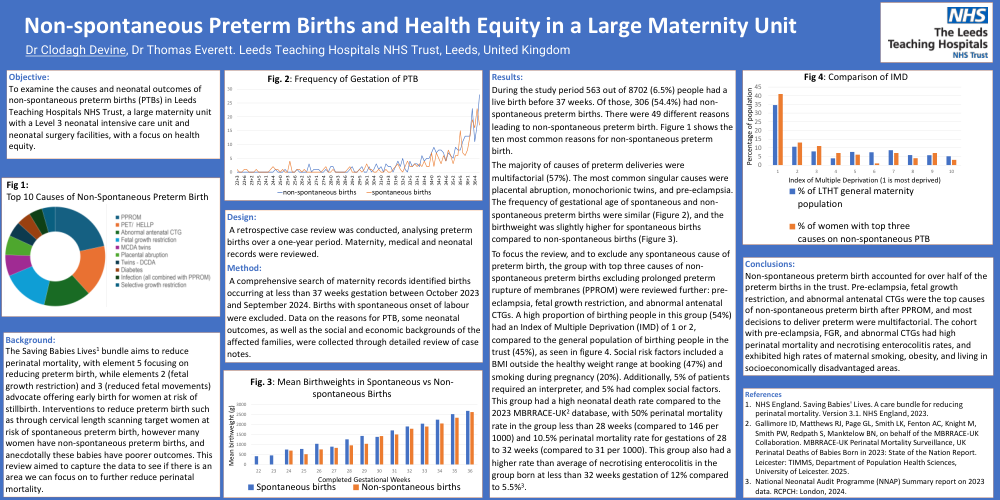
During the study period 563 out of 8702 (6.5%) people had a live birth before 37 weeks. Of those, 306 (54.4%) had non-spontaneous preterm births. There were 49 different reasons leading to non-spontaneous preterm birth. Figure 1 shows the ten most common reasons for non-spontaneous preterm birth.
The majority of causes of preterm deliveries were multifactorial (57%). The most common singular causes were placental abruption, monochorionic twins, and pre-eclampsia. The frequency of gestational age of spontaneous and non-spontaneous preterm births were similar (Figure 2), and the birthweight was slightly higher for spontaneous births compared to non-spontaneous births (Figure 3).
To focus the review, and to exclude any spontaneous cause of preterm birth, the group with top three causes of non-spontaneous preterm births excluding prolonged preterm rupture of membranes (PPROM) were reviewed further: pre-eclampsia, fetal growth restriction, and abnormal antenatal CTGs. A high proportion of birthing people in this group (54%) had an Index of Multiple Deprivation (IMD) of 1 or 2, compared to the general population of birthing people in the trust (45%), as seen in figure 4. Social risk factors included a BMI outside the healthy weight range at booking (47%) and smoking during pregnancy (20%). Additionally, 5% of patients required an interpreter, and 5% had complex social factors. This group had a high neonatal death rate compared to the 2023 MBRRACE-UK2 database, with 50% perinatal mortality rate in the group less than 28 weeks (compared to 146 per 1000) and 10.5% perinatal mortality rate for gestations of 28 to 32 weeks (compared to 31 per 1000). This group also had a higher rate than average of necrotising enterocolitis in the group born at less than 32 weeks gestation of 12% compared to 5.5%3.
Conclusions:
Non-spontaneous preterm birth accounted for over half of the preterm births in the trust. Pre-eclampsia, fetal growth restriction, and abnormal antenatal CTGs were the top causes of non-spontaneous preterm birth after PPROM, and most decisions to deliver preterm were multifactorial. The cohort with pre-eclampsia, FGR, and abnormal CTGs had high perinatal mortality and necrotising enterocolitis rates, and exhibited high rates of maternal smoking, obesity, and living in socioeconomically disadvantaged areas.
References