2,281 posters, 63 videos, 56 audios, 43 topics, 18 sessions, 6,174 authors, 2,323 institutions
ePostersLive by SciGen Technologies S.A. All rights reserved.
RCOG World Congress 2025
June 23 - 25, 2025 | ExCeL London, UK
EP.1006
Predicting Peripartum Cardiomyopathy: A Review
Poster Presenter
Authors
Affiliations
Part of Topic
High risk pregnancy
background
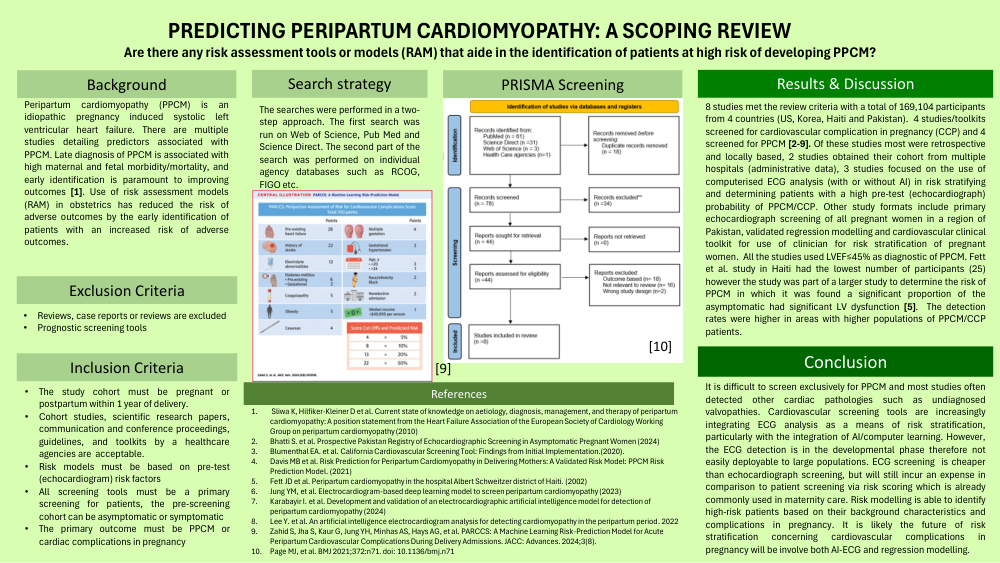
Peripartum cardiomyopathy (PPCM) is an idiopathic pregnancy induced systolic left ventricular heart failure. There are multiple studies detailing predictors associated with PPCM. Late diagnosis of PPCM is associated with high maternal and fetal morbidity/mortality, and early identification is paramount to improving outcomes [1]. Use of risk assessment models (RAM) in obstetrics has reduced the risk of adverse outcomes by the early identification of patients with an increased risk of adverse outcomes.
Results
8 studies met the review criteria with a total of 169,104 participants from 4 countries (US, Korea, Haiti and Pakistan). 4 studies/toolkits screened for cardiovascular complication in pregnancy (CCP) and 4 screened for PPCM [2-9]. Of these studies most were retrospective and locally based, 2 studies obtained their cohort from multiple hospitals (administrative data), 3 studies focused on the use of computerised ECG analysis (with or without AI) in risk stratifying and determining patients with a high pre-test (echocardiograph) probability of PPCM/CCP. Other study formats include primary echocardiograph screening of all pregnant women in a region of Pakistan, validated regression modelling and cardiovascular clinical toolkit for use of clinician for risk stratification of pregnant women. All the studies used LVEF≤45% as diagnostic of PPCM. Fett et al. study in Haiti had the lowest number of participants (25) however the study was part of a larger study to determine the risk of PPCM in which it was found a significant proportion of the asymptomatic had significant LV dysfunction [5]. The detection rates were higher in areas with higher populations of PPCM/CCP patients.
Conslusion
It is difficult to screen exclusively for PPCM and most studies often detected other cardiac pathologies such as undiagnosed valvopathies. Cardiovascular screening tools are increasingly integrating ECG analysis as a means of risk stratification, particularly with the integration of AI/computer learning. However, the ECG detection is in the developmental phase therefore not easily deployable to large populations. ECG screening is cheaper than echocardiograph screening, but will still incur an expense in comparison to patient screening via risk scoring which is already commonly used in maternity care. Risk modelling is able to identify high-risk patients based on their background characteristics and complications in pregnancy. It is likely the future of risk stratification concerning cardiovascular complications in pregnancy will be involve both AI-ECG and regression modelling.