2,281 posters, 63 videos, 56 audios, 43 topics, 18 sessions, 6,174 authors, 2,323 institutions
ePostersLive by SciGen Technologies S.A. All rights reserved.
RCOG World Congress 2025
June 23 - 25, 2025 | ExCeL London, UK
EP.0100
Indications and outcomes of hysterectomies for cervical indications
Poster Presenter
Part of Topic
Colposcopy & cervical pathology
Introduction:
Hysterectomy remains a pivotal surgical intervention for managing various cervical pathologies, including cervical cancer and pre-invasive lesions. While the overall rate of hysterectomies in the UK has plateaued in recent years—reflecting the increasing use of alternative therapies—cervical indications continue to comprise a significant proportion of cases, particularly when less invasive options are no longer viable. 1
Advances in surgical techniques have led to a notable shift in practice, with a marked increase in minimally invasive (laparoscopic) hysterectomies and a corresponding decline in abdominal and vaginal approaches across NHS hospitals .2For cervical cancer, especially in its early stages, surgical management strategies have evolved. Recent evidence suggests that less radical procedures, such as simple hysterectomy, may offer comparable oncological outcomes to radical hysterectomy while reducing surgical complications and improving quality of life for select patient groups..3 However, the choice of surgical approach can influence survival outcomes, as studies have reported differences in overall survival between minimally invasive and open radical hysterectomy, underscoring the importance of individualized treatment planning . 4
This audit examines the indications, outcomes and complications of hysterectomies performed for cervical indications at Gloucestershire Hospitals NHS Foundation Trust, aiming to provide contemporary data on surgical trends, patient outcomes, and the implications of evolving clinical practice. By analysing local data within the context of national and international findings, this audit seeks to inform best practice and optimise patient care for those undergoing hysterectomy for cervical indications.
Method:
A retrospective audit was conducted on all the hysterectomies performed for cervical indications at Gloucestershire Hospital NHS Foundation Trust from 15/11/2019 to 30/8/2024. Indication, initial and final pathology was recorded as well as age, parity, and BMI (if available). Complications were noted if readmitted or seen for follow up.
One hundred and seventeen patients were found from databases kept within the gynaecology department. Electronic databases were used to extract the data. Literature searches were carried out looking at outcomes for hysterectomies for cervical reasons.
Results:
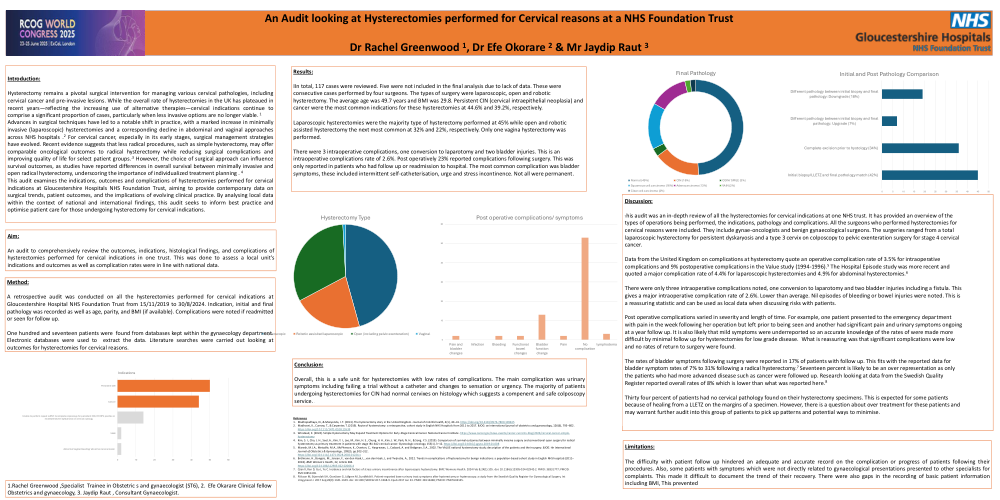
IIn total, 117 cases were reviewed. Five were not included in the final analysis due to lack of data. These were consecutive cases performed by four surgeons. The types of surgery were laparoscopic, open and robotic hysterectomy. The average age was 49.7 years and BMI was 29.8. Persistent CIN (cervical intraepithelial neoplasia) and cancer were the most common indications for these hysterectomies at 44.6% and 39.2%, respectively.
Laparoscopic hysterectomies were the majority type of hysterectomy performed at 45% while open and robotic assisted hysterectomy the next most common at 32% and 22%, respectively. Only one vagina hysterectomy was performed.
There were 3 intraoperative complications, one conversion to laparotomy and two bladder injuries. This is an intraoperative complications rate of 2.6%. Post operatively 23% reported complications following surgery. This was only reported in patients who had follow up or readmission to hospital. The most common complication was bladder symptoms, these included intermittent self-catheterisation, urge and stress incontinence. Not all were permanent. \
Discussion:
This audit was an in-depth review of all the hysterectomies for cervical indications at one NHS trust. It has provided an overview of the types of operations being performed, the indications, pathology and complications. All the surgeons who performed hysterectomies for cervical reasons were included. They include gynae-oncologists and benign gynaecological surgeons. The surgeries ranged from a total laparoscopic hysterectomy for persistent dyskaryosis and a type 3 cervix on colposcopy to pelvic exenteration surgery for stage 4 cervical cancer.
Data from the United Kingdom on complications at hysterectomy quote an operative complication rate of 3.5% for intraoperative complications and 9% postoperative complications in the Value study (1994-1996).5 The Hospital Episode study was more recent and quoted a major complication rate of 4.4% for laparoscopic hysterectomies and 4.9% for abdominal hysterectomies.6
There were only three intraoperative complications noted, one conversion to laparotomy and two bladder injuries including a fistula. This gives a major intraoperative complication rate of 2.6%. Lower than average. Nil episodes of bleeding or bowel injuries were noted. This is a reassuring statistic and can be used as local data when discussing risks with patients.
Post operative complications varied in severity and length of time. For example, one patient presented to the emergency department with pain in the week following her operation but left prior to being seen and another had significant pain and urinary symptoms ongoing at a year follow up. It is also likely that mild symptoms were underreported so an accurate knowledge of the rates of were made more difficult by minimal follow up for hysterectomies for low grade disease. What is reassuring was that significant complications were low and no rates of return to surgery were found.
The rates of bladder symptoms following surgery were reported in 17% of patients with follow up. This fits with the reported data for bladder symptom rates of 7% to 31% following a radical hysterectomy.7 Seventeen percent is likely to be an over representation as only the patients who had more advanced disease such as cancer were followed up. Research looking at data from the Swedish Quality Register reported overall rates of 8% which is lower than what was reported here.8
Thirty four percent of patients had no cervical pathology found on their hysterectomy specimens. This is expected for some patients because of healing from a LLETZ on the margins of a specimen. However, there is a question about over treatment for these patients and may warrant further audit into this group of patients to pick up patterns and potential ways to minimise.
Overall, this is a safe unit for hysterectomies with low rates of complications. The main complication was urinary symptoms including failing a trial without a catheter and changes to sensation or urgency. The majority of patients undergoing hysterectomies for CIN had normal cervixes on histology which suggests a compenent and safe colposcopy service. .