1,830 posters, 67 videos, 75 audios, 29 topics, 22 sessions, 4,727 authors, 1,697 institutions
ePostersLive by SciGen Technologies S.A. All rights reserved.
RCOG World Congress 2023
June 12 - 14, 2023 | London, UK

EP.1001
Association of CYP1A1 gene variants with polycystic ovarian syndrome in Arab women
Poster Presenter
Authors
Maha Al-Khaduri, Mallak Al Hatami, Fahad Zadjali, Yahya Al Farsi, Yahya Tamimi
Affiliations
Part of Topic
Benign Gynaecology
Association of CYP1A1 gene variants with polycystic ovarian syndrome in Arab women
OBJECTIVE:
To determine whether CYP1A1 gene variants are associated with polycystic ovarian syndrome (PCOS) in women of Arab ethnicity in Oman and whether there are associations between clinical or biochemical parameters with these variants.
BACKGROUND:
PCOS is an endocrine disorder that affects women of reproductive age. It is associated with irregular menstrual cycles, hirsutism, hyperandrogenism and metabolic disorders. (Hong et al., 2020) It is a multifactorial disorder associated with environmental and genetic factors. A meta-analysis suggested that that CYP1A1 MspI polymorphisms may contribute to increasing susceptibility to PCOS among Caucasian populations. (Shen et al. 2014) There is also an association between increased risk of PCOS and CYP1A1 polymorphisms among Turkish and Indian ethnicities, indicating that variant alleles of the gene may affect the metabolic and transport pathway of estrogen causing PCOS. (Akgül et al., 2011, Babu et al, 2004) Therefore, detecting common polymorphisms in the CYP1A1 gene might be promising as a biomarker for the diagnosis and prognosis of PCOS.
DESIGN:
Prospective case control study.
METHOD:
A sample size of 49 cases and 49 controls was estimated for a significance level of 5% at 60% power, with minor allele frequencies of 12% and 1% with a 1:1 ratio. We recruited 50 cases and 50 controls (Omani women) in reproductive age from the Gynecology clinic at Sultan Qaboos University Hospital in Oman. Cases fulfilled the Rotterdam criteria for PCOS. Controls were non-pregnant reproductive aged women who were not diagnosed with PCOS. Genetic disorders, congenital adrenal hyperplasia, androgen secreting tumors, Cushing syndrome, and hyperprolactinemia were excluded. Clinical and biochemical data was collected and analyzed. SPSS was used for statistical analysis. Gene Panel Exome Sequencing was conducted on DNA extracted from blood samples for CYP1A1 gene and data analyzed using ANNOVAR software. Statistical analysis was performed using SPSS for Descriptive statistics, Chi square test and Correlation analysis. Single nucleotide polymorphisms SNPs were tested for Hardy-Weinberg Equilibrium.
RESULTS:
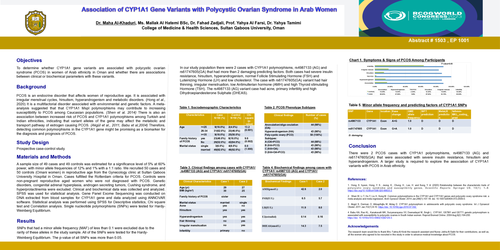
SNPs that had a minor allele frequency (MAF) of less than 0.1 were excluded due to the rarity of these alleles in the study sample. All of the SNPs were tested for the Hardy-Weinberg Equilibrium. The p-value of all SNPs was more than 0.05. In our study population there were 2 cases with CYP1A1 polymorphisms, rs4987133 (AG) and rs61747605(GA) that had more than 2 damaging predicting factors. Both cases had severe insulin resistance, hirsutism, hyperandrogenism, normal Follicle Stimulating Hormone (FSH) and Luteinizing Hormone (LH) and low cholesterol. The case with rs61747605(GA) variant had hair thinning, irregular menstruation, low Antimullerian hormone (AMH) and high Thyroid stimulating Hormone (TSH). The rs4987133 (AG) variant case had acne, primary infertility and high DHEAS.
CONCLUSIONS:
There were 2 PCOS cases with CYP1A1 polymorphisms, rs4987133 (AG) and rs61747605(GA) that were associated with severe insulin resistance, hirsutism and hyperandrogenism. A larger study is required to explore the association of CYP1A1 variants with PCOS in Arab ethnicity.