1,830 posters, 67 videos, 75 audios, 29 topics, 22 sessions, 4,727 authors, 1,697 institutions
ePostersLive by SciGen Technologies S.A. All rights reserved.
RCOG World Congress 2023
June 12 - 14, 2023 | London, UK

EP.0060
Disparity relating to ethnicity in readmission/reintervention rates after myomectomy in England
Poster Presenter
Authors
Affiliations
Part of Topic
Benign Gynaecology
Introduction
Emerging evidence suggests that there may be disparity concerning Women’s Health outcomes relating to ethnicity in the US. This is particularly concerning given that Black women suffer disproportionately from uterine fibroids. To date, there has been limited study regarding the impact of ethnicity on post-surgical outcomes after myomectomy.
Aims
The purpose of this study was to examine the impact of ethnicity on surgical route and reintervention outcomes post-myomectomy in England.
Methods
Retrospective, national population-based, cohort study utilising Hospital Episode Statistics(HES) data
Cohort determined based on HES dataset extract
Inclusion criteria: Patients were identified in the HES Admitted Patient Care dataset between 2010 and 2015 that underwent myomectomy in England under the NHS
Exclusion criteria: Women who were aged less than 18 years; underwent a non-elective procedure; were coded as having a hysterectomy during the encounter of their index procedure
All encounters linked relating to an individual cohort member using HESID until end of study. After the index treatment, all subsequent encounters scrutinised for the presence of reintervention OPCS4 procedural codes until the end of study. Patients undergoing hysterectomy or Uterine-preserving procedure (UPP) reinterventions contributed person-time to the study until first occurrence of either hysterectomy or UPP reintervention, death, or end of study (31st March 2020).
Primary outcome(s): UPP and hysterectomy reinterventions rates after index myomectomy
UPP reintervention included only myomectomy, uterine artery embolization, endometrial ablation, or MR guided focused ultrasound procedures
Chi-squared test was used to compare categorical variables. Binary logistic regression was used to provide an estimate of the crude risk for laparoscopic approach after myomectomy. Cox’s proportional-hazards regression model was used to provide an estimate of the crude risk for hysterectomy or UPP reintervention after index treatment for myomectomy.
Adjusted risk was conditioned on case-mix covariates that included: age, geographical region, comorbidities, and index of multiple deprivation.
British (White) women were the reference(comparator) group for minoritized groups because of the potential influence of unconscious bias.
Results
There were 9443 myomectomies undertaken over 5 years
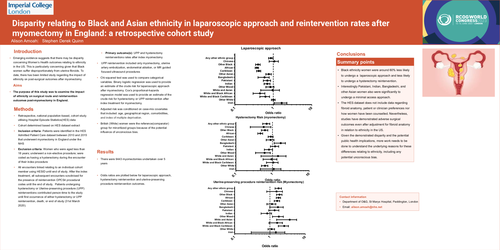
Odds ratios are plotted below for laparoscopic approach, hysterectomy reintervention and uterine-preserving procedure reintervention outcomes.
Contact information