1,830 posters, 67 videos, 75 audios, 29 topics, 22 sessions, 4,727 authors, 1,697 institutions
ePostersLive by SciGen Technologies S.A. All rights reserved.
RCOG World Congress 2023
June 12 - 14, 2023 | London, UK

EP.0985
Vitamin D and Zinc Against Placental Senescence in Preterm Birth
Part of Topic
Fetal Medicine
The Role of Vitamin D and Zinc Against Oxidative Stress and Placental Senescence in Preterm Birth
Yudianto Budi Saroyo1, Atikah Sayogo Putri2
1Maternal-Fetal Division, Department of Obstetrics and Gynaecology, Universitas Indonesia – Cipto Mangunkusumo Hospital
2Department of Obstetrics and Gynaecology, Universitas Indonesia – Cipto Mangunkusumo Hospital
Abstract
Objective: To examine the role of vitamin D and zinc against oxidative stress and placental senescence in women who underwent spontaneous preterm labor and term labor
Design: Comparative cross-section study
Method: Maternal serum and placental samples of term labor and spontaneous preterm labor were taken during 2017-2019 in two hospitals in Jakarta, Indonesia. Markers related to metabolism of vitamin D (25OHD, 1,25OH2D3, vtamin D receptor (VDR), CYP27B1) and zinc (Zinc, ZNT1, ZIP8), oxidative stress (8-OHdG), and placental senescence (GLB1, HMGB, and telomere T/S ratio) were evaluated with enzyme-linked immunosorbent assay (ELISA), liquid chromatography–mass spectrometry (LC-MS/MS), Inductively coupled plasma mass spectrometry (ICP-MS), and polymerase chain reaction (PCR).
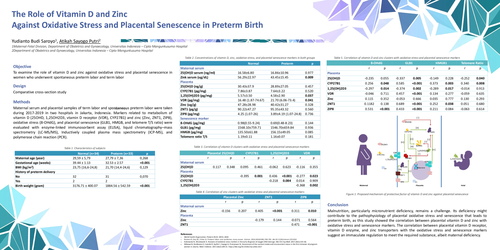
Results: 34 women with term labor and 33 with spontaneous preterm labor participated in this study. Both groups were vitamin D and zinc deficient, although preterm group has lower serum zinc level (43.45±15.45 vs 56.29±22.97 ug/dL, p=0.009). Preterm group has lower level of placental 1,25(OH)2D3 (4.58±2.90 vs 5.57±3.50 pg/ng, p=0.037) and placental VDR {21.70 (6.06-73.4) vs 16.48 (1.87-74.67), p=0.041). 8-OHdG and placental senescence markers were negatively correlated with placental 25(OH)D and 1,25(OH)2D3, as well as positively correlated with placental CYP27B1 and VDR. Although placental zinc has no correlation with oxidative stress and senescence markers, its transporters ZNT1 and ZIP8 were positively correlated with oxidative stress and senescence markers.
Conclusion:
Malnutrition, particularly micronutrient deficiency, remains a challenge. Its deficiency might contribute to the pathophysiology of placental oxidative stress and senescence that leads to preterm birth, as this study showed the correlation between placental vitamin D and zinc with oxidative stress and senescence markers. The correlation between placental vitamin D receptor, vitamin D enzyme, and zinc transporters with the oxidative stress and senescence markers suggest an immaculate regulation to suffice the need albeit maternal serum deficiency.