1,830 posters, 67 videos, 75 audios, 29 topics, 22 sessions, 4,727 authors, 1,697 institutions
ePostersLive by SciGen Technologies S.A. All rights reserved.
RCOG World Congress 2023
June 12 - 14, 2023 | London, UK

EP.0034
Determining the impact of NIPT on the uptake of invasive diagnostic testing
Poster Presenter
Part of Topic
Fetal Medicine
Determining the impact of NIPT on the uptake of invasive diagnostic testing
Objective: Non-invasive prenatal testing (NIPT) is a highly effective screening test for common aneuploidies. Prospective studies evaluating the use of NIPT as a contingent test to first trimester screening (FTS) within the NHS conclude that NIPT will reduce the need for invasive testing (chorionic villus sampling (CVS) or amniocentesis) from high-chance FTS results. This study evaluates the impact of NIPT on the uptake of invasive tests for all causes at a large UK tertiary fetal medicine centre.
Design: Retrospective review of singleton pregnancies with a high-chance FTS result booked at Birmingham Women’s Hospital between 2011-2022, and a parallel review of all invasive diagnostic tests performed in the same hospital between 2016-2022. NIPT became available at this hospital in October 2016.
Methods: Antenatal screening databases were used to identify women with a high-chance FTS result between 2011-2022 and decisions for further testing were reviewed. Data search on ViewPoint 6 identified women who underwent CVS or amniocentesis between 2016-2022, and the indications for these were interrogated. Chi-squared testing and Fisher’s exact test were used for statistical analysis.
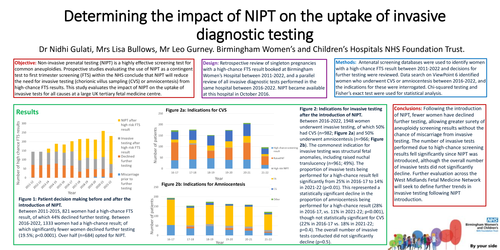
Results: Between 2011-2015, 821 women had a high-chance FTS result, of which 44% declined further testing. Between 2016-2022, 1333 women had a high-chance result; of which significantly fewer women declined further testing (19.5%; p<0.0001). Over half (n=684) opted for NIPT. Between 2016-2022, 1948 women underwent invasive testing, of which 50% had CVS (n=982) and 50% underwent amniocentesis (n=966). The commonest indication for invasive testing was structural fetal anomalies, including raised nuchal translucency (n=961; 49%). The proportion of invasive tests being performed for a high-chance result fell significantly from 25% in 2016-17 to 14% in 2021-22 (p<0.01). This represented a statistically significant decline in the proportion of amniocentesis being performed for a high-chance result (28% in 2016-17, vs. 11% in 2021-22; p<0.001), though not statistically significant for CVS (22% in 2016-17 vs. 18% in 2021-22; p=0.4). The overall number of invasive tests conducted did not significantly decline (p=0.5).
Conclusions: Following the introduction of NIPT, fewer women have declined further testing, allowing greater surety of aneuploidy screening results without the risk of miscarriage from invasive testing. The number of invasive tests performed due to high-chance screening results fell significantly since NIPT was introduced, although the overall number of invasive tests did not significantly decline. Further evaluation across the West Midlands Fetal Medicine Network will seek to define further trends in invasive testing following NIPT introduction.