1,830 posters, 67 videos, 75 audios, 29 topics, 22 sessions, 4,727 authors, 1,697 institutions
ePostersLive by SciGen Technologies S.A. All rights reserved.
RCOG World Congress 2023
June 12 - 14, 2023 | London, UK

EP.0981
Serum hormone concentrations post GnRH agonist trigger on metaphase II oocytes
Poster Presenter
Part of Topic
Reproductive Medicine/Assisted Reproduction
IS MEASUREMENT OF LH LEVEL POST GnRH AGONIST TRIGGER USEFUL IN PREDICTING OOCYTE MATURITY IN ANTAGONIST IVF/ICSI CYCLES?
S. Sawant1, A. Gudi2 , A. Shah2, R. Homburg3
1.Newham University Hospital- Bart's Health NHS Trust, Fertility, London, United Kingdom.2.Fertility Plus 112- Harley street- London W1G 7JQ, Fertility Clinic, London, United Kingdom.3.The Hewitt Fertility Centre, Liverpool Women's Hospital, Liverpool. L8 7SS, United Kingdom.
BACKGROUND Gonadotrophin-releasing hormone (GnRH) agonist is being used as an alternative trigger to Human Chorionic Gonadotrophin, as it significantly reduces the risk of developing ovarian hyperstimulation syndrome (OHSS), especially in women with polycystic ovarian syndrome (PCOS). However, its use has raised concerns of a suboptimal LH response and subsequent increased risk of empty follicle syndrome (EFS) and poor outcome at oocyte retrieval, thus needing a rescue hCG trigger. Studies have shown that an LH of less than 15iU/l at 12 hours post trigger increases the risk of EFS and poor oocyte recovery. However, newer data suggests that there is no definitive cut-off value of LH below which EFS is guaranteed and that progesterone levels are likely more significant.
OBJECTIVE To determine if the serum concentrations of LH, FSH, or progesterone influence the development of mature (MII) oocytes post GnRH agonist trigger during an antagonist protocol in IVF/ICSI cycle.
STUDY DESIGN, MATERIALS AND METHODS This was a single centre prospective observational study at a university fertility center in northeast London. The study recruited 104 women undergoing IVF/ICSI treatment from April 2019 to April 2021 . All patients had a diagnosis of PCOS with AMH >20, and received a GnRH agonist as the trigger for oocyte maturation. LH, FSH, and progesterone levels were measured at 12 hours post GnRH agonist administration and compared to outcomes for percentage of mature oocytes, fertilisation rate, and blastocyte formation rate. The results were analysed using SPSS software and Pearson correlation to determine the relationship between hormone level and outcome. This study was interrupted by the SARS-CoV-2 pandemic and as a results, the number of study participants were less than originally intended.
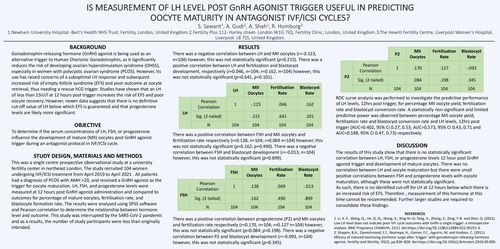
RESULTS There was a negative correlation between LH and MII oocytes (r=-0.123, n=104) however, this was not statistically significant (p=0.215). There was a positive correlation between LH and fertilization and blastocyst development, respectively (r=0.046, n=104; r=0.162, n=104) however, this was not statistically significant (p=0.641, p=0.101). There was a positive correlation between FSH and MII oocytes and fertilization rate respectively (r=0.138, n=104; r=0.069 n=104) however, this was not statistically significant (p=0.162; p=0.490). There was a negative correlation between FSH and blastocyst development (r=-0.013, n=104) however, this was not statistically significant (p=0.899). There was a positive correlation between progesterone (P2) and MII oocytes and fertilization rate respectively (r=0.170, n=104; r=0.127 n=104) however, this was not statistically significant (p=0.084; p=0.198). There was a negative correlation between P2 and blastocyst development (r=-0.093, n=104) however, this was not statistically significant (p=0.345).
ROC curve analysis was performed to investigate the predictive performance of LH levels, 12hrs post trigger, for percentage MII oocyte yield, fertilization rate and blastocyst conversion rate. A statistically non-significant and limited predictive power was observed between percentage MII oocyte yield, fertilization rate and blastocyst conversion rate and LH levels, 12hrs post trigger (AUC=0.402, 95% CI 0.27, 0.53; AUC=0.573, 95% CI 0.43, 0.71 and AUC=0.598, 95% CI 0.47, 0.73) respectively
DISCUSSION The results of this study show that there is no statistically significant correlation between LH, FSH, or progesterone levels 12 hour post GnRH agonist trigger and development of mature oocytes. There was no correlation between LH and oocyte maturation but there were small positive correlations between FSH and progesterone levels with oocyte maturation, although these were not statistically significant. As such, there is no identified cut-off for LH at 12 hours below which there is an increased risk of EFS. Therefore , measurement of this hormone at this time cannot be recommended. Further larger studies are required to consolidate these findings. LH MII Oocytes Fertilisation Rate Blastocyst Rate LH Pearson Correlation 1 -.123 .046 .162 Sig. (2-tailed) .215 .641 .101 N 104 104 104 104 FSH MII Oocytes Fertilisation Rate Blastocyst Rate FSH Pearson Correlation 1 .138 .069 -.013 Sig. (2-tailed) .162 .490 .899 N 104 104 104 104 P2 MII Oocytes Fertilisation Rate Blastocyst Rate P2 Pearson Correlation 1 .170 .127 -.093 Sig. (2-tailed) .084 .198 .345 N 104 104 104 104
REFERENCES 1. Li, X.-F., Wang, Q., He, Q.-Q., Wang, X., Xing-Yu LV, Tang, X., Zhong, Z., Ding, Y.-B. and Wan, Q. (2022). Low LH level does not indicate poor IVF cycle outcomes with GnRh-a single trigger: a retrospective analysis. BMC Pregnancy Childbirth, 22(1). doi:https://doi.org/10.1186/s12884-022-05251-4. 2. Shapiro, B.A., Daneshmand, S.T., Restrepo, H., Garner, F.C., Aguirre, M. and Hudson, C. (2011). Efficacy of induced luteinizing hormone surge after ‘trigger’ with gonadotropin-releasing hormone agonist. Fertility and Sterility, 95(2), pp.826–828. doi:https://doi.org/10.1016/j.fertnstert.2010.09.009